

THE FORUM: NORTHWESTERN’S PREMIER LEGAL BLOG

U.S. v. Google: The Biggest Antitrust Lawsuit Since ‘98
By: Ana Cucalon
Edited by: Anna Dellit and Colin Crawford
The United States Justice Department has accused Google of abusing its power to exclude competitors from the market and form an illegal monopoly. The case is a jarring move against modern-day tech giants and is one of many recent efforts by the federal government to reign in Silicon Valley’s biggest conglomerates. While it is not illegal in the United States to have a monopoly, federal prosecutors worry that Google isn’t allowing competition to present itself, let alone overpower it in the market, and is therefore illegally excluding its competitors. [1] The case mainly focuses on sections 1 and 2 of the 1890 Sherman Act, which states:
Sec. 1. Every contract, combination in the form of trust or other- wise, or conspiracy, in restraint of trade or commerce among the several States, or with foreign nations, is hereby declared to be illegal. Every person who shall make any such contract or engage in any such combination or conspiracy, shall be deemed guilty of a misdemeanor, and, on conviction thereof, shall be punished by fine not exceeding five thousand dollars, or by imprisonment not exceeding one year, or by both said punishments, at the discretion of the court.
Sec. 2. Every person who shall monopolize, or attempt to monopolize, or combine or conspire with any other person or persons, to monopolize any part of the trade or commerce among the several States, or with foreign nations, shall be deemed guilty of a misdemeanor, and, on conviction thereof; shall be punished by fine not exceeding five thousand dollars, or by imprisonment not exceeding one year, or by both said punishments, in the discretion of the court.[2]
In the lawsuit, the U.S. government details when and how through its expansion Google violated this Antitrust Act, according to federal prosecutors, and leaves Google to defend its actions and intentions from as early as the year 2000, when Google launched Google Ads. [3]
Antitrust and antimonopoly laws usually revolve around monetary issues, specifically how monopolies drive up prices and hurt consumers. In the new era of digital technology, Google is free and accessible to consumers despite its growing popularity and outstanding worth. Federal prosecutors argue that while Google’s negative impact on consumers can’t necessarily be quantified by price, Google’s monopoly still hurts consumers by illegally excluding its competition. Furthermore, Google’s obstruction of the competition incapacitates other businesses from succeeding in the search engine market, therefore hurting consumers by forcing them to use a product that is not necessarily the best one. For example, Google exhaustively collects user data to generate ads and personalized content. The government claims that Google’s domination over its market could impede consumers from choosing a search engine that collects less data on them. They claim that by taking out the consumer’s choice to pick a search engine, Google is violating the core of the antitrust laws. [4] Google’s domination over the market makes it impossible for other products to surface, products that could be better for consumers or at least incentivize other companies to provide better services.
Most importantly, federal prosecutors argue that Google’s billion-dollar agreements with electronic companies such as Apple have excluded its competitors from the market and illegally monopolized the search engine business. Their claim is proved if by doing so, the agreements have hurt consumers, competitors, and the general innovation of the industry. For example, Google has a 1 billion dollar agreement with Apple to make Google the default search engine for all Apple products. When a user goes to look something up on Safari, Apple’s browser, their device takes them directly to Google. [5] Google has similar agreements with Mozzila, Firefox, and other wireless providers. It also has agreements with Android companies to download the Chrome app on their devices by default. Federal prosecutors argue that Google has used these contracts to make it inaccessible for competition to gain access to the wider public market. They believe that since Google has so many users, it has much more data than any of its competitors to make its search engine better, leading to more users continuing to use it. This cycle is then illegally accelerated by the above agreements. This is because Google is now at risk of owing its success to these contracts instead of its organic consumer pool, which would make the contracts illegal. To conclude, the Justice Department argues that the agreements exponentially increase Google’s size and domination, making it more valuable and further excluding its competition. [6]
Google’s defense centers on three main points. First, its popularity among consumers. It argues that people who use Google choose Google because they like it, not because Google uses agreements to block out competition. It claims its dominance is solely based on the continued success of its product, highlighting how companies choose to partner with it because consumers prefer it. Second, the agreements they hold with other tech companies are not as exclusive as the government depicts them. Google says that users can easily change their default browser from Google to another search engine with a few clicks and that the purpose of the agreements is to create a seamless experience for those who choose Google. Lastly, it argues that it does not dominate the search engine market nearly as much as the government depicts. The Justice Department states that Google has a 90% market share when you define its competition as “general search” (pop in any question and get an answer). [7] In contrast, Google says it has less than 90% market share because it competes with many more platforms than just the ones allowing for “general search”. For example, it says it competes with Amazon for searching for products, TikTok and Redditt for less generalized questions, Spotify for music and podcasts, and Chat GPT for academic help. On that account, Google affirms that it is not in dominance of its market or competition, and is therefore not violating antitrust laws as it does not monopolize the search engine market. [8]
After hearing both sides, the judge has to decide three things: is Google a monopoly? If yes, did these agreements violate the Sherman Antitrust Act? What line should be drawn for these powerful companies that own big online platforms? If the Judge rules in favor of the government, Google would likely be asked to change its behavior and would be limited in its ability to engage in agreements such as the one it has with Apple. If the Judge rules for Google, it could send a message to other Silicon Valley companies that the government’s increased pressure on them is not a serious threat. In addition, Washington would receive the message that antitrust laws cannot properly oversee companies based on providing free services.
Finally, the trial has the potential to shape the future of tech as corporations fight to dominate platforms such as artificial intelligence. As this case progresses, the question remains whether Google and companies like it will continually be placed in a position of advantage to dominate data marketplaces, and how that would impact the new era of the internet. The official case, titled U.S. and Plaintiff States v. Google LLC, can be further tracked and viewed on the Justice Department’s official website.
Notes:
The Daily, The New York Times. 2023. “U.S. v. Google.” (The New York Times, September 13, 2023). https://www.nytimes.com/2023/09/11/podcasts/the-daily/google-monopoly-trial.html.
National Archives. 2022. “Sherman Anti-Trust Act (1890)” (National Archives, 2022). https://www.archives.gov/milestone-documents/sherman-anti-trust-act.
U.S. v. Google LLC, 2023CV00108, Washington, DC, (District Court for the Eastern District of Virginia. 2023).
Kerr, Dara. 2023. “The DOJ's antitrust trial against Google over its search dominance begins.” (NPR, September 12, 2023). https://www.npr.org/2023/09/12/1198558372/doj-google-monopoly-antitrust-trial-search-engine.
Villasenor, John. 2023. “A primer on some key issues in U.S. v. Google | Brookings.” (Brookings Institution). https://www.brookings.edu/articles/a-primer-on-some-key-issues-in-u-s-v-google/.
(The Daily, The New York Times 2023)
(The Daily, The New York Times 2023)
(The Daily, The New York Times 2023)
Bibliography:
The Daily, The New York Times. 2023. “U.S. v. Google.” The New York Times, September 13, 2023.https://www.nytimes.com/2023/09/11/podcasts/the-daily/google-monopoly-trial.html.
Kang, Cecilia. 2023. “In Its First Monopoly Trial of Modern Internet Era, U.S. Sets Sights on Google.” The New York Times, September 12, 2023. https://www.nytimes.com/2023/09/06/technology/modern-internet-first-monopoly-trial-us-google-dominance.html.
Kerr, Dara. 2023. “The DOJ's antitrust trial against Google over its search dominance begins.” NPR, September 12, 2023. https://www.npr.org/2023/09/12/1198558372/doj-google-monopoly-antitrust-trial-search-Engine.
“Sherman Anti-Trust Act (1890) | National Archives.” 2022. National Archives |. https://www.archives.gov/milestone-documents/sherman-anti-trust-act.
U.S. Department of Justice. 2023. “Justice Department Sues Google for Monopolizing Digital Advertising Technologies.” Department of Justice, January 24, 2023. https://www.justice.gov/opa/pr/justice-department-sues-google-monopolizing-digital-advertising-technologies.
U.S. v. Google LLC, 2023CV00108, Washington, DC, (District Court for the Eastern District of Virginia. 2023).
Villasenor, John. 2023. “A primer on some key issues in U.S. v. Google | Brookings.” Brookings Institution. https://www.brookings.edu/articles/a-primer-on-some-key-issues-in-u-s-v-google/.

Can Government Officials Violate the First Amendment through Social Media?
By: Maddy Goldman
Edited by: isabella Canales and Grace Wu
Americans treasure their First Amendment right to free speech. The freedom to protest, act, speak, and dress in any manner has driven politics and social reform throughout history. However, with this immense amount of freedom comes an immense amount of debate. Should we place limitations on free speech? Who gets to set and enact these boundaries? The government? The people? These questions demonstrate a gray area in the First Amendment, where, in certain instances, it can become unclear how to deal with free speech or the potential restriction of it.
However, another recent development has sparked a new debate on the question of free speech: the internet. With the creation of the internet and social media platforms like Facebook and Twitter, the gray area of the First Amendment grows. Does everyone have the right to publicly post their opinions online? Is there such a thing as a “private” account? What is the role of the government concerning free speech and social media? This last question has been brought to the forefront of the legal scene in recent times.
Government-specific questions regarding free speech and social media have risen rapidly after various officials were sued for violating the First Amendment via their actions on Twitter and Facebook. Should officials post updates and promote themselves through it? Are they speaking as the government or their private self when they post, comment, or converse on social media? Does this difference matter? Can officials block their critics? Or is that an infringement of the First Amendment?
Two exemplary cases that demonstrate the confusing connection between free speech, the government, the people, and social media are O'Connor-Ratcliff v. Garnier and Lindke v. Freed. In both cases, the plaintiff sued a government official for violating their First Amendment right to free speech. [1] Many of the aforementioned questions were brought up, and many were left unanswered. Ultimately, it is unclear how best to handle the issues which arise when social media, the government, and the question of free speech are intertwined. As demonstrated by the decisions and discussions surrounding O'Connor-Ratcliff v. Garnier and Lindke v. Freed, people are divided about whether an official’s social media account counts as an extension of their governmental role, or if it is simply a personal page unrelated to the government. [2]
O'Connor-Ratcliff v. Garnier occurred in October 2017 when Michelle O’Connor-Ratcliff and T.J. Zane blocked two of their main critics, Christopher and Kimberly Garnier, on social media. [3] O’Connor-Ratcliff and Zane were both trustees for the Poway Unified School District, which is classified as a governmental/official position. [4] They originally started their social media pages as a way to promote their campaigns; however, after being elected to the Board of Trustees, they transitioned their accounts to official ones. [5] They implemented new official titles and began to post news, business, and updates pertaining to the Poway Unified School District. [6] Parents such as Christopher and Kimberly Garnier, however, began voicing their concerns and criticisms regarding their children's schools in the replies of the trustees' Facebook and Twitter posts. [7] As the critique's intensity and insistence increased, Ratcliff and Zane began to first hide, and then delete negative comments on posts. [8] This meant the Garniers’ critiquing comments could no longer be seen or attached to the trustees’ posts. This also meant all future critiques from the Garniers were stopped. Consequently, the Garniers sued the trustees, claiming the trustees violated their First Amendment right to free speech. [9] The court decided that public officials could not, due to the First Amendment, block individuals on their social media accounts. [10]
Another similar incident occurred in October 2023, in Lindke v. Freed. Similarly to Ratcliff and Zane, James Freed originally created a private account, where he posted for his friends and family. [11] However, as time passed he amassed over 5,000 followers, forcing him to convert his account to a public profile. [12] He was soon elected as city manager for Port Huron, Michigan, subsequently changing his profile to show his official name and title. [13] On this page, Freed posted both personal and professional updates, the latter of which included news on topics such as city policies. [14, 15] People, such as Kevin Lindke, also began to post critical thoughts in regard to Freed’s various policies. [16]He was specifically upset about Freed’s policies surrounding COVID-19. [17] Freed began to delete or hide Lindke’s critical comments. [18] Ultimately, Freed blocked Lindke from his social media pages. [19] Thus, similarly to O'Connor-Ratcliff v. Garnier, the plaintiff, Lindke, sued Freed, claiming his First Amendment rights to free speech were being violated. [20] The lower and Sixth Circuit courts dismissed Lindke’s Case. However, Lindke's petition for certiorari was granted by the Supreme Court, and the case will be viewed again on April 24, 2023. [21]
In both of these cases, the plaintiffs argued that the official was acting in the name of the government, and thus was restricting free speech by preventing them from voicing their opinions on a public platform. Lindke and Garner both sued under 42 U.S.C. § 1983, which states:
Every person who, under color of any statute, ordinance, regulation, custom, or usage, of any State or Territory or the District of Columbia, subjects, or causes to be subjected, any citizen of the United States or other person within the jurisdiction thereof to the deprivation of any rights, privileges, or immunities secured by the Constitution and laws, shall be liable to the party injured in an action at law, suit in equity, or other proper proceeding for redress. [22, 23]
Despite arguing similar concepts, neither of these cases have led to a clear conclusion on what role the government and social media hold in free speech and vice versa. The main issue regarding this topic is “whether government officials are even acting in their government capacities–that is, taking ‘state action’–when they curate their social media profiles.” [24] This question divided and puzzled the Court. If the officials were acting privately, then their act of blocking critics should not violate the First Amendment. However, the same is not true if they were acting as a governmental authority.
Using the above logic, in O'Connor-Ratcliff v. Garnier, the trustees were found to have violated the First Amendment since the trustees were deemed to be acting in the name of the government. [25] Meanwhile, in Lindke v. Freed, the court granted summary judgment to Freed, meaning Freed’s Facebook page did not count as governmental or state action. [26] Hence, according to the court, he did not violate the First Amendment. The different ruling in these two cases clearly outlines the gray area mentioned earlier.
Thus, many questions remain unanswered. Even if it is decided that an official blocking a critic on social media violates the First Amendment only if the official is acting in the name of the government, it is still unclear how to determine for whom the official is acting. Do we base it on their account’s name? In both O'Connor-Ratcliff v. Garnier and Lindke v. Freed, the officials updated their account names to their official titles. Should we take into account the content posted? Freed had more personal posts, while O’Connor-Ratcliff had more political and official posts. [26] Could this difference in intent of the page be the reason one official was deemed to have violated the law, while the other was not? Even after a thorough examination of two key cases, the realm of free speech on social media remains largely debated and complex.
Notes:
Howe, Amy. “Justices Weigh Rules for When Public Officials Can Block Critics on Social Media.” SCOTUSblog, November 3, 2023. https://www.scotusblog.com/2023/10/justices-weigh-rules-for-when-public-officials-can-block-critics-on-social-media/.
Howe, Amy. “Justices Weigh Rules for When Public Officials Can Block Critics on Social Media.” SCOTUSblog, November 3, 2023. https://www.scotusblog.com/2023/10/justices-weigh-rules-for-when-public-officials-can-block-critics-on-social-media/.
"O'Connor-Ratcliff v. Garnier." Oyez. Accessed November 16, 2023, https://www.oyez.org/cases/2023/22-324.
"O'Connor-Ratcliff v. Garnier." Oyez. Accessed November 16, 2023, https://www.oyez.org/cases/2023/22-324.
“Garnier v. O’Connor-Ratcliff.” Harvard Law Review, March 24, 2023, https://harvardlawreview.org/print/vol-136/garnier-v-oconnor-ratcliff/.
Howe, Amy. “Justices Weigh Rules for When Public Officials Can Block Critics on Social Media.” SCOTUSblog, November 3, 2023. https://www.scotusblog.com/2023/10/justices-weigh-rules-for-when-public-officials-can-block-critics-on-social-media/.
“Garnier v. O’Connor-Ratcliff.” Harvard Law Review, March 24, 2023, https://harvardlawreview.org/print/vol-136/garnier-v-oconnor-ratcliff/.
“Garnier v. O’Connor-Ratcliff.” Harvard Law Review, March 24, 2023, https://harvardlawreview.org/print/vol-136/garnier-v-oconnor-ratcliff/.
“Garnier v. O’Connor-Ratcliff.” Harvard Law Review, March 24, 2023, https://harvardlawreview.org/print/vol-136/garnier-v-oconnor-ratcliff/.
Howe, Amy. “Justices Consider Liability for Officials Who Block Critics on Social Media.” SCOTUSblog, November 1, 2023, https://www.scotusblog.com/2023/10/justices-consider-liability-for-officials-who-block-critics-on-social-media/.
"Lindke v. Freed." Oyez. Accessed November 16, 2023, https://www.oyez.org/cases/2023/22-611.
"Lindke v. Freed." Oyez. Accessed November 16, 2023, https://www.oyez.org/cases/2023/22-611.
"Lindke v. Freed." Oyez. Accessed November 16, 2023, https://www.oyez.org/cases/2023/22-611.
"Lindke v. Freed." Oyez. Accessed November 16, 2023, https://www.oyez.org/cases/2023/22-611.
“Garnier v. O’Connor-Ratcliff.” Harvard Law Review, March 24, 2023, https://harvardlawreview.org/print/vol-136/garnier-v-oconnor-ratcliff/.
“Garnier v. O’Connor-Ratcliff.” Harvard Law Review, March 24, 2023, https://harvardlawreview.org/print/vol-136/garnier-v-oconnor-ratcliff/.
“Garnier v. O’Connor-Ratcliff.” Harvard Law Review, March 24, 2023, https://harvardlawreview.org/print/vol-136/garnier-v-oconnor-ratcliff/.
"Lindke v. Freed." Oyez. Accessed November 16, 2023, https://www.oyez.org/cases/2023/22-611.
"Lindke v. Freed." Oyez. Accessed November 16, 2023, https://www.oyez.org/cases/2023/22-611.
“Garnier v. O’Connor-Ratcliff.” Harvard Law Review, March 24, 2023, https://harvardlawreview.org/print/vol-136/garnier-v-oconnor-ratcliff/.
“Lindke v. Freed.” Legal Information Institute. Accessed February 13, 2024, https://www.law.cornell.edu/supct/cert/22-611
"Lindke v. Freed." Oyez. Accessed November 16, 2023, https://www.oyez.org/cases/2023/22-611.
“42 U.S. Code § 1983 - Civil Action for Deprivation of Rights.” Legal Information Institute. Accessed November 16, 2023, https://www.law.cornell.edu/uscode/text/42/1983.
“O’Connor-Ratcliff v. Garnier and Lindke v. Freed.” American Civil Liberties Union, September 19, 2023, https://www.aclu.org/cases/oconnor-ratcliff-v-garnier-and-lindke-v-freed.
“Garnier v. O’Connor-Ratcliff.” Harvard Law Review, March 24, 2023, https://harvardlawreview.org/print/vol-136/garnier-v-oconnor-ratcliff/.
No. 22-611 I T Supreme Court of the United States. Accessed November 16, 2023, https://www.supremecourt.gov/DocketPDF/22/22-611/270233/20230630161427317_Amicus%20-%20ASU%20Law%20-%20Lindke%20v%20Freed%20-%20No%2022-611.pdf.
Howe, Amy. “Justices Weigh Rules for When Public Officials Can Block Critics on Social Media.” SCOTUSblog, November 3, 2023. https://www.scotusblog.com/2023/10/justices-weigh-rules-for-when-public-officials-can-block-critics-on-social-media/.
Bibliography:
“42 U.S. Code § 1983 - Civil Action for Deprivation of Rights.” Legal Information Institute. Accessed November 16, 2023. https://www.law.cornell.edu/uscode/text/42/1983.
“Garnier v. O’Connor-Ratcliff.” Harvard Law Review, March 24, 2023. https://harvardlawreview.org/print/vol-136/garnier-v-oconnor-ratcliff/.
Golde, Kalvis. “Lindke v. Freed.” SCOTUSblog. Accessed November 16, 2023. https://www.scotusblog.com/case-files/cases/lindke-v-freed/.
Golde, Kalvis. “O’Connor-Ratcliff V. Garnier.” SCOTUSblog. Accessed November 16, 2023. https://www.scotusblog.com/case-files/cases/oconnor-ratcliff-v-garnier/.
Howe, Amy. “Justices Consider Liability for Officials Who Block Critics on Social Media.” SCOTUSblog, November 1, 2023. https://www.scotusblog.com/2023/10/justices-consider-liability-for-officials-who-block-critics-on-social-media/.
Howe, Amy. “Justices Weigh Rules for When Public Officials Can Block Critics on Social Media.” SCOTUSblog, November 3, 2023. https://www.scotusblog.com/2023/10/justices-weigh-rules-for-when-public-officials-can-block-critics-on-social-media/.
Jennifer Stisa Granick, Vera Eidelman. “The Supreme Court Will Set an Important Precedent for Free Speech Online: ACLU.” American Civil Liberties Union, October 19, 2023. https://www.aclu.org/news/privacy-technology/the-supreme-court-will-set-an-important-precedent-for-free-speech-online.
"Lindke v. Freed." Oyez. Accessed November 16, 2023. https://www.oyez.org/cases/2023/22-611
“Lindke v. Freed.” Legal Information Institute. Accessed February 13, 2024, https://www.law.cornell.edu/supct/cert/22-611
No. 22-611 I T Supreme Court of the United States. Accessed November 16, 2023. https://www.supremecourt.gov/DocketPDF/22/22-611/270233/20230630161427317_Amicus%20-%20ASU%20Law%20-%20Lindke%20v%20Freed%20-%20No%2022-611.pdf.
“O’Connor-Ratcliff v. Garnier and Lindke v. Freed.” American Civil Liberties Union, September 19, 2023. https://www.aclu.org/cases/oconnor-ratcliff-v-garnier-and-lindke-v-freed.
"O'Connor-Ratcliff v. Garnier." Oyez. Accessed November 16, 2023. https://www.oyez.org/cases/2023/22-324.

The Adult Survivors Act: The End to a Year of Record-Breaking Sexual Assault Suits
By: Sarah Wejman
Edited by: Jack Pacconi and Angie Chung
The day after Thanksgiving marked the end of one of the most influential state sexual assault laws to date. The Adult Survivors Act (ASA), put into effect from November 24, 2022, to the end of the year, was an amendment to New York’s Civil Practice Law and Rules. The ASA essentially created a one-year period to allow victims whose statute of limitations expired to sue their abusers.[1] This period has caused a surge of over 3,000 sexual abuse civil suits.[2]
The ASA led to many high-profile lawsuits, including those against actor Jamie Foxx, former New York Governor Andrew Cuomo, New York Mayor Eric Adams, and former President Donald Trump. There were also “at least 479 suits for charges of abuse at Rikers Island,”[3] a prison infamous for a culture infiltrated with mismanagement, perpetual violence, and an increasing number of jail deaths. Former hospital patients accounted for a handful of other cases, several of which were against a former Columbia University gynecologist, Robert Hadden.[4]
In years before the ASA’s extension, New York passed a couple of progressive but less expansive sexual assault and abuse laws. In 2019, the state extended the statute of limitations to 20 years for individuals filing civil suits for certain sex crimes, and in the same year, they passed the Child Victims Act, which created a “look back period” so that people who were sexually abused as children could file suit as adults.[5]
The passing of such laws sparked a national debate on whether this type of legislation was beneficial. Several Democratic lawmakers strongly vouched for its extension and called for a permanent version of it. Most notably, Sen. Brad Holman-Sigal of Manhattan stated that “statutes of limitations only serve to protect the perpetrators.”[6] Liz Roberts, the CEO of Safe Horizon, a New York organization to support victims of violence, echoed his sentiments in a recent statement, explaining that “what we have learned is that trauma takes time” and, as evidenced by many of the recent cases, it is harder to confront sexual assault committed by a person of higher authority and power.[7] On the other hand, others claimed that the statute of limitations extension, aside from for children and prisoners, may potentially endanger the defendant's rights due to a lack of evidence and witnesses. As Harvard Law Professor Emeritus Alan Dershowitz stated many years ago, “[h]ow do you expect people to remember details of something that happened or didn’t happen?”[8] In years to come, sexual assault victims might have increasingly different rights depending on their state. Being a states’ rights issue, it will be interesting to see how other states will react and whether or not they will take similar measures to New York.
Notes:
Adult Survivors Act, S66 §214-j (2022)
Hurubie Meko, “A Final Wave of Sex-Abuse Lawsuits as One-Year Window Closes in New York,” The New York Times, November 27, 2023, https://www.nytimes.com/2023/11/27/nyregion/adult-survivors-act-lawsuits.html.
Hurubie Meko, “A Final Wave.”
Corinne Ramey and Erin Ailworth, “The Law That Brought to Light a Flurry of Sexual-Assault Allegations,” The Wall Street Journal, November 28, 2023, https://www.wsj.com/us-news/new-york-law-sexual-assault-accusations-60daa 252?page=1.
Corinne Ramey and Erin Ailworth, “The Law That.”
Betsy McCaughey, “No, New York Shouldn’t Extend the Adult Survivors Act,” New York Post, December 4, 2023, https://nypost.com/2023/12/04/opinion/no-new-york-shouldnt-extend-the-adult -survivors-act/.
Hurubie Meko, “A Final Wave.”
Hurubie Meko, “A Final Wave.”
Bibliography:
Adult Survivors Act, S66 §214-j (2022)
McCaughey, Betsy. “No, New York Shouldn’t Extend the Adult Survivors Act.” New York Post, December 4, 2023. https://nypost.com/2023/12/04/opinion/no-new-york-shouldnt-extend-the-adult-survivors -act/.
Meko, Hurubie. “A Final Wave of Sex-Abuse Lawsuits as One-Year Window Closes in New York.” The New York Times, November 27, 2023. https://www.nytimes.com/2023/11/27/nyregion/adult-survivors-act-lawsuits.html.
Ramey, Corinne, and Erin Ailworth. “The Law That Brought to Light a Flurry of Sexual-Assault Allegations.” The Wall Street Journal, November 28, 2023. https://www.wsj.com/us-news/new-york-law-sexual-assault-accusations-60daa252?page= 1.
School Segregation in the Wake of Brown v. Board
By: Morgan Dreher
edited by: Isabel Gortner and Isabel Niemer
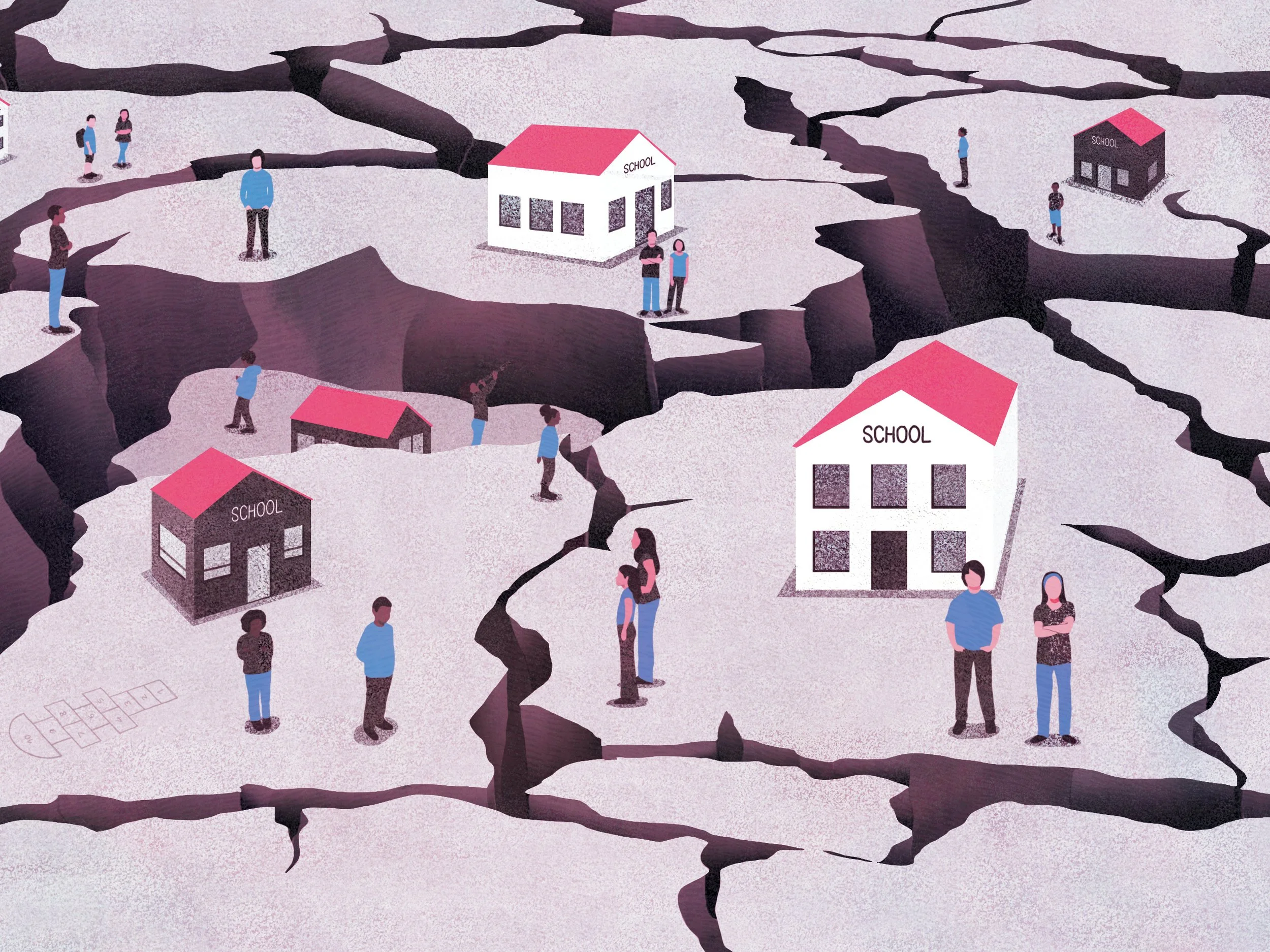
Brown v. Board of Education: the landmark case that ruled “separate but equal” was inherently unequal, and solved school segregation in the United States, right? [1] Not quite. In modern times, about one in five public school students attend “racially isolated” schools and disadvantaged districts receive $4,200 less per student annually than wealthier, neighboring districts. [2] There is no shortage of research demonstrating that racially and economically integrated schools improve the academic and emotional outcomes of students across all backgrounds, [3] so why are Black students today still as segregated as they were in the 1960s? [4]
To understand the issue of modern school segregation, one must first comprehend the enforcement of Brown v. Board, and the subsequent legal proceedings. The public possesses a general understanding of what it means to be “separate” but inherently unequal, [5] but the confusion arises around how this was implemented. While the first decision in the Brown case declared that school segregation violated the Equal Protection Clause of the Fourteenth Amendment, Brown II delegated oversight to the lower courts, to be conducted with “all deliberate speed.” [7] The ambiguous nature of this decision meant states were not under any time constraint to facilitate integration, allowing them to create their own timeline. [8]
In addition, if segregation was not a direct product of policy, courts had minimal ability to enforce integration. [9] Largely contributing to this limited power was the 1974 case, Milliken v. Bradley. The Supreme Court ruled that if Michigan suburbs contributing to high segregation in Detroit were not actively hurting Detroit students, they could not be held to active desegregation efforts either, further limiting the courts’ capacities to enforce desegregation. [10] In the decision, Justice Thurgood Marshall foresaw that “the very evil that Brown was aimed at will not be cured but will be perpetuated.” [11] In short, the courts began to only consider if the intent was segregation, dismissing other policies and actions creating segregation, [12] and moving further away from their commitment to integration. [13]
Furthermore, housing segregation is so intrinsically tied to school segregation that its history must be mentioned. The practice of “redlining” was a collection of racist housing policies created by the Federal Housing Administration, which categorized people of color as high risk and forced them into segregated neighborhoods. [14] Although the 1986 Fair Housing Act made race-based housing discrimination illegal, the legacy of redlining persists. [15] This has direct implications for school segregation because district zoning maps do not take neighborhood segregation into account when drawing their boundaries. [16] As a result of redlining and the Milliken decision, today’s school segregation pertains more to districts than individual schools. [17] Because school funding is derived from property taxes, entire districts are often disadvantaged, with about one-third less money per student than their wealthier counterparts. [18]
So, is the current lack of integration caused by legal proceedings or the continued ramifications of housing segregation? The answer is both, with the addition of several external factors. Another commonly cited source of school segregation is district secession, where schools separate from their district with the intent of more concentrated control. [19] These new schools contribute to resegregation because they are often comprised of wealthier white and Asian students, with fewer Hispanic and Black students, and less representation from students of lower socioeconomic status. [20] An additional cause of segregation is a lack of public and political support for integration efforts, such as those involving funding. Although former President Obama allotted federal grants for “Opening Doors, Expanding Opportunities,” intended to fund efforts for public school integration, the Trump administration pulled these grants, moving integration efforts backwards. [21] Other factors include direct opposition to integration and separation of students based on ability and testing, which often involves racial bias. [22][23] Ultimately, because segregation is no longer codified into law after Brown v. Board, racial inequality is reproduced and spread across many systems, [24] and the United States will require comprehensive reform to desegregate fully. [25]
While comprehensive reform is not yet on the table, certain districts and cities can be analyzed as case studies to direct future, widespread efforts. For example, Cambridge, Massachusetts has adopted a “controlled choice” model, where parents rank their top choices for schools, and the district makes final decisions that reflect its socioeconomic distributions. [26] Integration efforts by race can be difficult to achieve based on legal precedent, so this district utilizes income as a “powerful equalizer.” [27] On the contrary, areas like San Antonio have less diversity within their districts, so they are instead focused on developing high-quality schools with substantial resources and opportunities. [28] These schools prioritize in-district students, but also attract out-of-district students of higher socioeconomic status, thus facilitating diversity. [29]
School districts across the country must continue to pursue integration. An article from JJ Packer of Reading Partners discusses how students in integrated schools have more academic success, including more likelihood of attending college and less likelihood of dropping out. [30] These same students have proven to have emotional benefits, including less anxiety and fewer biases. [31] Ultimately, efforts to integrate schools will improve the educational experience of students, [32] and for Brown v. Board of Education to see its true objective manifest in modern times, widespread reform must occur across the various systems that perpetuate racial segregation and inequality.
Notes:
Earl Warren and Supreme Court Of The United States, U.S. Reports: Brown v. Board of Education, 349 U.S. 294, 1954, Periodical. https://www.loc.gov/item/usrep349294/.
Elissa Nadworny and Cory Turner, “Milliken v. Bradley: Supreme Court Case Has Helped Keep Schools Segregated,” NPR, 2019. https://www.npr.org/2019/07/25/739493839/this-supreme-court-case-made-school-district-lines-a-tool-for-segregation.
JJ Packer, “Why American school segregation didn't end with Brown v. Board of Education - Reading Partners,” Reading Partners 2023. https://readingpartners.org/blog/why-american-school-segregation-didnt-end-with-brown-v-board-of-education/.
Cassidy Foley, "School Segregation: A Modern Issue," Celebration of Learning, 2018.https://digitalcommons.augustana.edu/celebrationoflearning/2018/presentations/21
G. R. López and R. Burciaga, “The Troublesome Legacy of Brown v. Board of Education,” Educational Administration Quarterly 50 (5): 796-811, 2014. https://doi.org/10.1177/0013161X14551410.
López and Burciaga, “The Troublesome Legacy of Brown v. Board of Education.”
López and Burciaga, “The Troublesome Legacy of Brown v. Board of Education.”
López and Burciaga, “The Troublesome Legacy of Brown v. Board of Education.”
Packer, “Why American school segregation didn't end with Brown v. Board of Education - Reading Partners.”
Nadworny and Turner, “Milliken v. Bradley: Supreme Court Case Has Helped Keep Schools Segregated.”
Nadworny and Turner, “Milliken v. Bradley: Supreme Court Case Has Helped Keep Schools Segregated.”
López and Burciaga, “The Troublesome Legacy of Brown v. Board of Education.”
J. R. Feagin & B. M. N. Barnett, “Success and Failure: How Systemic Racism Trumped the Brown v. Board of Education Decision,” University of Illinois Law Review, 2004(5), 1099-1130, 2004. https://illinoislawreview.org/print/volume-2004-issue-5/success-and-failure-how-systemic-racism-trumped-the-brown-v-board-of-education-decision/
López and Burciaga, “The Troublesome Legacy of Brown v. Board of Education.”
Sequoia Carrillo and Pooja Salhotra, “U.S. schools remain highly segregated, government report finds,” NPR, 2022. https://www.npr.org/2022/07/14/1111060299/school-segregation-report.
Carly Berwick, “3 Promising Models of School Integration,” Edutopia, 2018. https://www.edutopia.org/article/3-promising-models-school-integration/.
Packer, “Why American school segregation didn't end with Brown v. Board of Education - Reading Partners.”
Nadworny and Turner, “Milliken v. Bradley: Supreme Court Case Has Helped Keep Schools Segregated.”
Carrillo and Salhotra, “U.S. schools remain highly segregated, government report finds.”
Carrillo and Salhotra, “U.S. schools remain highly segregated, government report finds.”
Janel George and Linda Darling-Hammond, “Brown at 67: Segregation, Resegregation, and the Promise of Federal Policy,” Learning Policy Institute, 2021. https://learningpolicyinstitute.org/blog/brown-67-segregation-resegregation-and-promise-of-federal-policy.
Packer, “Why American school segregation didn't end with Brown v. Board of Education - Reading Partners.”
Feagin and Barnett, “Success and Failure: How Systemic Racism Trumped the Brown v. Board of Education Decision.”
Andrea Dyrness, “Cultural Exclusion and Critique In the Era of Good Intentions: Using Participatory Research to Transform Parent Roles in Urban School Reform,” Social Justice, 36(4 (118)), 36–53, 2009. http://www.jstor.org/stable/29768560
Foley, "School Segregation: A Modern Issue.”
Berwick, “3 Promising Models of School Integration.”
Berwick, “3 Promising Models of School Integration.”
Berwick, “3 Promising Models of School Integration.”
Berwick, “3 Promising Models of School Integration.”
Packer, “Why American school segregation didn't end with Brown v. Board of Education - Reading Partners.”
Packer, “Why American school segregation didn't end with Brown v. Board of Education - Reading Partners.”
Packer, “Why American school segregation didn't end with Brown v. Board of Education - Reading Partners.”
Bibliography:
Berwick, Carly. 2018. “3 Promising Models of School Integration.” Edutopia. https://www.edutopia.org/article/3-promising-models-school-integration/.
Carrillo, Sequoia, and Pooja Salhotra. 2022. “U.S. schools remain highly segregated, government report finds.” NPR. https://www.npr.org/2022/07/14/1111060299/school-segregation-report.
Dyrness, A. (2009). “Cultural Exclusion and Critique In the Era of Good Intentions: Using Participatory Research to Transform Parent Roles in Urban School Reform.” Social Justice, 36(4 (118)), 36–53. http://www.jstor.org/stable/29768560
Feagin, J. R., & Barnett, B. M. N. (2004). “Success and Failure: How Systemic Racism Trumped the Brown v. Board of Education Decision.” University of Illinois Law Review, 2004(5), 1099-1130. https://illinoislawreview.org/print/volume-2004-issue-5/success-and-failure-how-systemic-racism-trumped-the-brown-v-board-of-education-decision/
Foley, Cassidy. (2018) "School Segregation: A Modern Issue." Celebration of Learning.
https://digitalcommons.augustana.edu/celebrationoflearning/2018/presentations/21
George, Janel, and Linda Darling-Hammond. 2021. “Brown at 67: Segregation, Resegregation, and the Promise of Federal Policy.” Learning Policy Institute. https://learningpolicyinstitute.org/blog/brown-67-segregation-resegregation-and-promise-of-federal-policy.
López, G. R., and R. Burciaga. 2014. “The Troublesome Legacy of Brown v. Board of Education.” Educational Administration Quarterly 50 (5): 796-811. https://doi.org/10.1177/0013161X14551410.
Nadworny, Elissa and Corey Turner. 2019. “Milliken v. Bradley: Supreme Court Case Has Helped Keep Schools Segregated.” NPR. https://www.npr.org/2019/07/25/739493839/this-supreme-court-case-made-school-district-lines-a-tool-for-segregation.
Packer, JJ. 2023. “Why American school segregation didn't end with Brown v. Board of Education - Reading Partners.” Reading Partners. https://readingpartners.org/blog/why-american-school-segregation-didnt-end-with-brown-v-board-of-education/.
Warren, Earl, and Supreme Court Of The United States. U.S. Reports: Brown v. Board of Education, 349 U.S. 294. 1954. Periodical. https://www.loc.gov/item/usrep349294/.