

THE FORUM: NORTHWESTERN’S PREMIER LEGAL BLOG
What the Supreme Court Should Do Next Time Abortion Is on the Docket: A Gender Theory Perspective
By: Abigail Sprinsky
Edited by: Anna Dellit and Gabriela Pesantez
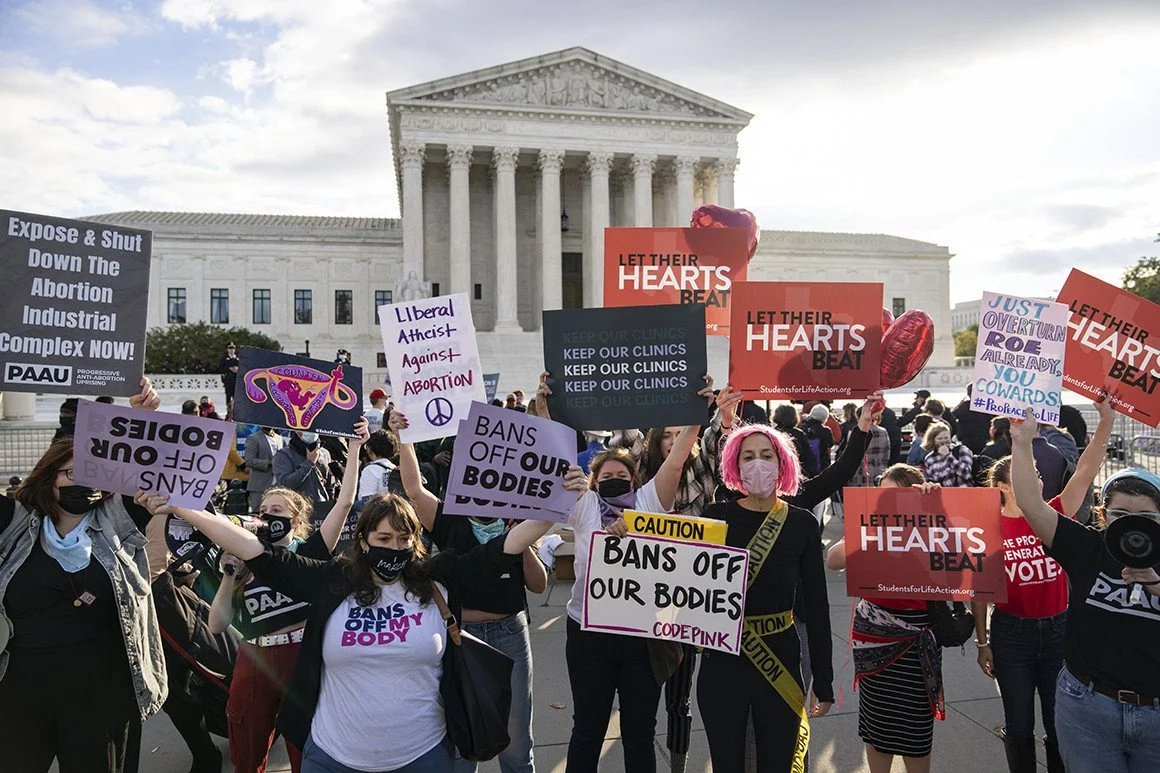
In the case of Dobbs v. Jackson Women’s Health Center, the court ruled to overturn Roe v. Wade, and in effect removed abortion access as a protected right. In a dissenting opinion, Justices Breyer, Kagan, and Sotomayor argue the invalidity of the majority’s stare decisis justification and maintain that abortion should be protected to enhance the biological, social, and economic freedoms of women. They make use of reproductive justice frameworks from the past, present, and future that connect abortion to the broader issue of the freedom to thrive. However, the justices do not expand on how a reproductive justice framework can be implemented at the judicial level to unpack broader systems of oppression, which would have made the dissenting opinion groundbreaking and useful for when the issue inevitably appears again before the Supreme Court. By focusing on the existing individual choice framework within the current system of government and economics, the dissenting opinion does not acknowledge the broader demands articulated by communities of color and anti-capitalists in reproductive justice movements.
The majority bases their decision on the concept of stare decisis and changing public opinion on the issue of abortion, while the dissenters use both recent and earlier historical evidence to counter these claims. The majority references Griswold, Obergefell, Roe, and Casey as a “constitutional fabric, protecting autonomous decision making over the most personal of life decisions”, invalidating the stare decisis argument. They also argue that the Court’s use of stare decisis is inconsistent with the visions put forth by Alexander Hamilton and Chief Justice John Marshall. [1] The justices argue that today’s court has strayed from the just pathway paved by the founding fathers and the constitutional framework judicial precedent established. The majority also argues that the facts of life surrounding abortion have evolved. Though the majority opinion is correct in recognizing that people now identify different points of viability, they are incorrect in stating that the popular opinion is in favor of abortion bans. Common law recognized quickening as the point of viability, at which abortion was deemed illegal, demonstrating that popular opinion historically granted women bodily autonomy in the eyes of the law. [2] In addition, the justices mention that part of the Casey decision expressed the sentiment that the facts of life surrounding abortion had not changed. [3] Both set a precedent in favor of female bodily autonomy, making the reliance on stare decisis hypocritical. The historical evidence in the dissenting opinion highlights the unjust behavior of the majority.
The justices make use of the Redstockings’ framing of abortion as an issue of “making the personal political” and a pro-choice/anti-choice binary. The Redstockings argued that by addressing abortion as a women’s issue, which was historically relegated to the “private sphere”, in the “public sphere”, they could cut off female oppression at its root. [4] As a result, abortion was initially framed within the context of family life and traditional roles, which they disagreed with. The dissenting opinion utilizes the popular ideology that “experiences, values, and religious training” are motivations for making abortion illegal. [5] In their opinion the justices also argue that the government has been hesitant to enter issues of personal liberty, specifically with regards to “bodily integrity” and “family life”, as an argument against the consistency of the majority ruling with precedent. [6] In this way, the opinion frames abortion within a values binary. This reinforces a framework established by the Redstockings that resulted in the alienation of women of color and those who were low-income. While this binary and its rhetoric is useful for building coalitions within the Supreme Court and Congress for writing legislation, it sets a harmful precedent for implementation by ignoring the nuances of how people are affected by abortion. According to Michelle Murphy, it is a privileged vantage point for “the abuses of population control [to be] parried with a politics of individual choice and the individual right to choose to have or not have children”. [7] The Young Lords Party (YLP) identified decades ago how the individual choice framework alienates women of color, making it an unusable framework for the just future of reproductive politics that the dissenting justices desire.
One of the most common frameworks used by debaters of the abortion issue in the present that is identified in the dissenting opinion is the medicalization of abortion. While the modern medicalization of abortion is a very logical argument that can be useful for persuading politicians, it ignores the fact that abortion is part of a broader system of oppression that the current medical system contributes to. The justices argue that without safe and legal abortion access “maybe [women] will try an unsafe method of abortion, and come to physical harm, or even die”, which justifies abortion as a public health measure. [8] Contemporary proponents of abortion also claim that it is a personal health issue, as it can be used to save women from possible negative health effects because of pregnancy. However, “women of color, Indigenous, queer, and decolonial feminist reproductive justice has long been critical of this privileged version of reproductive politics, which pivots on the well-resourced individual user and consumer of reproductive health care services and commodities”, which means that the medicalization framework is not useful for dismantling the systems of oppression that abortion access is supposed to aid in solving. [9] The United States healthcare system has a history of neglecting and abusing communities of color, especially with regards to reproductive health. [10] This means that establishing abortion as part of the current healthcare system will not effectively serve the communities who need to be granted access to abortions the most. The dissenting opinion does not try to operate outside the existing systems that create female oppression.
The dissenting opinion also uses the modern intersectionality framework and the YLP’s demand for the “freedom to thrive” as part of its support for abortion access, but fails to articulate how the abortion issue represents broader systems of oppression, specifically racist ones, that must be dismantled. The justices state that in order for women to participate equally in American society, they must have reproductive control over their lives, including the right to choose to have children. [11] The Supreme Court also acknowledges how abortion and the carceral system interconnect, noting that “perhaps, in the wake of today’s decision, a state will criminalize the woman’s conduct, too, incarcerating or fining her for daring to seek or obtain an abortion”. [12] While the dissenting opinion acknowledges that abortion has broader impacts on women beyond family planning, it does not attempt to establish that dismantling broader systems of oppression is essential for women to achieve the reproductive freedom they believe the codification of Roe will provide. Reproduction must be retheorized in the context of racism, capitalism, and environmentalism to achieve reproductive justice. While the YLP was active, they made demands for the end of sterilization abuse and resources to take care of the children that people of color chose to have, meaning that a true reproductive justice framework would expand beyond just abortion access. [13] Modern feminists of color, on the other hand, identify the carceral system as one that routinely subjects women of color to social violence, making it very difficult for them to achieve reproductive freedom. For the dissenting opinion to be effectively situated in the reproductive justice framework, it would need to provide protections for women of color from racist systems of oppression.
The dissenting justices use data illustrating how low-income women have a disproportionate demand for abortion access but do not consider how capitalism reinforces patriarchal structures that prevent women from achieving financial and labor freedom. In addition, the fact that they are utilizing population statistics illustrates how they are not considering the broader forces of oppression that impact reproduction. According to Murphy, “an insistence of opposition to population and human numbering as a feminist framing for land defense while still puzzling through how reproductive politics is integral to environmental justice” is a crucial aspect of the reproductive justice framework. [14] By operating within the existing social structures, the Supreme Court, in both the majority and dissent, reinforces systems of oppression that created the unequal abortion access they seek to remedy. Reproductive justice can only be achieved by challenging the current systems of oppression. According to the Redstockings, “the major division in the [abortion rights] movement is between those who want to work inside the system and those who want to work outside the system,” and the dissenters reinforce this division. [15]
Using historical, individual choice, and intersectional frameworks, the dissenting justices in the Dobbs case argue that the majority opinion contradicts historical precedent and modern conceptions of abortion's role in creating an equitable society. In their articulation of how they should move forward from this decision, the dissenting judges implore the Court to rule more justly than in this case, as “the constitutional regime we enter today erases the woman’s interest and recognizes only the State’s”, thus relegating women to be second-class citizens. [16] They argue that “applications of liberty and equality can evolve while remaining grounded in constitutional principles, constitutional history, and constitutional precedents”, which the Dobbs ruling does not do. [17] In the future, the justices hope to see a ruling in favor of reinstating Roe that protects bodily integrity, consistent with the constitutional fabric created by judicial precedent. [18] However, the dissenting opinion does not include that codifying Roe would not be enough to achieve the justice from the Court that they envision. Enshrining a ruling that is centered around a reproductive justice framework, which acknowledges multiple systems of oppression and the way that all users of abortion are affected differently, is necessary for creating a legal system that fairly and sustainably provides abortion access.
Notes:
Dobbs v. Jackson Women's Health Organization, No. 19–1392 (June 24, 2022) at 30.
Ibid., 13
Ibid., 46
Nelson, Jennifer. Women of Color and the Reproductive Rights Movement. N.p.: New York University Press, 2003 at 22.
Dobbs v. Jackson Women's Health Organization, No. 19–1392 (June 24, 2022) at 7.
Ibid., 19
Murphy, Michelle. "Against Population, Towards Afterlife." In Making Kin Not Population, edited by Adele E. Clark and Donna Haraway, 101-24. N.p.: Prickly Paradigm Press, 2018 at 108-9.
Dobbs v. Jackson Women's Health Organization, No. 19–1392 (June 24, 2022) at 4.
Murphy, Michelle. "Against Population, Towards Afterlife." In Making Kin Not Population, edited by Adele E. Clark and Donna Haraway, 101-24. N.p.: Prickly Paradigm Press, 2018 at 108-9.
Nelson, Jennifer. Women of Color and the Reproductive Rights Movement. N.p.: New York University Press, 2003 at 119.
Dobbs v. Jackson Women's Health Organization, No. 19–1392 (June 24, 2022) at 24.
Ibid., 3
Nelson, Jennifer. Women of Color and the Reproductive Rights Movement. N.p.: New York University Press, 2003 at 119.
Murphy, Michelle. "Against Population, Towards Afterlife." In Making Kin Not Population, edited by Adele E. Clark and Donna Haraway, 101-24. N.p.: Prickly Paradigm Press, 2018 at 108.
Sarachild, Kathie. "Going For What We Really Want." Speech transcript, The Women's Strike March, August 26, 1971.
Dobbs v. Jackson Women's Health Organization, No. 19–1392 (June 24, 2022) at 12.
Ibid., 18
Ibid., 18
Bibliography:
Dobbs v. Jackson Women's Health Organization, No. 19–1392 (June 24, 2022).
Murphy, Michelle. "Against Population, Towards Afterlife." In Making Kin Not Population, edited by Adele E. Clark and Donna Haraway, 101-24. N.p.: Prickly Paradigm Press, 2018.
Nelson, Jennifer. Women of Color and the Reproductive Rights Movement. N.p.: New York University Press, 2003.
Power of Women Collective. "Wageless of the World." In All Work and No Pay: Women, Housework, and the Wages Due, 25-33. N.p., 1975.
Roberts, Dorothy E. "Prison, Foster Care, and the Systemic Punishment of Black Mothers." UCLA Law Review 59, no. 1474 (2012): 1474-500.
Sarachild, Kathie. "Going For What We Really Want." Speech transcript, The Women's Strike March, August 26, 1971.
Effectiveness and Implications of The California Consumer Privacy Act
By: Sari Richmond
Edited by: lauren levinson and alex brunet
The 2018 enactment of the California Consumer Privacy Act (CCPA), which went into effect on January 1, 2020, was a major step in US data privacy law. The CCPA, the first law of its kind in the United States, gives Californians more control over their personal data and places strict requirements on companies. [1]
By giving people the right to know what personal information is gathered about them, to whom it is sold, and how to access, delete, and opt out of having their personal information sold, the CCPA seeks to improve consumer privacy. [1]
Initial assessments suggest that the CCPA substantially increased consumer awareness and control over personal information. [2] Companies have been compelled to revise their data collection and processing practices, which has led to greater transparency.
However, maximizing the law's effectiveness has been challenging for multiple reasons. Compliance costs for small and mid-sized enterprises have been overwhelming. [3] Additionally, the California Attorney General's office is mainly responsible for enforcement of the law, and has been criticized for a lack of proactiveness. Because one of the main goals of the law was to have a deterrent effect, this behavior from the Attorney General’s office may be stifling its effectiveness. [1] Furthermore, vagueness in the CCPA’s language has led to a variety of interpretations, complicating consistent enforcement throughout the state, especially because of California’s high volume of businesses and high population.
The CCPA can be seen as an addition to California's existing consumer protection laws, like the Unfair Competition Law (UCL) and the Consumers Legal Remedies Act (CLRA). These laws both aim to safeguard consumers from deceptive business practices and ensure fair competition. [4]
The CCPA works with some ideas present in the Fourth Amendment, which protects against unreasonable searches and seizures. By extension, these ideas can apply to individuals' control over their personal information. This aligns with the Supreme Court's decision in Katz v. United States (1967), which expanded the Fourth Amendment's protection to include certain expectations of privacy. From this perspective, the provisions outlined in the CCPA are safely constitutional as they hinge on the idea of personal privacy. [4]
However, critics argue that data, particularly in aggregate form, constitutes speech and that the law could infringe on the free speech rights outlined in the First Amendment. This argument parallels the Supreme Court's decision in Sorrell v. IMS Health Inc. (2011), where the Court struck down a Vermont law restricting the sale of prescriber-identifiable data. [6] The Court ruled in this case that the information about doctors' prescribing habits is a form of speech, meaning selling and using this data is protected under the First Amendment. [6] In addition, because the case concerned doctors and pharmaceutical companies, there was concern that speech was being restricted in a certain group of people – a perspective that could be applied to the CCPA as it clearly prioritizes personal privacy over the rights of a business to share information.
The CCPA represents a notable step toward greater consumer privacy in the digital age. Thus far it has been effective, but faces challenges in enforcement and interpretation. Legally, it bridges consumer protection statutes with constitutional privacy and free speech considerations. As data privacy continues to evolve, the CCPA sets a precedent for future legislation, and it has the potential to influence broader federal data privacy laws.
Notes:
“California Consumer Privacy Act (CCPA) | State of California - Department of Justice - Office of the Attorney General.” 2024. California Department of Justice.
Mulgund, Pavankumar. 2022. “The implications of the California Consumer Privacy Act (CCPA) on healthcare organizations: Lessons learned from early compliance experiences.” Science Direct.
Kessel, Emily, Sarah Miller, and Carrie Gardner. 2021. “Potential Implications of the California Consumer Privacy Act (CCPA) for Insider Risk Programs.” SEI Blog.
“California's Unfair Competition Law and Consumers Legal Remedies Act - 2023 Overview.” 2024. Steptoe.
Stewart, Potter. n.d. “Katz v. United States.” Oyez.
Kennedy, Anthony M. 2011. “Sorrell v. IMS Health Inc.” Oyez.
Bibliography:
“California Consumer Privacy Act (CCPA) | State of California - Department of Justice - Office of the Attorney General.” 2024. California Department of Justice. https://oag.ca.gov/privacy/ccpa.
“California's Unfair Competition Law and Consumers Legal Remedies Act - 2023 Overview.” 2024. Steptoe. https://www.steptoe.com/en/news-publications/californias-unfair-competition-law-and-consumers-legal-remedies-act-2023-overview.html.
Kennedy, Anthony M. 2011. “Sorrell v. IMS Health Inc.” Oyez. https://www.oyez.org/cases/2010/10-779.
Kessel, Emily, Sarah Miller, and Carrie Gardner. 2021. “Potential Implications of the California Consumer Privacy Act (CCPA) for Insider Risk Programs.” SEI Blog. https://insights.sei.cmu.edu/blog/potential-implications-of-the-california-consumer-privacy-act-ccpa-for-insider-risk-programs/.
Mulgund, Pavankumar. 2022. “The implications of the California Consumer Privacy Act (CCPA) on healthcare organizations: Lessons learned from early compliance experiences.” Science Direct. https://www.sciencedirect.com/science/article/pii/S2211883721000666.
Stewart, Potter. n.d. “Katz v. United States.” Oyez.
https://www.oyez.org/cases/1967/35.

A Time Limit on Creativity?: The Supreme Court Addresses Intellectual Property Law in the Music Industry
By: Faith Magiera
EDited by: chloe shah and claire quan
Sampling in the music industry is no new phenomenon. Songs on the radio today often use old beats or melodies and repurpose them in order to create a new song. To pair with the prevalence of sampling is also the increase of copyright claims based on the use of original songs in other works. [1] In a May 2024 Supreme Court ruling in WARNER CHAPPELL MUSIC, INC., ET AL. v. NEALY, questions about intellectual property law were answered while also raising new questions about the future of the statute of limitations regarding copyright cases. [2] This case builds on the recent focus on intellectual property and ownership in the arts, as we see artists like Taylor Swift grapple with reclaiming their creative works while also navigating questions about the statute of limitations and the underlying worth of originality in creative works. [3] While the increase in copyright lawsuits includes more than the sampling issue underlying Warner v. Nealy, the idea that the Supreme Court is addressing issues surrounding intellectual property adds to the burgeoning importance of copyright law in creative works. [4]
The case begins with the story of how the joint music venture, Music Specialist Inc., came to be. Tony Butler and Sherman Nealy created the company in 1983 and began to craft a portfolio under the umbrella of the company, with the joint venture ending soon after a small portfolio was created. [5] Nealy subsequently went to jail for 2 periods, one spanning 1989-2008 and one spanning 2013-2015. [6] While Nealy was in jail, Butler licensed some of the works with Warner Chappell Music, Inc., which eventually led to a famous, media-publicized, and licensed Flo Rida song “In the Ayer” that sampled one of their pieces, “Jam the Box.” [7] Nealy argued that, as the agreement to sample his portfolio occurred without his knowledge, he had grounds to sue for copyright infringement. [8] In order to prove his standing based on the Copyright Act after so much time has passed, he had to assert that he “commenced [the lawsuit] within three years after the claim accrued.” [9]
The majority opinion, authored by Elena Kagan and decided in a 6-3 margin, sided with Sherman Nealy. [10] The reasoning of the opinion was based on the use of the discovery rule as underlying the statute of limitations for copyright law. Under the discovery rule, a claim can be filed within three years of the person offended learning about the infringement, which is commonly used in medical malpractice cases. [11] While its use here can be questioned and is questioned later in the dissenting opinion, Warner Chappell did not object to the use of the discovery rule governing the case in any of their briefs. [12] As Nealy proved that he did not learn of the infringements until 2016, the majority opinion holds not only that Nealy can recover all the copyright damages, but also that the court does not have to decide “whether a copyright claim accrues when a plaintiff discovers or should have discovered an infringement, rather than when the infringement happened” because the “issue is not properly presented here.” [13] The end decision of the case, while ruling in favor of the defendant because of the idea that a “judicially invented damages limit” would be the reasoning to withhold awarding damages to Nealy, it also fails to address whether the discovery rule should be applied at all. [14]
The dissenting opinion, authored by Gorsuch and joined by Alito and Thomas, takes issue with the use of the discovery rule without detailing why it is applicable. [15] In the main thesis of the dissent they state that “Rather than address[ing] that question [of the application of discovery rule], the Court takes care to emphasize that its resolution must await a future case.” [16] This reasoning in the dissent refers specifically to the “without deciding” clause in the second sentence of the majority opinion, as the opinion signals from the very start that while there are greater questions about the statute of limitations regarding the Copyright Act, they will ultimately not be addressed in this decision. [17] The dissent additionally takes issue with the fact that “the Act almost certainly does not tolerate a discovery rule.” [18] Through stating that the discovery rule cannot be used in this context as it does not fall under the special circumstances that usually govern applications of the discovery law, Gorsuch ends the opinion by asserting that this case followed faulty logic by “answer[ing] a question …that almost certainly does not [matter].” [19]
Concluding this story about creativity and intellectual property law by pointing out the importance of the dissent shows that while this case may be a win for additional copyright claims and protections around old pieces of artwork, there is also an open path for the reinvestigation of what constitutes a good copyright claim. Consequently, it becomes important to tune into these rulings as the Supreme Court continues to grapple with questions that will impact creativity in the arts for years to come, especially as they relate to the discovery rule and statute of limitations in the future.
Notes:
Wang, Amy X.. 2020. “How Music Copyright Lawsuits Are Scaring Away New Hits.” Rolling Stone. January 9, 2020. https://www.rollingstone.com/pro/features/music-copyright-lawsuits-chilling-effect-935310/?sub_action=logged_in.
Brittain, Blake. 2024. “US Supreme Court Rules against Warner Music in Copyright Damages Case.” Reuters. May 9, 2024. https://www.reuters.com/legal/us-supreme-court-rules-against-warner-music-copyright-damages-case-2024-05-09/.
Milano, Brett. “How Taylor Swift Changed the Copyright Game by Remaking Her Own Music.” Harvard Law School. April 3, 2024. https://hls.harvard.edu/today/how-taylor-swift-changed-the-copyright-game-by-remaking-her-own-music/.
Wang, “How Music Copyright Lawsuits Are Scaring Away New Hits.”
Warner Chappell Music, Inc., et al. v. Nealy et al., 601 U.S. 1 (2024)
Warner Chappell Music, Inc., et al. v. Nealy et al., 601 U.S. 2 (2024)
Warner Chappell Music, Inc., et al. v. Nealy et al., 601 U.S. 2 (2024)
Warner Chappell Music, Inc., et al. v. Nealy et al., 601 U.S. 2 (2024)
Copyright Act, 17 U.S.C § 507.
Warner Chappell Music, Inc., et al. v. Nealy et al., 601 U.S. 1 (2024)
“Statutes of Limitations and the Discovery Rule in Medical Malpractice Lawsuits.” 2018. Justia. September 14, 2018. https://www.justia.com/injury/medical-malpractice/statutes-of-limitations-and-the-discovery-rule/#:~:text=In%20general%2C%20the%20discovery%20rule.
Warner Chappell Music, Inc., et al. v. Nealy et al., 601 U.S. 4 (2024)
Warner Chappell Music, Inc., et al. v. Nealy et al., 601 U.S. 4 (2024)
Warner Chappell Music, Inc., et al. v. Nealy et al., 601 U.S. 6 (2024)
Warner Chappell Music, Inc., et al. v. Nealy et al., 601 U.S. 1 (2024)
Warner Chappell Music, Inc., et al. v. Nealy et al., 601 U.S. 1 (2024)
Warner Chappell Music, Inc., et al. v. Nealy et al., 601 U.S. 1 (2024)
Warner Chappell Music, Inc., et al. v. Nealy et al., 601 U.S. 1 (2024)
Warner Chappell Music, Inc., et al. v. Nealy et al., 601 U.S. 3 (2024)
Bibliography:
Brittain, Blake. 2024. “US Supreme Court Rules against Warner Music in Copyright Damages Case.” Reuters. May 9, 2024. https://www.reuters.com/legal/us-supreme-court-rules-against-warner-music-copyright-damages-case-2024-05-09/.
Copyright Act, 17 U.S.C § 507.
Milano, Brett. “How Taylor Swift Changed the Copyright Game by Remaking Her Own Music.” Harvard Law School. April 3, 2024. https://hls.harvard.edu/today/how-taylor-swift-changed-the-copyright-game-by-remaking-her-own-music/.
“Statutes of Limitations and the Discovery Rule in Medical Malpractice Lawsuits.” 2018. Justia. September 14, 2018. https://www.justia.com/injury/medical-malpractice/statutes-of-limitations-and-the-discovery-rule/#:~:text=In%20general%2C%20the%20discovery%20rule.
Wang, Amy X.. 2020. “How Music Copyright Lawsuits Are Scaring Away New Hits.” Rolling Stone. January 9, 2020. https://www.rollingstone.com/pro/features/music-copyright-lawsuits-chilling-effect-935310/?sub_action=logged_in.
Warner Chappell Music, Inc., et al. v. Nealy et al., 601 U.S. (2024)

Understanding the Public Lands Rule
By: Kunjal Bastola
Edited by: Connor Tooman and grace wu
On Thursday, April 18, the Department of the Interior announced the Public Lands Rule to promote the conservation of land and wildlife.[1] This rule guides the Bureau of Land Management (BLM) in the protection of clean water and wildlife habitats, restoration of lands and waters where necessary, and consideration of science, data, and Indigenous knowledge when making decisions.[2] The 245 million acres of land managed by the BLM are primarily used for industrial purposes, such as ranching and drilling, but this new rule allows the BLM to offer “restoration and mitigation leases” to companies intending to use the lands for conservation purposes.[3] This has the effect of putting “conservation, recreation, and renewable energy development on equal footing with resource extraction.”[4] Before this, the BLM offered leases to oil and gas companies, mining firms, and ranchers, contributing to the United States’ high amount of greenhouse gas emissions.[5] While the new rule doesn’t erase the damages done by mining and drilling on public lands, it makes some headway in mitigating those damages and potentially converting the use of public lands from environmentally harmful tactics to more sustainable uses.
Under President Biden, the BLM has increased its focus on mitigating the effects of climate change and development, but there is more to be done. This rule has been in the works since it was first proposed in April 2023. The final rule came after a 90-day comment period during which the BLM held five public meetings and received over 200,000 comments, with the vast majority of them supporting the rule.[6] “Today’s final rule helps restore balance to our public lands as we continue using the best-available science to restore habitats, guide strategic and responsible development, and sustain our public lands for generations to come,” said Interior Secretary Deb Haaland in a statement.[7]
While this new rule is a huge step forward for environmentalists, the decision does not come without some pushback, especially from fossil fuel industry groups and Republican officials. National Mining Association President and CEO, Rich Nolan, said in a statement that “this rule will obstruct responsible domestic mining projects and compound permitting challenges, further deepening our already grave foreign mineral import reliance.”[8] John Barrasso, a Republican senator from Wyoming, calls the rule a threat to the “Wyoming way of life,” saying he plans to introduce a Congressional Review Act “to repeal this outrageous rule.”[9]
As the debate over how to administer public lands continues, converting lands previously used for the extraction of fossil fuels to lands used for the restoration and replenishment of wildlife habitats is a huge step forward for the Biden administration and environmentalists. With droughts and wildfires running rampant throughout the country’s lands, steps must be taken to mitigate the effects of climate change before the damage it causes becomes irreversible. The Public Lands Rule is a step in the right direction, but there is still a lot more work to be done.
Notes:
“Biden-Harris Administration finalizes strategy to guide balanced management, conservation of public lands,” Bureau of Land Management, April 18, 2024, https://www.blm.gov/press-release/biden-harris-administration-finalizes-strategy-guide-balanced-management-conservation.
“Public Lands Rule,” Bureau of Land Management, Accessed May 22, 2024. https://www.blm.gov/public-lands-rule.
Kiley Price, “The Biden Administration Makes Two Big Moves To Conserve Public Lands, Sparking Backlash From Industry,” Inside Climate News, April 23, 2024, https://insideclimatenews.org/news/23042024/todays-climate-biden-public-lands-conservation/.
Maxine Joselow, “ The U.S. just changed how it manages a tenth of its land,” The Washington Post, April 18, 2024, https://www.washingtonpost.com/climate-environment/2024/04/18/biden-public-lands-conservation-rule/.
Maxine Joselow, “ The U.S. just changed how it manages a tenth of its land,” The Washington Post, April 18, 2024, https://www.washingtonpost.com/climate-environment/2024/04/18/biden-public-lands-conservation-rule/.
“Biden-Harris Administration finalizes strategy to guide balanced management, conservation of public lands,” Bureau of Land Management, April 18, 2024, https://www.blm.gov/press-release/biden-harris-administration-finalizes-strategy-guide-balanced-management-conservation.
“Biden-Harris Administration finalizes strategy to guide balanced management, conservation of public lands,” Bureau of Land Management, April 18, 2024, https://www.blm.gov/press-release/biden-harris-administration-finalizes-strategy-guide-balanced-management-conservation.
“New BLM Conservation Rule Will Obstruct Responsible Domestic Mining, Deepen Import Reliance,” National Mining Association, April 18, 2024, https://nma.org/2024/04/18/new-blm-conservation-rule-will-obstruct-responsible-domestic-mining-deepen-import-reliance/.
John Barasso, “Barrasso: BLM Rules Threatens Wyoming Way of Life,” April 18, 2024, https://www.barrasso.senate.gov/public/index.cfm/news-releases?ID=4B3DBFE1-45F9-4DD4-AEB4-41FD8B19CE08.
Bibliography:
Barrasso, John. “Barrasso: BLM Rules Threatens Wyoming Way of Life.” April 18, 2024. https://www.barrasso.senate.gov/public/index.cfm/news-releases?ID=4B3DBFE1-45F9-4DD4-AEB4-41FD8B19CE08.
“Biden-Harris Administration finalizes strategy to guide balanced management, conservation of public lands.” Bureau of Land Management. April 18, 2024. https://www.blm.gov/press-release/biden-harris-administration-finalizes-strategy-guide-balanced-management-conservation.
Joselow, Maxine. “ The U.S. just changed how it manages a tenth of its land.” The Washington Post. April 18, 2024. https://www.washingtonpost.com/climate-environment/2024/04/18/biden-public-lands-conservation-rule/.
“New BLM Conservation Rule Will Obstruct Responsible Domestic Mining, Deepen Import Reliance.” National Mining Association. April 18, 2024. https://nma.org/2024/04/18/new-blm-conservation-rule-will-obstruct-responsible-domestic-mining-deepen-import-reliance/.
Price, Kiley. “The Biden Administration Makes Two Big Moves To Conserve Public Lands, Sparking Backlash From Industry.” Inside Climate News. April 23, 2024. https://insideclimatenews.org/news/23042024/todays-climate-biden-public-lands-conservation/.
“Public Lands Rule.” Bureau of Land Management. https://www.blm.gov/public-lands-rule.