

THE FORUM: NORTHWESTERN’S PREMIER LEGAL BLOG
Trump's anti-media rhetoric, unlike any other
By: Elizabeth Truelove
Edited by: Brooke Sharp and Lana Alnajm
Introduction
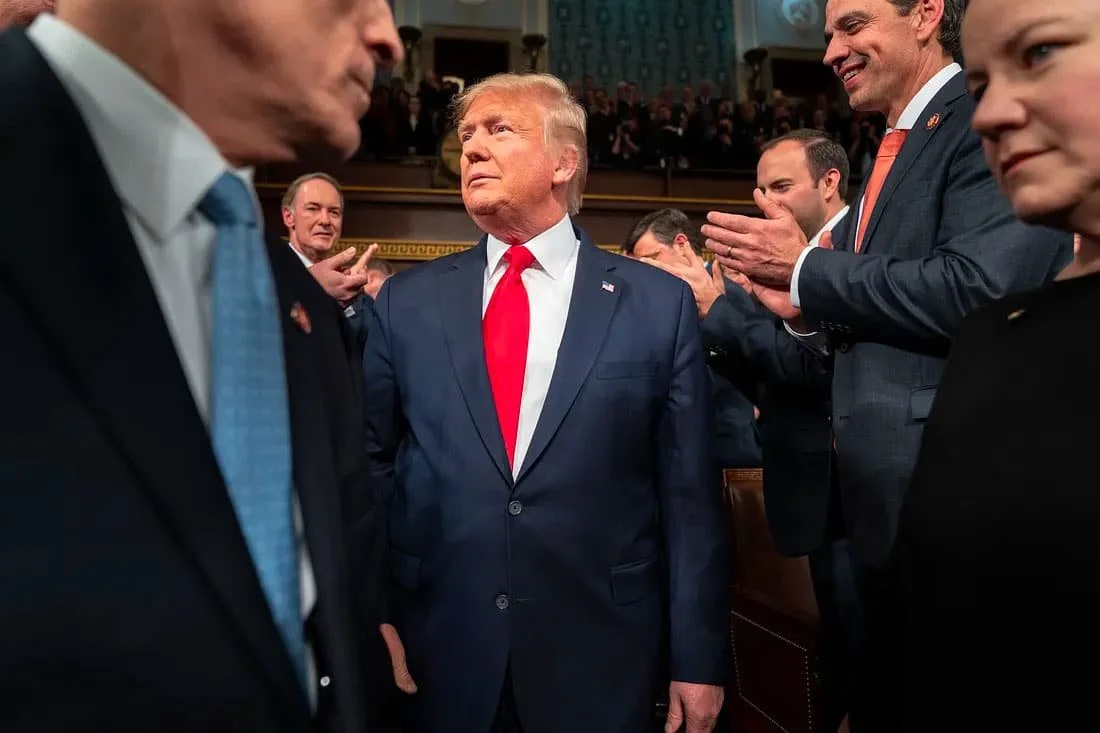
From his first presidential campaign, President Donald Trump has never been a friend of the press. Even within 30 days of taking office for his first presidency, Trump tweeted on his personal account that the media “is the enemy of the American People!” [1] Though, tensions between presidents and the media are nothing new. Whether it is the Bill Clinton post-Monica Lewinsky scandal or Richard Nixon auditing his “enemies list,” it seems inevitable for presidents to clash with the press. [2] Even Thomas Jefferson, infamous for his quote choosing a world with the news versus a world without, went back on his word years later, calling a newspaper a "diluted vehicle.” [3]
While these disputes between the Oval Office and the press seem inevitable, Trump has taken his hatred of the press to a full-fledged war. Namely, Trump and his administration have pursued legal actions that not only abuse their political power, but also weaken the legitimacy of the First Amendment’s freedom of the press clause.
Lawsuits against networks
Filed in March of 2024, Trump’s lawsuit against ABC News acted as a catalyst for his ongoing attempts to sue the press. In a debate on-air, ABC News anchor George Stephanopoulos inaccurately claimed that the then-president-elect Donald Trump had been found civilly liable for sexually abusing E. Jean Carroll under New York State Penal Law. Despite the jury voting majorly in favor of Carroll, they had determined she failed to prove that Trump raped her “within the narrow, technical meaning of a particular section of the New York Penal Law.” On this technicality, Stephanopoulos’ assertion is incorrect. So, days after the on-air clip, the lawsuit had been filed. [4]
That December, ABC News agreed to pay $15 million in settlement of the case, in addition to $1 million in legal fees, to the construction of Donald Trump’s presidential library. [5] This outcome was rare for defamation lawsuits between the government and news outlets, but not necessarily a surprise. Proving defamation requires substantial proof in both saying misinformation, but also proving the source knew the information they claimed to be true, to be false. So, why settle when they could win?
While ABC News made no official comment, besides a statement of regret laid out in their settlement agreement, various political and financial reasons at stake certainly changed the playing field. Firstly, in an era of developing AI practices and anti-media rhetoric from Trump, people’s trust in news outlets have reached all-time lows. [6] So, asking a jury to protect the expanse of the First Amendment, now more than ever, would prove challenging. Further, the network’s parent company, Disney, consistently requires government approval from the Federal Communications Commission (FCC), so it is in their best interest to submit to the administration’s wishes now, than to face complications in the future. The best interest for Disney, however, has turned this case into the stepping stone for Trump’s political revenge agenda and a worse consequence for journalism at large.
Following this lawsuit, Trump said that he plans to continue suing media outlets because “they’re very dishonest” and that “[w]e need a great media. We need a fair media.” [7] And sue he did. Trump has attempted to sue reputable outlets, such as The New York Times and Wall Street Journal, but his only notable victory dealt with CBS News this past summer. [16] Coincidentally, CBS News’ parent company, Paramount, was in the process of being sold to Skydance Media from Redstone, but needed government approval. Paramount, like Disney, settled their lawsuit with another multi-million dollar payment to Trump’s presidential library. [4]
FCC political power
Despite settling their lawsuit less than a year prior, ABC announced that ‘Jimmy Kimmel Live!’ would be pulled indefinitely off air after pressure from FCC Chairman Brendan Carr following the host’s comments on Charlie Kirk’s death. Kimmel, known to speak out against Trump, spoke about Kirk’s death days afterwards, mocking Trump’s reaction to Kirk’s death in interviews. [8] In response, Carr, a Trump appointee, threatened to take legal action against ABC for Kimmel’s comments, a blatant move that kick-started the onslaught of measures taken by media outlets in the following days.
Previously, in the pulling of CBS’ “The Late Night Show with Stephen Colbert,” Carr had only echoed the statement announced by CBS, claiming the decision was based on financial issues. However, Colbert had just criticized parent company Paramount’s lawsuit settlement with Trump, and, just days after pulling Colbert’s show, Paramount’s merger had been approved by the FCC. [9] So, Carr’s public threat to ABC confirmed these supposed coincidences to strategic misuse of the FCC as an avenue for the legal-takedown of Trump’s enemies.
Shortly after Carr’s threat, Nexstar and Sinclair, owners of ABC affiliate stations across the country, announced their plans to remove Kimmel’s show. Then Disney, ABC’s parent company, followed. All three companies had business ventures awaiting approval from the FCC at that time. [10]
Though Sinclair and Nexstar, two owners of large ABC affiliate stations quickly reinstated, coincidently following a significant drop in Disney’s stock value, Carr believes the support of Nexstar and Sinclair in this battle as a “turning point” for the FCC. [11] Broadcast networks, including CBS, ABC, and NBC, have a license from the FCC that requires them to “act in public interest,” so Carr believes the FCC has failed to enforce this among networks. In his interview on FOX News following the reinstatement of Kimmel’s show, Carr shared his hope for the future now that “America’s broadcasters are standing up for the interests of their community.” [12] Under the guise of “public interest,” Brendan Carr has turned a regulatory agency into a political weapon, abusing his power outside of office to discredit and destroy any opposition to the president.
Pentagon Press Policy
Journalists in the Pentagon press room have adjusted to numerous censorship changes, largely due to national security concerns, over the decades of its existence. However, Defense Secretary Pete Hegseth recently enforced a new pledge on Pentagon correspondents on the basis of what he calls “common sense.” [13] After initial complaints from news outlets, such as CNN, Fox News Media, ABC News Media and more, the department revised the policy’s wording. Despite this, the main principles stood: journalists would need permission to publish both classified and unclassified information given by the department, and have the potential to lose their press pass if they do not follow these guidelines.
As a result of the policy, 40 to 50 journalists handed in their press passes and waltzed out of the Pentagon following the 4 p.m. deadline set on October 15, including CNN, The Washington Post, The New York Times, and even Fox News, a historically right-leaning company. [14]
Even if journalists are removed from the Pentagon’s press room, they can still report on the briefings and information coming from the Pentagon. However, numerous correspondents shared that their proximity to the Pentagon, most of the time, mattered far more than the information they received. Tom Bowman, NPR’s Pentagon correspondent of 28 years, wrote an opinion on why he handed over his press pass, citing specific times he garnered key information by just walking the halls of the department and making relationships with officials there. [15]
By creating this physical boundary between the Pentagon’s press room and its reporters, Hegseth has removed the check on the information shared about America’s national security and defense. Of course, reporters will continue to question the validity of Hegseth’s statements on his department’s operations, but without their physical presence, the public is left clueless on if their billions of tax-paying dollars are being abused by the Defense Department.
Conclusion
Through his legal pursuits via his own executive power, or his appointees in outside departments and agencies, Trump has established an anti-media campaign unlike any American president. His actions against the media, both as corporations and their reputations, dismantle the power of the First Amendment’s freedom of the press and the American value that journalism is key to a functioning democracy. The future for the media remains in question: whether it will regain popularity post-Trump or if Americans have now shifted to an anti-institution culture as a result.
Endnotes:
Gerhard Peters and John T. Woolley, “Donald J. Trump (1st Term), Tweets of February 17, 2017,” The American Presidency Project, February 17,2017, https://www.presidency.ucsb.edu/documents/tweets-february-17-2017.
Ryan Mattimore, “Presidential Feuds With the Media Are Nothing New,” History, January 26, 2018, https://www.history.com/articles/presidents-relationship-with-press.
Thomas Jefferson to John Norvell, November 6, 1807, Manuscript/Mixed Material. http://hdl.loc.gov/loc.mss/mtj.mtjbib017268.
Michael R. Sisak, “ABC agrees to give $15 million to Donald Trump’s presidential library to settle defamation lawsuit,” The Associated Press, December 14, 2024, http://apnews.com/article/abc-trump-lawsuit-defamation-stephanopoulos-04aea8663310af39ae2a85f4c1a56d68.
Trump v. American Broadcasting Companies, Inc. 1:24-cv-21050, (S.D. Fla. Dec 14, 2024) ECF No. 58.
Kirsten Eddy and Elisa Shearer, “How Americans’ trust in information from news organizations and social media sites has changed over time,” Pew Research Center, October 29, 2025, https://www.pewresearch.org/short-reads/2025/10/29/ how-americans-trust-in-information-from-news-organizations-and-social-media-sites-has-changed-over-time/.
Hadas Gold, “Emboldened by ABC settlement, Trump threatens more lawsuits against the press,” CNN, December 16, 2024, https://www.cnn.com/2024/12/16/media/trump-threaten-news-media-lawsuits-abc-settlement.
New York Post, “Here’s What Jimmy Kimmel Said About Charlie Kirk: The Full Moment,” Youtube, September 17, 2025, https://www.youtube.com/watch?v=4ATqJc2MjDY.
Brooks Barnes, Michael M. Grynbaum, and John Koblin, “ABC Pulls Jimmy Kimmel Off Air for Charlie Kirk Comments After F.C.C Pressure,” The New York Times, September 17, 2025, https://www.nytimes.com/2025/09/17/business/media/abc-jimmy-kimmel.html.
David Folkenflik, “Jimmy Kimmel’s suspension shows power of FCC’s Brendan Carr,” NPR, September 19, 2025, https://www.npr.org/2025/09/19/nx-s1-5546764/fcc-brendan-carr-kimmel-trump-free-speech.
Yun Li, “Disney investors say handling of Jimmy Kimmel suspension put politics over shareholders, demand records,” CNBC, September 25, 2025, https://www.cnbc.com/2025/09/25/jimmy-kimmel-disney-investors-politics-fiduciary-duty.html.
Fox News, “‘TURNING POINT’: FCC chair speaks on Kimmel show suspension,” Youtube, September 18, 2025, https://www.youtube.com/watch?v=jFLM591chps.
Pete Hegseth, “Secretary of War Pete Hegseth Addresses General and Flag Officers at Quantico, Virginia,” September 30, 2025, https://www.war.gov/News/Transcripts/Transcript/Article/4318689/secretary-of-war-pete-hegseth-addresses-general-and-flag-officers-at-quantico-v/.
Daniel Arkin, “Five major broadcast networks say they won’t sign new Pentagon media policy,” NBC News, October 14, 2025, https://www.nbcnews.com/news/us-news/five-major-broadcast-networks-say-will-not-sign-new-pentagon-press-pol-rcna237526.
Tom Bowman, “Opinion: Why I’m handing in my Pentagon press pass,” NPR, October 14, 2025, https://www.npr.org/2025/10/14/g-s1-93297/pentagon-reporter-opinion-press-policy.
Daisuke Wakabayashi and Michael M. Grynbaum, “Trump sues The New York Times for Articles Questioning His Success,” The New York Times, September 16, 2025, https://www.nytimes.com/2025/09/16/business/media/trump-lawsuit-new-york-times.html.
Bibliography:
Arkin, Daniel. “Five major broadcast networks say they won’t sign new Pentagon media policy.”
NBC News, October 14, 2025. https://www.nbcnews.com/news/us-news/five-major-broadcast-networks-say-will-not-sign-new-pentagon-press-pol-rcna237526.
Barnes, Brooks, Michael M. Grynbaum, and John Koblin,.“ABC Pulls Jimmy Kimmel Off Air for Charlie Kirk Comments After F.C.C Pressure.” The New York Times, September 17, 2025. https://www.nytimes.com/2025/09/17/business/media/abc-jimmy-kimmel.html.
Bowman, Tom. “Opinion: Why I’m handing in my Pentagon press pass.” NPR, October 14, 2025. https://www.npr.org/2025/10/14/g-s1-93297/pentagon-reporter-opinion-press-policy.
Eddy, Kirsten and Elisa Shearer. “How Americans’ trust in information from news organizations and social media sites has changed over time.” Pew Research Center, October 29, 2025. https://www.pewresearch.org/short-reads/2025/10/29/how-americans-trust-in-information-from-news-organizations-and-social-media-sites-has-changed-over-time/.
Folkenflik, David. “Jimmy Kimmel’s suspension shows power of FCC’s Brendan Carr.” NPR, September 19, 2025. https://www.npr.org/2025/09/19/nx-s1-5546764/fcc-brendan-carr-kimmel-trump-free-speech.
Fox News. “‘TURNING POINT’: FCC chair speaks on Kimmel show suspension.” Youtube, September 18, 2025. https://www.youtube.com/watch?v=jFLM591chps.
Gold, Hadas. “Emboldened by ABC settlement, Trump threatens more lawsuits against the press.” CNN, December 16, 2024. https://www.cnn.com/2024/12/16/media/trump-threaten-news-media-lawsuits-abc-settlement.
Hegseth, Pete. “Secretary of War Pete Hegseth Addresses General and Flag Officers at Quantico, Virginia.” September 30, 2025. https://www.war.gov/News/Transcripts/Transcript/Article/4318689/secretary-of-war-pete-hegseth-addresses-general-and-flag-officers-at-quantico-v/.
Li, Yun. “Disney investors say handling of Jimmy Kimmel suspension put politics over shareholders, demand records.” CNBC, September 25, 2025. https://www.cnbc.com/2025/09/25/jimmy-kimmel-disney-investors-politics-fiduciary-duty.html.
Mattimore, Ryan. “Presidential Feuds With the Media Are Nothing New.” History, January 26, 2018. https://www.history.com/articles/presidents-relationship-with-press.
New York Post. “Here’s What Jimmy Kimmel Said About Charlie Kirk: The Full Moment.” Youtube, September 17, 2025. https://www.youtube.com/watch?v=4ATqJc2MjDY.
Peters, Gerhard and John T. Woolley. “Donald J. Trump (1st Term), Tweets of February 17, 2017.” The American Presidency Project, February 17,2017. https://www.presidency.ucsb.edu/documents/tweets-february-17-2017.
Sisak, Michael R. “ABC agrees to give $15 million to Donald Trump’s presidential library to settle defamation lawsuit.” The Associated Press, December 14, 2024. http://apnews.com/article/abc-trump-lawsuit-defamation-stephanopoulos-04aea8663310af39ae2a85f4c1a56d68.
Thomas Jefferson to John Norvell, November 6, 1807. Manuscript/Mixed Material. http://hdl.loc.gov/loc.mss/mtj.mtjbib017268.
Trump v. American Broadcasting Companies, Inc. 1:24-cv-21050, (S.D. Fla. Dec 14, 2024) ECF No. 58.
Wakabayashi, Daisuke and Michael M. Grynbaum. “Trump sues The New York Times for Articles Questioning His Success.” The New York Times, September 16, 2025. https://www.nytimes.com/2025/09/16/business/media/trump-lawsuit-new-york-times.html.
Turning Neighbor Against Neighbor: How Texas Redefines Abortion Regulation Across State Lines
By: Lucy Lu
Edited by: Hailey Kim and Sophia Cheng
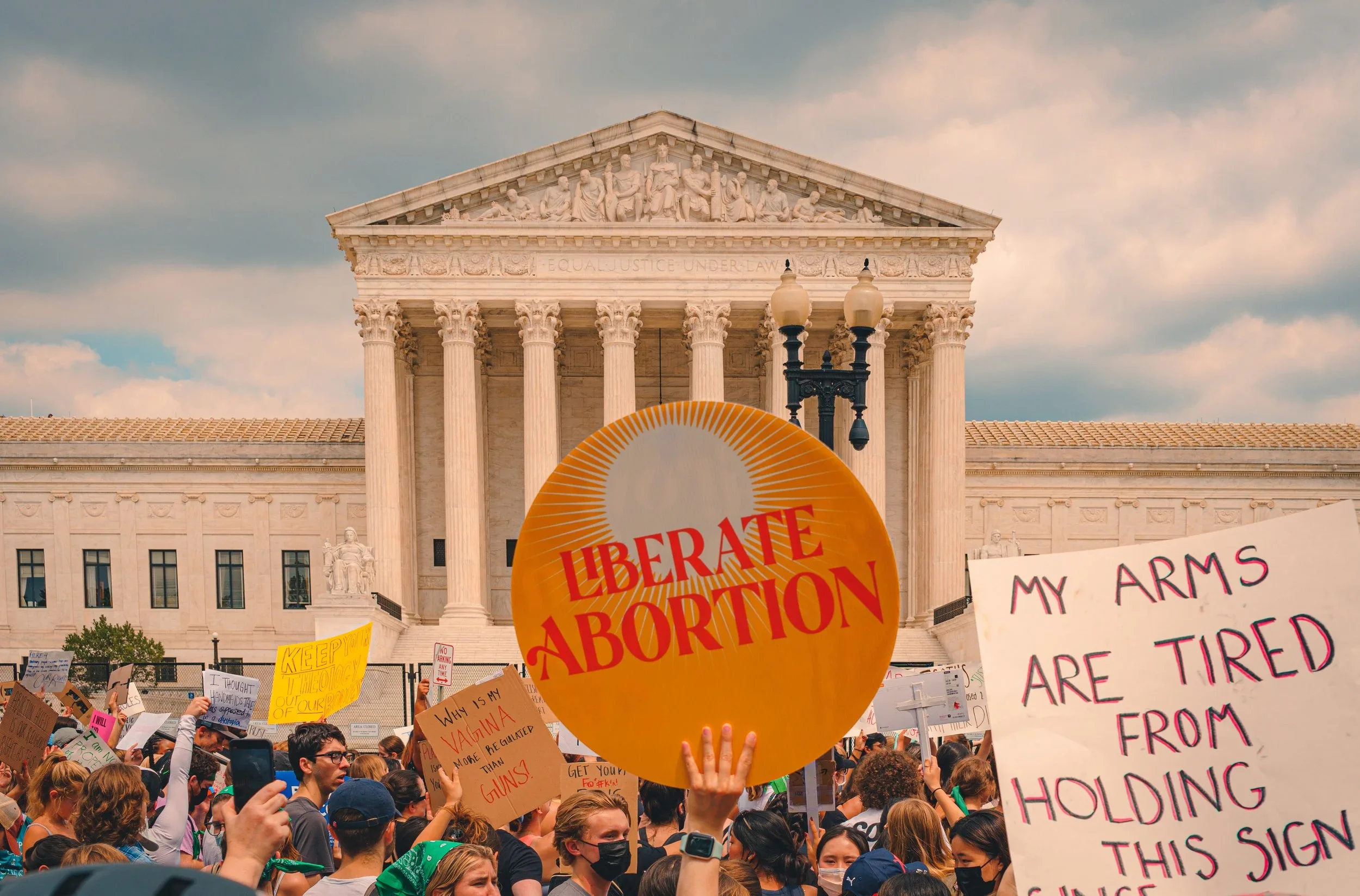
The Supreme Court's choice in Dobbs v. Jackson Women's Health (2022) to overrule Roe v. Wade (1973) is not only significant because it outlaws abortion, but also because it threatens the overall status of American women as equal and autonomous beings. The authority to regulate abortion is now left to the states, whose divergent political climates — and, by proxy, abortion laws — leave women with unequal access to care that was once broadly guaranteed. In this patchwork, interstate commerce has played a central role in accessing abortion services, and Texas is among the states where this issue is especially prevalent.
Back in 1973, Roe v. Wade found Texas’s criminalization of abortion and abortion attempts, except when necessary to save the mother’s life, unconstitutional per the right to privacy established in the 14th Amendment. However, Texas’s efforts to limit access to abortion did not stop after the ruling. As Justices Stephen Breyer, Sonia Sotomayor, and Elena Kagan cited in their Dobbs dissent, “as Texas has recently shown, a State can turn neighbor against neighbor, enlisting fellow citizens in the effort to root out anyone who tries to get an abortion, or to assist another in doing so.” Although the Roe majority had decreed that the constitutional right to privacy included the right to abortion, Texas nevertheless maintained its interest in protecting prenatal life and its longstanding, deeply rooted opposition to abortion. For years before the Dobbs decision, Texas tried to turn individuals against each other to restrict access to abortion. In the post-Roe period, these efforts have continued, exemplified by means like the Texas House Bill 7.
Texas House bill 7 was introduced on August 28, 2025, allowing private citizens to sue individuals or entities involved in the manufacture, distribution, or mailing of abortion pills to or from Texas. Shortly thereafter, on September 17, the bill was signed into law by Governor Greg Abbott, to be effective starting December 4. The signing of the bill into law has prompted extensive discussion among providers outside of Texas who, since Dobbs, have been prescribing and shipping abortion pills across state lines to women in Texas by operating. Some out-of-state providers have vowed “no anticipatory obedience” to this newly enacted law, even in the face of potential suits that can carry a minimum penalty of $100,000.
Despite the heightened liability risk involved, these organizations are not planning to exclude Texas from their services. They partially rely on protection under “shield laws,” legal protections for individuals providing healthcare assistance in states where it is legal. These shield laws protect them from civil, criminal, and professional consequences in states where the care is illegal.
The dedication of these organizations and individuals to providing equal access to abortion to all women, disregarding state boundaries, is undoubtedly notable, but concerns remain. Legal scholars have pointed out that not only is the applicability of shield laws yet to be tested in court, but the new Texas law may still “hamper or dissuade people who don’t want to be implicated, who don’t want to face the risk of liability,” thereby further limiting access to abortion for women in Texas.
Receiving abortion care across state lines already constrains women’s right to life and liberty in the post-Roe era. In Georgia resident Amber Thurman’s case, for example, Georgia’s six-week ban left Thurman with no choice but to seek a legal abortion in North Carolina. To do so, Thurman had to schedule a day off work, find a babysitter for her son, and make an excuse to borrow a car from a relative. It is important to note that women like Thurman can take these steps only because they have the financial means. For women who do not have this capacity and live in states where abortion is banned, they simply lose their access to abortion completely. Not only is out-of-state abortion logistically and financially taxing, but it can also be life-threatening if not utilized properly. Thurman ultimately chose to take abortion pills, after which she developed a rare but serious complication that required dilation and curettage (D&C) to clear her uterus. However, doctors in Georgia were hesitant to perform this necessary procedure out of fear of felony prosecution, as state law requires physicians to be certain that a patient is inarguably on the brink of death before intervening with procedures such as a D&C. If Thurman were a resident of North Carolina instead, she would have received an abortion procedure in a timely manner that could have saved her life. In such cases — where women’s state of residence and financial capacity dictate how readily, if at all, they can obtain abortion care — these women’s reliance on external circumstances erodes their agency over their bodies. Moreover, although options such as mailing abortion pills have been regarded as cheaper and more accessible alternatives to alleviate these burdens, the Texas law makes even this last resort more precarious for women in the state of Texas.
This outcome was hardly unexpected. In Justices Breyer, Sotomayor, and Kagan’s dissent in Dobbs, they predicted that overruling Roe v. Wade would only complicate abortion law and lead to the rise of more issues that the majority of the Court had claimed to resolve. The Justices wrote, “After this decision, some States may block women … from receiving abortion medications from out of state.” They also raised questions like, “Can a State prohibit advertising out-of-state abortions or helping women get to out-of-state providers?” and, “Can a State interfere with the mailing of drugs used for medication abortions?”
These concerns are precisely what has manifested in the recent Texas law. By permitting private suits that could result in tremendous fines against providers, pharmaceutical manufacturers, and even those who mail pills, the state of Texas is trying to promote public surveillance and instill fear and hesitation in those facilitating abortion care across state lines, creating a society short on trust and support. And with the successful adoption of this Texas bill, it is hard not to foresee the spread of the same law being adopted in other states. With access to abortion becoming more limited across the nation, we are left wondering what’s next, making the dissent’s caution in Dobbs more plausible.
There is no doubt that American women would have substantially less autonomy over their reproductive decisions if these trends were to find their way into other state legislatures. The significant social roles and equal rights that women in the United States have fought for over more than a century, from the women’s suffrage movement to Title VII, will be challenged and may even risk being lost. The clock would turn backward, diminishing women’s social and economic standing and reducing them to mere reproductive machines. This is not just about one Texas law; it is a nationwide issue in the post-Dobbs era and, even more broadly, an issue affecting half of humanity.
Notes:
Roe v. Wade, 410 U.S. 113 (1973).
Dobbs v. Jackson Women’s Health Organization, 597 U.S. 215 (2022).
Texas Legislature, House, An Act relating to prohibitions on the manufacture, distribution, or mailing of abortion-inducing drugs and authorizing private civil actions, Tex. H.B. 7, 89th Leg., 2nd Called Spec. Sess., introduced August 28, 2025, https://capitol.texas.gov/BillLookup/History.aspx?LegSess=89R&Bill=HB7.
Carter Sherman, “Abortion Pill Providers Targeted by New Texas Law Refuse ‘Anticipatory Obedience,’” The Guardian, September 18, 2025, https://www.theguardian.com/world/2025/sep/18/abortion-pill-texas-law.
Sherman, “Abortion Pill Providers Targeted by New Texas Law.”
“Shield Laws for Reproductive and Gender-Affirming Health Care: A State Law Guide,” Center on Reproductive Health, Law, and Policy, UCLA School of Law, last modified October 2025, https://law.ucla.edu/academics/centers/center-reproductive-health-law-and-policy/shield-laws-reproductive-and-gender-affirming-health-care-state-law-guide.
Sherman, “Abortion Pill Providers Targeted by New Texas Law.”
Kavitha Surana, “Abortion Bans Have Delayed Emergency Medical Care. In Georgia, Experts Say This Mother’s Death Was Preventable,” ProPublica, September 16, 2024, https://www.propublica.org/article/georgia-abortion-ban-amber-thurman-death.
Surana, “Abortion Bans Have Delayed Emergency Medical Care.”
Dobbs v. Jackson Women’s Health Organization, 597 U.S. 215 (2022).
Dobbs v. Jacson Women’s Health Organizations, 597 U.S. 215 (2022).
Bibliography:
Center on Reproductive Health, Law, and Policy, UCLA School of Law. Shield Laws for Reproductive and Gender-Affirming Health Care: A State Law Guide. Last modified October 2025. https://www.law.ucla.edu/academics/centers/center-reproductive-health-law-and-policy/shield-laws-reproductive-and-gender-affirming-health-care-state-law-guide.
Dobbs v. Jackson Women’s Health Organization, 597 U.S. 215 (2022).
Roe v. Wade, 410 U.S. 113 (1973).
Sherman, Carter. “Abortion Pill Providers Targeted by New Texas Law Refuse ‘Anticipatory Obedience.’” The Guardian, September 18, 2025. https://www.theguardian.com/world/2025/sep/18/abortion-pill-texas-law.
Surana, Kavitha. “Abortion Bans Have Delayed Emergency Medical Care. In Georgia, Experts Say This Mother’s Death Was Preventable.” ProPublica, September 16, 2024. https://www.propublica.org/article/georgia-abortion-ban-amber-thurman-death.
Texas Legislature. House. An Act relating to prohibitions on the manufacture, distribution, or mailing of abortion-inducing drugs and authorizing private civil actions. Tex. H.B. 7. 89th Legislature, 2nd Called Special Session. Introduced August 28, 2025. https://capitol.texas.gov/BillLookup/History.aspx?LegSess=89R&Bill=HB7.
Reimagining the ICC’s Role in Prosecuting Digital Intellectual Property Crimes
By: Alan Tai
Edited by: Alexa Tan and Clark Mahoney
For much of human history, spoils of war have been tangible: gold, grain, art, people. One of the oldest examples is in the 8th century BC, when Assyrian king Tiglath-Pileser III took the statues of gods from enemy cities.[1] During the Second World War, looting (or pillaging) was common among both Axis and Allied soldiers, targeting museums, homes, and cultural spaces. Even as recently as 2003, looters stole 15,000 objects from the National Museum in Baghdad during the chaos of the Iraq War.
What counts as a spoil of war has vastly changed today. The most consequential assets, from national registries to proprietary software, exist only as information, oftentimes exclusively in the digital space. Notably, much of this data is protected under modern-day intellectual property (IP) law. IP is broadly recognized as “creations of the mind,” which can include digital cultural works across a variety of mediums.[2] Digital IP can also be cultural; examples of digital cultural works exist in Indigenous communities in the U.S., who have digitized artworks, hosted Cree language lessons on social media, and produced games that teach students about Indigenous culture.[3] In many ways, these works are analogous to physical artifacts: they embody collective memory, transmit cultural identity, and serve as repositories of tradition; they can be irreparably damaged or erased through intentional destruction; they can be misappropriated or used without consent; and they hold community-level significance that makes their exploitation materially harmful.
However, international humanitarian law (IHL) remains anchored in a physical definition of “property.” From the 1954 Hague Convention to the International Committee of the Red Cross, cultural property is frequently mentioned but has generally been limited to physical assets.[4] The Tallinn Manual 2.0, an academic project addressing the application of international law to cyber activities, debated the meaning of terms like “object” and “property,” with a majority of the writers agreeing that “sensu stricto” (strictly speaking), the IHL notion of “object” does not include data due to its intangibility.[5]
Despite the fixation on “property” as physical assets, the importance of digital property in the modern age is apparent. Christopher Greulich and Eric Talbot Jensen of the J. Reuben Clark Law School suggest that definitions of “pillage” are transforming during the digital era, particularly with the rise of cyber crimes.[6] For instance, Chinese intellectual property theft from the U.S. is valued at 225 to 600 billion dollars yearly.[7] With cybercrime rapidly proliferating, the need to consider its implications from the lens of IHL is only growing, especially for future cases where it may be used to target digital cultural property.
Richard Ong offers a perspective on how cybercrime may target digital cultural IP in the Columbia Human Rights Law Review. Actors may attack and exploit cultural property as a method of ideological assertion or gaining economic benefits.[8] A proof of concept for this comes from the 2014 North Korean cyberattack on U.S. film studio Sony Pictures, motivated by the negative portrayal of Kim Jong Un in the film The Interview. Ong states that “cyberattacks are a potent means of targeting cultural objects” at a time when museums, archives, and heritage institutions have become digitized through online galleries and multimedia exhibits. It is not difficult to imagine a world several decades into the future where the tenets of a subgroup’s culture — language, art, craftsmanship — exist solely as digital artifacts after rapid cultural assimilation.
The International Criminal Court (ICC) is one actor that may be equipped to handle digital IP crime. It is an independent judicial body that is governed by the Rome Statute, which 123 nations are party to.[9] The ICC’s mandate is to prosecute genocide, crimes against humanity, war crimes, and crimes of aggression—crimes that can include the pillaging of cultural IP. Under Article 8(2)(b)(xvi) and 8(2)(e)(v) of the Rome Statute, “pillage” is explicitly listed as a war crime.[10] Traditionally, pillage refers to the appropriation of physical property without consent, especially during armed conflict. As stated earlier, classical legal readings of IHL view pillage as only involving tangible goods.
However, given the importance of cultural data, it is reasonable—perhaps just—for the ICC to encompass IP crimes under pillaging. If cultural data performs the same social and historical functions as physical artifacts, its appropriation produces the same type of harm that classical pillage provisions aim to prevent. In fact, the ICC has already recognized cultural destruction as a standalone war crime with intangible harms. The 2016 Prosecutor v. Ahmad Al Faqi Al-Mahdi case is the ICC’s most relevant and recent precedent. Al-Mahdi, a member of a Malian jihadist organization, was convicted for intentionally directing the destruction of cultural buildings in Timbuktu, Mali in 2012.[11] The case lays the groundwork for prosecuting further crimes against cultural property, even in the context of digital IP. The Court emphasized that the destruction was criminal because it harmed the identity and history of a cultural community, even if the damage did not result in major economic losses or human casualties, which many saw as a landmark precedent. The symbolic nature of the act was at the heart of the case, rather than its tangible consequences. Cyberattacks on digital cultural property in the future may follow identical motivations and therefore be subject to the same logic used by the prosecution in this case.
While the ICC’s ruling in Al-Mahdi did not endorse a broader scope for the Rome Statute’s protection for cultural property (the court focused on facts applied to Article 8(2)(e)(iv) on intentionally directed attacks on buildings), an ICC report published in 2021 offered further clarifications on how the Court views cultural property.[12] The report shifts the Court’s terminology from “cultural property” to “cultural heritage,” which it views as a “broad concept which incorporates both tangible and intangible expressions of human life”—a definition that would include digital artifacts. The ICC aligns its work with human rights law, stating that attacks on cultural heritage may violate not only IHL, but also human rights such as freedom of expression and religion.
More forcefully, the report outlines how cultural heritage destruction can be linked to other major crimes within the ICC’s jurisdiction. Destruction can constitute persecution (Article 7(1)(h) of the Rome Statute) when used to intentionally and severely deprive a group of people of fundamental rights based on their identity; extermination (Article 7(1)(b)) when intended to bring about the destruction of a people; and torture (Article 7(1)(f)) when it involves severe mental suffering. Acts of cultural heritage destruction may even provide evidence of the specific intent required for genocide (Article 6). The strategies outlined in the 2021 report represent considerable progress in developing jurisprudence on how IP theft may be prosecuted on an international level when it is used to erase, exploit, or appropriate protected groups, especially during times of armed conflict.
There is still work to be done to make IP crimes widely prosecutable by the Court. The 2021 report primarily focuses on the destruction of cultural heritage, yet IP crimes nowadays are diverse in nature, from the wholesale expropriation to the discrete manipulation of IP. This is only exacerbated by the rise in generative artificial intelligence, which enhances cyber operations. Ronald Alcala in the International Review of the Red Cross proposes mechanisms in which states can strengthen digital cultural IP protection.[15] Alcala argues that during peacetime, states must purposefully and deliberately identify digital works they consider to be important to cultural heritage. This system could involve blockchain authentication, online registrations, or digital identifiers like watermarks. Actions like these would help bolster ICC cases because they create a clear evidentiary record of ownership, provenance, and cultural significance, allowing prosecutors to demonstrate that targeted digital assets meet the thresholds of “property” under IHL. A record of digital cultural works is analogous to how the United Nations Educational, Scientific and Cultural Organization (UNESCO) marks physical cultural heritage sites. In fact, UNESCO World Heritage designation was used by prosecutors to prove the cultural significance of the Malian sites damaged in Al Mahdi.
Beyond these peacetime considerations, Alcala contends that laws must be conceptualized to protect digital material. In the context of IHL, this approach means that legal interpretations of “property” must expand to include digital IP. Additionally, physical cultural property in the form of digital surrogates, which are digitized versions of physical artifacts, must be protected. This interpretation would focus on cultural information and significance rather than the originality of the work itself. Under such a view, an actor who intentionally pillages digitized museum archives to target a particular community could fall within the ICC’s evolving jurisprudence on cultural property crimes.
Although the ICC has outlined strategies and frameworks to tackle digital cultural IP crimes, its efficacy is limited. For one, key actors have not signed or ratified the Rome Statute, including three permanent members of the United Nations Security Council: the United States, Russia, and China.[13] Countries which have experienced armed conflict in recent years, such as Israel, Syria, Lebanon, and Libya, are also not party to the ICC. In addition, the Court has suffered from a reputation crisis, with observers noting that it applies a “selective application of justice,” primarily targeting African conflicts and serving neo-colonial Western interests.[14] Powerful nations have targeted the ICC, with the United States applying sanctions to the organization and Russia rejecting the Court’s charges against Vladimir Putin and other Russian officials for the war in Ukraine. If the ICC were to prosecute IP crimes, it must hold powerful countries and individuals accountable and work with both party and non-party states to secure the evidence needed for successful cases. This is crucial within the digital realm of IP crime, given how digital evidence must be collected, verified, stored, and deployed properly.[15]
Digital IP now occupies the same cultural and historical spaces that physical artifacts once exclusively held. While widespread aggression has yet to be seen, it is clear that harms inflicted through cyberattacks, data theft, and digital manipulation have the potential to mirror the violence of traditional pillage: erasing the identities and histories of vulnerable cultural groups. The ICC’s jurisprudence has not fully embraced digital cultural property as “property” under IHL, but the Court’s evolving posture uniquely positions it to take on this challenge and set standards that can enhance doctrinal clarity. If the international community is to prevent future cultural erasure in the digital age, the ICC must reimagine pillage and cultural property for a world where heritage is shared via network streams, encoded onto hard drives, and attacked with bytes rather than bombs.
Notes:
[1] Blue Shield International, “Looting and Pillage,” accessed Nov. 17, 2025, https://theblueshield.org/looting-and-pillage/
[2] World Intellectual Property Organization, “What Is Intellectual Property (IP)?,” accessed Nov. 17, 2025, https://www.wipo.int/en/web/about-ip
[3] Education Northwest, “Native Communities Harnessing the Internet to Share Traditional Knowledge,” accessed Nov. 17, 2025, https://educationnorthwest.org/insights/how-native-communities-are-harnessing-internet-share-traditional-and-contemporary
[4] Richard Ong, “Hard Drive Heritage: Digital Cultural Property in the Law of Armed Conflict,” Columbia Human Rights Law Review 53, no. 1 (2021): 248–294.
[5] Laurie R. Blank and Eric Talbot Jensen, “LOAC and the Protection and Use of Digital Property,” in The Rights to Privacy and Data Protection in Times of Armed Conflict, ed. Russell Buchan and Asaf Lubin (Tallinn: NATO CCDCOE Publications, 2022), 58.
[6] Eric Talbot Jensen and Christopher D. Greulich, “Cyber Pillage,” Southwestern Journal of International Law 26, no. 2 (2020): 264–288.
[7] Tech Diplomacy, “IP Theft,” accessed Nov. 17, 2025, https://techdiplomacy.org/tech-diplomacy/ip-theft/
[8] Ong, “Hard Drive Heritage.”
[9] Legal Information Institute, Cornell Law School, “International Criminal Court,” accessed Nov. 17, 2025, https://www.law.cornell.edu/wex/international_criminal_court
[10] Rome Statute of the International Criminal Court, July 17, 1998, 2187 U.N.T.S. 90.
[11] Harvard Law Review, “Prosecutor v. Ahmad Al Faqi Al Mahdi,” Harvard Law Review 130 (2017): 1978–1985, https://harvardlawreview.org/print/vol-130/prosecutor-v-ahmad-al-faqi-al-mahdi/
[12] Office of the Prosecutor, International Criminal Court, Policy on Cultural Heritage (June 14, 2021), https://www.icc-cpi.int/sites/default/files/itemsDocuments/20210614-otp-policy-cultural-heritage-eng.pdf
[13] United Nations Treaty Collection, accessed Nov. 19, 2025, https://treaties.un.org/Pages/ViewDetails.aspx?src=TREATY&mtdsg_no=XVIII-10&chapter=18&clang=_en
[14] Peace Research Institute Oslo (PRIO), “The International Criminal Court at Risk of Collapse,” accessed Nov. 19, 2025, https://www.prio.org/comments/1164
[15] International Criminal Court Forum, “Cyber Evidence Debate — How Can Cyber Evidence Help the ICC?,” accessed Nov. 19, 2025, https://iccforum.com/cyber-evidence
Bibliography:
Blue Shield International. “Looting and Pillage.” Accessed Nov. 17, 2025. https://theblueshield.org/looting-and-pillage/
Blank, Laurie R., and Eric Talbot Jensen. “LOAC and the Protection and Use of Digital Property in Armed Conflict.” In The Rights to Privacy and Data Protection in Times of Armed Conflict, edited by Russell Buchan and Asaf Lubin, 50–66. Tallinn: NATO CCDCOE Publications, 2022.
Education Northwest. “Native Communities Harnessing the Internet to Share Traditional Knowledge.” Accessed Nov. 17, 2025. https://educationnorthwest.org/insights/how-native-communities-are-harnessing-internet-share-traditional-and-contemporary
Harvard Law Review. “Prosecutor v. Ahmad Al Faqi Al Mahdi.” Harvard Law Review 130 (2017): 1978–1985. https://harvardlawreview.org/print/vol-130/prosecutor-v-ahmad-al-faqi-al-mahdi/.
International Criminal Court Forum. “Cyber Evidence Debate — How Can Cyber Evidence Help the ICC?” Accessed Nov. 19, 2025. https://iccforum.com/cyber-evidence.
International Criminal Court, Office of the Prosecutor. Policy on Cultural Heritage. June 14, 2021. https://www.icc-cpi.int/sites/default/files/itemsDocuments/20210614-otp-policy-cultural-heritage-eng.pdf.
Jensen, Eric Talbot, and Christopher D. Greulich. “Cyber Pillage.” Southwestern Journal of International Law 26, no. 2 (2020): 264–288.
Legal Information Institute, Cornell Law School. “International Criminal Court.” Accessed Nov. 17, 2025. https://www.law.cornell.edu/wex/international_criminal_court.
Ong, Richard. “Hard Drive Heritage: Digital Cultural Property in the Law of Armed Conflict.” Columbia Human Rights Law Review 53, no. 1 (2021): 248–294.
Peace Research Institute Oslo (PRIO). “The International Criminal Court at Risk of Collapse.” Accessed Nov. 19, 2025. https://www.prio.org/comments/1164.
Rome Statute of the International Criminal Court. July 17, 1998. 2187 U.N.T.S. 90.
Tech Diplomacy. “IP Theft.” Accessed Nov. 17, 2025. https://techdiplomacy.org/tech-diplomacy/ip-theft/.
United Nations Treaty Collection. Accessed Nov. 19, 2025. https://treaties.un.org/Pages/ViewDetails.aspx?src=TREATY&mtdsg_no=XVIII-10&chapter=18&clang=_en.
World Intellectual Property Organization. “What Is Intellectual Property (IP)?” Accessed Nov. 17, 2025. https://www.wipo.int/en/web/about-ip.
The Voting Rights Act is in Jeopardy (Again)
By: Gabs Villemarette
Edited By: Valerie Lane and David Liu
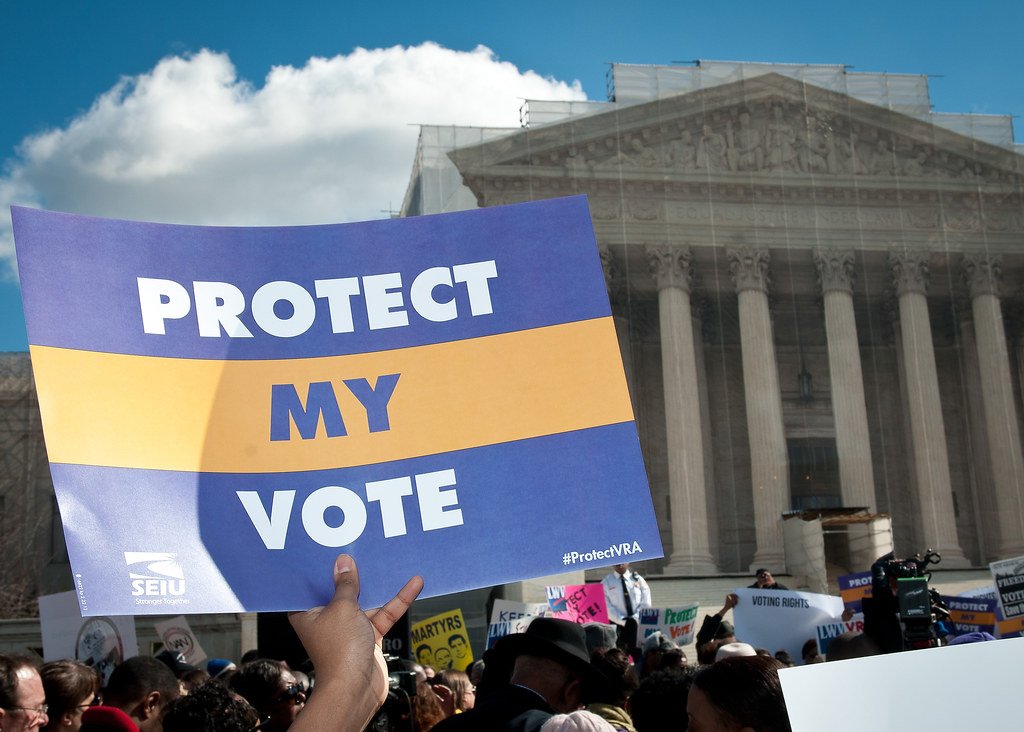
Recently, the Supreme Court directed their attention to Louisiana v. Callais, which concerns Section 2 of the Voting Rights Act of 1965. This section allows for race to be considered when redrawing districts from the local to the congressional level, with the intent of preventing districts that “result in a denial or abridgement of the right of any citizen of the United States to vote on account of race or color.”[1] Conservative-leaning Associate Justices Alito, Gorsuch, and Thomas have clearly expressed their belief that the creation of minority districts has its basis in outdated research on racial discrimination, and therefore, racial demographics should not be considered when creating congressional districts. Even Associate Justice Kavanaugh, often regarded as a “swing vote,” argued that the Voting Rights Act has served its purpose “for a limited period of time.” [2]
This would not be the first time voting rights have faced a sudden change from the Supreme Court. The 2013 Shelby County v. Holder decision led by Chief Justice Roberts effectively struck down Sections 4 and 5 of the Voting Rights Act of 1965. [3] Section 4 required states and localities with a history of racialized voter discrimination to receive “preclearance,” or approval by the federal government, before making any changes to their election process. [4] The intended purpose was to focus on states and counties with a history of racial discrimination. The ruling stated that Section 4 was unconstitutional since the formula used to determine which areas had discriminatory histories was, at that point, over half a century old. The court claimed modern voter discrimination is less severe comparatively. Thus, these sections of the Voting Rights Act had outlived their purpose in combating racial tensions as they existed in the 20th century.
Despite the similarities between the 2013 ruling and the current arguments of other conservative justices, the comparatively moderate Chief Justice Roberts seems much more hesitant to fully eliminate Section 2 based on his lack of involvement. His neutrality may be because of the rise in discriminatory voting laws following the Shelby County v. Holder decision was authored by Justice Roberts himself. The decision allowed previously-outlawed strict voter ID requirements that have appeared in predominantly red states like Texas, Alabama, and Mississippi. In these same predominantly red states, which were previously covered by the preclearance of Sections 4 and 5 of the Voting Rights Act of 1965, over 1,500 polling places were closed in the five years following Shelby County v. Holder. [5] Such examples of voter suppression will only become more common with the continued denigration of the Voting Rights Act of 1965, with little standing in the Supreme Court’s way.
There is already an incoming wave of pushback on the state level. Within the past few years, many states have been trying to preemptively counter the Supreme Court with their own legislation. This legislation is likely a response to the Court's recent decisions; only California and Illinois had their own voting rights acts prior to Shelby County v. Holder, whereas seven more states have enacted voting rights laws following the aforementioned decision. The most recent states to enact their own voting rights laws have been Connecticut (2023), Minnesota (2024), and Colorado (2025), in an attempt to enshrine their minority voters’ rights. [6] Despite these small victories, many states have yet to introduce their own Voting Rights Act entirely. [6] The Voting Rights Acts combat disenfranchisement by reducing voter dilution and intimidation, ultimately increasing voter turnout, especially among groups that are underrepresented in the American legal system. [7]
However, the efficacy of this state-side strategy is lacking, as the states that have introduced legislation have no way to guarantee that they will pass; Michigan's Voting Rights Act was struck down in the state House of Representatives this year. [8] Notably, most states that have successfully passed Voting Rights Acts are deep blue states, leaving voters in red states with little possibility of passing a state-wide Voting Rights Act. A lack of voter protections will, of course, impact minority voters in red and swing states, with no guarantee of minority districts to give representation to those who arguably need it most. The largest weakness of these state Voting Rights Acts (VRAs) is their lack of scope in comparison to the federal Voting Rights Act of 1965, even if they pass successfully. On the state level, VRAs cannot address congressional districts as Section 2 currently does; they solely apply to the local government level, which is also covered by the federal VRA. So, while the states are putting a valiant effort to uphold voting rights, the fate of minority congressional districts is still left to the Louisiana v. Callais Supreme Court ruling.[6]
These new challenges to established civil rights legislation brings into question the future of American democracy. If the court decides to repeal Section 2, it becomes more likely that Republicans will gain between 19-27 House seats after congressional districts are redrawn. [9] This single decision by the Supreme Court has the potential to reshape the American congressional landscape in favor of Republican interests at the expense of minority voters, especially in the South.
Notes:
1. 52 U.S. Code § 10301, https://www.law.cornell.edu/uscode/text/52/10301
2 . Zach Montellaro, Josh Gerstein and Andrew Howard, ‘Conservative Justices Seem Poised to Weaken Voting Rights Act,’ Politico, October 15, 2025, https://www.politico.com/news/2025/10/15/supreme-court-voting-rights-act-argument-00609187
2. ‘Shelby County v. Holder.’ Oyez. Accessed November 21, 2025.
https://www.oyez.org/cases/2012/12-96.
3. ‘Shelby County v. Holder,’ Brennan Center for Justice, August 4, 2018, www.brennancenter.org/our-work/court-cases/shelby-county-v-holder
4. ‘How Shelby County v. Holder Broke Democracy,’ Legal Defense Fund, https://www.naacpldf.org/shelby-county-v-holder-impact/
5. ‘State Voting Rights Acts,’ National Conference of State Legislatures, June 4, 2025, https://www.ncsl.org/elections-and-campaigns/state-voting-rights-acts
6. Lata Nott, ‘Strengthening Democracy Through State Voting Rights Acts (State VRAs),’ Campaign Legal Center, April 29 2025,
https://campaignlegal.org/cases-actions/strengthening-democracy-through-state-voting-rights-act s-state-vras
7. ‘The Michigan Legislature Fails to Act, Delivers a Devastaing Blow to Voting Rights,’ Legal Defense Fund https://www.naacpldf.org/press-release/the-michigan-legislature-fails-to-act-delivers-a-devastating-blow-to-voting-rights/
8. ‘What Happens in the South Doesn’t Stay in the South,’ Black Voters Matter Fund & Fair Fight Action, October 8 2025,
https://www.politico.com/f/?id=00000199-c097-dae2-ab9d-ded7d6fb0000
Bibliography:
52 U.S. Code § 10301, https://www.law.cornell.edu/uscode/text/52/10301
‘How Shelby County v. Holder Broke Democracy,’ Legal Defense Fund,
https://www.naacpldf.org/shelby-county-v-holder-impact/
‘The Michigan Legislature Fails to Act, Delivers a Devastaing Blow to Voting Rights,’ Legal Defense Fund https://www.naacpldf.org/press-release/the-michigan-legislature-fails-to-act-delivers-a-devastating-blow-to-voting-rights/
Montellaro, Zach, Josh Gerstein and Andrew Howard, ‘Conservative Justices Seem Poised to Weaken Voting Rights Act,’ Politico, October 15, 2025, https://www.politico.com/news/2025/10/15/supreme-court-voting-rights-act-argument-00609187
Nott, Lata ‘Strengthening Democracy Through State Voting Rights Acts (State VRAs),’ Campaign Legal Center, April 29 2025,
https://campaignlegal.org/cases-actions/strengthening-democracy-through-state-voting-rights-act s-state-vras
‘Shelby County v. Holder,’ Brennan Center for Justice, August 4, 2018,
www.brennancenter.org/our-work/court-cases/shelby-county-v-holder
‘Shelby County v. Holder.’ Oyez. Accessed November 21, 2025.
https://www.oyez.org/cases/2012/12-96.
‘State Voting Rights Acts,’ National Conference of State Legislatures, June 4, 2025, https://www.ncsl.org/elections-and-campaigns/state-voting-rights-acts
‘What Happens in the South Doesn’t Stay in the South,’ Black Voters Matter Fund & Fair Fight Action, October 8 2025, https://www.politico.com/f/?id=00000199-c097-dae2-ab9d-ded7d6fb0000