

THE FORUM: NORTHWESTERN’S PREMIER LEGAL BLOG

Analyzing The Washington Post’s “NYPD officer sues over ‘get out of jail’ cards, claiming corruption” In Response To Max Weber’s Rationalization Model
By: Dylan Meretsky
Edited by: Isabel Gortner and alexandria nagy
The intricate interplay between theoretical models of law and real-world events frequently reveals compelling insights into the dynamics of human behavior. This article analyzes The Washington Post’s “NYPD officer sues over ‘get out of jail’ cards, claiming corruption,” from June 5, 2023, which describes the story of an NYPD officer, Mathew Bianchi, who took a principled stand against the widespread distribution and acceptance of so-called “get out of jail free” cards, officially known as “courtesy cards.”[1] Courtesy cards, though ostensibly designed to foster positive community relations, have engendered a culture of discretionary law enforcement and have created a culture of preferential treatment under the law for those with connections to police officers.[2] To analyze the lawsuit and Bianchi’s situation, we turn to Max Weber’s Rationalization Model, which provides a valuable framework for understanding the underlying social dynamics. This analysis examines where Weber’s model effectively explains the facts presented in the article and where it falls short. Furthermore, this article will evaluate limitations in the model itself, highlighting instances where it may not fully capture the nuances of real-world events. This examination aims to provide a deeper understanding of how the market for courtesy cards has disrupted the rationalization of law enforcement and the implications this has for society in general.
Max Weber’s Rationalization Model posits that institutions, including law enforcement agencies, may become rationalized over time, leading to the establishment of formal rules and procedures.[3] However, in the case of courtesy cards and Officer Bianchi, we observe a deviation from this model. These cards introduce an element of discretion into law enforcement, allowing officers to make subjective judgments based on personal connections rather than adhering to strictly established rules and regulations. For example, while the “driver was going double the speed limit on a city boulevard” and “did not have a valid license,” effectively breaking the law for multiple offenses, because of his courtesy card, he was allowed to “break the law with impunity,” according to Bianchi.[4] Such an example confuses which law or system should be followed and results in “formal rules” or laws not being applicable or enforced. It is important to note that this is not a rare occurrence and that “as many as half the drivers [Bianchi] stopped [while patrolling on Staten Island] carried the cards.”[5] For Weber’s model to be true, the law needs to be predictable and followed.[6] Because of the discrepancy introduced by courtesy cards, where the application of the law becomes contingent on personal relationships and arbitrary judgments, the very essence of a rationalized legal system is undermined. In this case, power tends to reside more in the personal connections and relationships of individuals to law enforcement officers rather than being solely derived from their official positions within the bureaucratic office. Thus, this situation challenges Weber’s concept of power being primarily office-based in a rationalized bureaucracy. Bianchi’s actions and lawsuit highlight the importance of upholding formal rules and procedures to maintain a just and equitable legal system, where every citizen is subject to the same set of laws, and justice is dispensed impartially, as Weber’s model suggests.
Weber’s model also places importance on the development and enforcement of formal processes and clear recordkeeping, both of which are fundamental elements of a rationalized bureaucracy.[7] In a well-functioning legal system, formal processes ensure that actions are conducted consistently, transparently, and with accountability. This includes maintaining accurate records of law enforcement activities, such as arrests, citations, and the outcomes of cases. However, courtesy cards undermine this aspect of rationalization by creating a shadow system of discretionary justice that operates outside the bounds of formal documentation.
The method by which persons obtain such cards is arbitrary, based on preferences and no formal process, thereby demonstrating where the facts of the case deviate from Weber’s model. For example, the article indicates that cards are “distributed by police officers to family members, friends, and anyone else.”[8] The language “anyone else” is intentionally vague and implies that there is no formal system or limitations on who can be a cardholder or receive the benefits that ensue from such a card. Bianchi indicates that the courtesy cards “are handed out not only to friends and family but also in recognition of benefits such as meal discounts — something he views as a violation of the impartiality expected of police.”[9] The informal and arbitrary methods of how and to whom these cards are distributed have led to a reported trend of “cards cropping up for sale online.”[10] This ad hoc and informal distribution process challenges the assumption underlying Weber’s theory of clearly defined rules and rationalization within bureaucratic systems.
The acceptance of courtesy cards within the NYPD, as revealed in the article, raises questions about their compatibility with Max Weber’s Rationalization Model. In Weber’s framework, decisions made within bureaucracies are expected to adhere to a logical and consistent rules-based framework to establish the truth and achieve rational objectives in law enforcement.[11] However, the courtesy card system operates in a manner that can be viewed as undermining the pursuit of the truth in enforcing the law. For example, Bianchi’s “supervisors reviewed body-camera footage from stops after his colleagues complained he was giving tickets to their courtesy-card-carrying family members and friends.”[12] This practice implies that officers may be subject to scrutiny and reprimand for applying the law impartially, further deterring the pursuit of truth and fairness in law enforcement.
It is important to consider that Officer Bianchi’s actions, which include challenging the courtesy card system and subsequently suing the NYPD for its lack of impartiality, align with Weber's model. Bianchi’s decision to issue tickets to individuals with courtesy cards, despite facing potential repercussions, should be regarded as an effort to apply the law uniformly and to seek the truth, rather than giving preferential treatment based on personal connections. Not only does Bianchi seek to uncover the truth, but he also upholds his formal, clear, and delineated responsibilities as a law enforcement officer. In doing so, Bianchi adheres to his belief that power resides in the office and not the individual. In this sense, Bianchi’s actions represent an attempt to uphold the principles of consistency and impartiality that Weber’s model values within bureaucratic systems. Further, Bianchi’s act of suing the NYPD reflects the validity of Weber’s model by following the formal bureaucratic structure and emphasizing the role of legal procedures in addressing organizational issues. While the courtesy card system may initially appear inconsistent with Weber’s Rationalization Model, Bianchi’s actions exemplify the model’s underlying principles of equal application of the law to all members of society and the over-arching desire to seek truth and justice within the bureaucracy.
It is apparent however that Weber’s Rationalization Model falters in certain respects relating to Officer Bianchi’s actions. Despite formal bureaucratic expectations, Bianchi’s transfer from the traffic unit to regular patrol, based on his ticketing of a friend of NYPD Chief Jeffrey Maddrey,[13] highlights the prevalence of informal, personal connections over official positions. This incident underscores how informal power dynamics can apply to supersede formal authority within bureaucracies, thus challenging Weber’s ideal of consistent, rule-based decision-making.
In conclusion, while Weber’s Rationalization Model aids in understanding how certain aspects of bureaucracy function, such as formal processes and consistency, it proves inadequate in explaining the intricate dynamics of the courtesy card controversy within the NYPD. Its limitations, including the neglect of informal practices, nuanced decision-making, cultural influences, and ethical dimensions, are apparent weaknesses when applied to this complex issue. Officer Bianchi’s resistance to the flawed system underscores the urgency for the NYPD to adopt a more nuanced and culturally sensitive sociological approach. This case highlights the intricate interplay between formal structures, informal networks, and personal connections in contemporary bureaucracies, emphasizing the necessity for a comprehensive framework that incorporates both formal and informal dynamics to truly comprehend the complexities of modern societal challenges.
notes:
Brittany Shammas, “NYPD officer sues over ‘get out of jail’ cards, claiming corruption,” The Washington Post, June 5, 2023, https://www.washingtonpost.com/nation/2023/06/05/nypd-pbacard-lawsuit/.
Shammas, “NYPD officer sues.”
Joanna Grisinger, “Legal Studies 206: Lecture 2 – Theoretical Models of Law” (Presentation, Northwestern University, Evanston, IL, September 21, 2023).
Shammas, “NYPD officer sues.”
Shammas, “NYPD officer sues.”
Grisinger, “Legal Studies 206: Lecture 2 – Theoretical Models of Law.”
Grisinger, “Legal Studies 206: Lecture 2 – Theoretical Models of Law.”
Shammas, “NYPD officer sues.”
Shammas, “NYPD officer sues.”
Shammas, “NYPD officer sues.”
Grisinger, “Legal Studies 206: Lecture 2 – Theoretical Models of Law.”
Shammas, “NYPD officer sues.”
Shammas, “NYPD officer sues.”
Bibliography:
Shammas, Brittany. “NYPD officer sues over ‘get out of jail’ cards, claiming corruption.”
The Washington Post. June 5, 2023. https://www.washingtonpost.com/nation/2023/06/05/nypd-pbacard-lawsuit/.
Grisinger, Joanna. “Legal Studies 206: Lecture 2 – Theoretical Models of Law.”
Presentation. Northwestern University. Evanston, IL. September 21, 2023.

How Will Artificial Intelligence Change the Legal Industry?
By: Laila Skramstad
Edited By: Simon Carr and Micah Sandy
Since the release of ChatGPT and other artificial intelligence (AI) assistants in the last few years, there has been contentious debate about its integration within society. There is a broad consensus that AI assistants and technologies will improve efficiency in the workplace, but technology scholars and policymakers are concerned the software will disrupt industries by replacing human labor. Perceptions of the future of AI in fundamental industries differ, as proponents argue it will be beneficial to improving business efficiency, but its capacity to execute more nuanced tasks – like research, management, and writing – may be limited. There are also ethical concerns about how much involvement AI should have in industries that directly impact the civil rights dynamics in society, particularly the legal industry.
A recent Brookings Institutargued that firms integrating AI into their practice will likely be more efficient and more profitable. The report states that “AI can be used to very quickly produce initial drafts, citing the relevant case law, advancing arguments, and rebutting (as well as anticipating) arguments advanced by opposing counsel,” but human input will still be necessary in the courtroom.1 In the context of the legal industry, AI can serve as a complement to human skills but nothing more as of yet. However, a recent Goldman Sachs report on AI’s impact on economic growth projected that AI technology can automate 44% of work in the legal industry, which is a considerable percentage.2 Additionally, the author Richard Susskind noted in a Forbes interview in January that the evolution of “systems that will enable people to draft their own documents, secure legal guidance without lawyers, and assess their own legal risks” is forthcoming.3 Thus, some of the basic legal advice lawyers can provide may be overrun by AI assistant software. This could potentially replace or reduce the need for paralegals and assistants, but not lawyers themselves due to their capacity to execute complex litigation that is currently unattainable for AI.
Ben Allgrove, chief innovation officer at Baker McKenzie, said in a New York Times interview “The reality is AI has not disrupted the legal industry.”4 Lawyers; key role in law is irreplaceable by AI, especially since the process of litigation requires a human component to preserve both sides’ civil rights in a case. Therefore, the integration of AI will be much slower in the legal industry compared to other sectors given the necessity for lawyer oversight of drafts before presenting arguments to the court. Nonetheless, law schools should still make adjustments to integrate the role of AI in the legal industry to prepare future lawyers for what will likely be a significant professional change as they enter the legal industry. Some top law schools have already begun the integration of AI curriculum with classes discussing ethical issues surrounding AI, AI policy, and balancing power between AI and humans. For example, Columbia Law School professor Colleen Chien has begun to teach “The Technology, Business, Law, and Policy of AI,” a class that “sets out to train students to spot and analyze legal issues raised by AI companies and projects, among other things.”5 As more becomes known about AI and robust policies that regulate it, these AI curriculum will like evolve to fit the current context.
Discussions surrounding the role of AI’s future in the legal industry and the greater society have led to regulation proposals in the United States. Congress has yet to pass comprehensive AI regulation. However, there has been a steady growth in the adoption of laws that regulate the software in some states. Including in states such as New York, Illinois, and Maryland.6 Additionally, the National Conference of State Legislatures indicates general AI bills and resolutions were introduced and enacted in at least 17 states last year, with some still pending.In 2023, more states anticipate similar changes to adopt privacy laws and AI-powered decision-making tools.7 The gradual integration of AI assistants in the legal industry will likely bring more specific bills that regulate its use in law. Thus, the phenomenon of implementing AI in the legal industry illuminates the tensions between ethics and efficiency that characterize the modern era of technological advancement.
Notes:
1. John Villasenor. “How AI Will Revolutionize the Practice of Law.” Brookings. Brookings Insitute, March 21, 2023.
https://www.brookings.edu/blog/techtank/2023/03/20/how-ai-will-revolutionize-the-pract ice-of-law/#:~:text=AI%20can%20be%20used%20to,be%20much%20faster%20with%2 0AI.
2. Jan Hatzius, Joseph Briggs, Devesh Kodnani, and Giovanni Pierdomenico. “The Potentially Large Effects of Artificial Intelligence on Economic Growth
(Briggs/Kodnani).” Goldman Sachs. Goldman Sachs, March 26, 2023.
https://www.ansa.it/documents/1680080409454_ert.pdf.
3. Mark A. Cohen. “How Transformative Will Generative AI and Other Tools Be for the Legal Industry?” Forbes. Forbes Magazine, January 25, 2023.
https://www.forbes.com/sites/markcohen1/2023/01/23/how-transformative-will-generativ e-ai-and-other-tools-be-for-the-legal-industry/?sh=6d9cacc14334.
4. Steve Lohr. “A.I. Is Coming for Lawyers, Again.” The New York Times. The New York Times, April 10, 2023.
https://www.nytimes.com/2023/04/10/technology/ai-is-coming-for-lawyers-again.html.
5. Kim Peretti, Dan Felz, Alysa Austin. “AI Regulation in the U.S.: What's Coming, and What Companies Need to Do in 2023.” Law.com. ALM, February 14, 2023. https://www.law.com/2023/02/14/ai-regulation-in-the-u-s-whats-coming-and-what-compa nies-need-to-do-in-2023/.
6. NCSL. “Report Legislation Related to Artificial Intelligence.” National Conference of State Legislatures, 2023.
https://www.ncsl.org/technology-and-communication/legislation-related-to-artificial-intel ligence.
7. NCSL. “Report Legislation Related to Artificial Intelligence.” National Conference of State Legislatures, 2023. https://www.ncsl.org/technology-and-communication/legislation-related-to-artificial-intelligence.
BIBLIOGRAPHY:
Cohen, Mark A. “How Transformative Will Generative AI and Other Tools Be for the Legal Industry?” Forbes. Forbes Magazine, January 25, 2023.
https://www.forbes.com/sites/markcohen1/2023/01/23/how-transformative-will-generative ai-and-other-tools-be-for-the-legal-industry/?sh=6d9cacc14334.
Hatzius, Jan, Joseph Briggs, Devesh Kodnani, and Giovanni Pierdomenico. “The Potentially Large Effects of Artificial Intelligence on Economic Growth (Briggs/Kodnani).” Goldman Sachs. Goldman Sachs, March 26, 2023. https://www.ansa.it/documents/1680080409454_ert.pdf.
Kim Peretti, Dan Felz and Alysa Austin. “AI Regulation in the U.S.: What's Coming, and What Companies Need to Do in 2023.” Law.com. ALM, February 14, 2023. https://www.law.com/2023/02/14/ai-regulation-in-the-u-s-whats-coming-and-what-compan ies-need-to-do-in-2023/.
Lohr, Steve. “A.I. Is Coming for Lawyers, Again.” The New York Times. The New York Times, April 10, 2023.
https://www.nytimes.com/2023/04/10/technology/ai-is-coming-for-lawyers-again.html.
NCSL. “Report Legislation Related to Artificial Intelligence.” National Conference of State Legislatures, 2023.
https://www.ncsl.org/technology-and-communication/legislation-related-to-artificial-intelli gence.
Villasenor, John. “How AI Will Revolutionize the Practice of Law.” Brookings. Brookings Insitute, March 21, 2023.
https://www.brookings.edu/blog/techtank/2023/03/20/how-ai-will-revolutionize-the-practic e-of-law/#:~:text=AI%20can%20be%20used%20to,be%20much%20faster%20with%20AI
National Pork Producers Council v. Ross: How Can A State Regulate The Products Sold Within Its Borders?
By: Alexandra Dickerman
Originally sent for publication on may 11th, 2023.
Edited By: Luke Vredenburg and Isabel Gortner
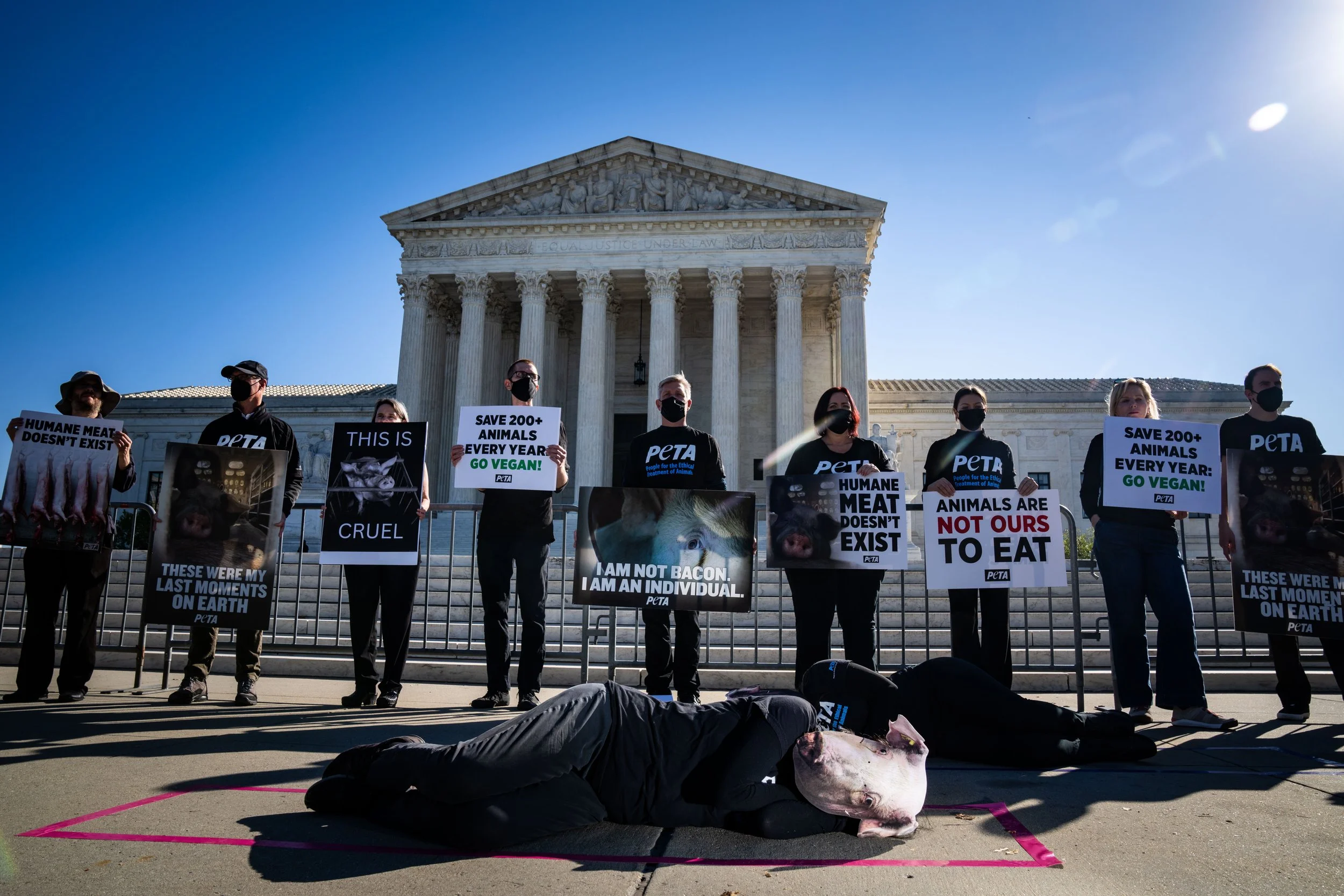
Knowledge of the inhumane practices of many farming establishments is becoming more widespread, but unfortunately, there is a lack of federal legislation protecting livestock. This problem has not gone unnoticed by the state of California, which has a history of passing protective legislation for farm animals. However, a recent lawsuit concerning the state’s most comprehensive farm animal welfare law, Proposition 12, is threatening to upend important animal welfare advancements, jeopardize public health, and call into question the sovereignty of the states. As a result, the justices of the Supreme Court, who are currently deciding the case, must consider their decision carefully, as its consequences could be significant and widespread.
While Proposition 12 is currently California’s strongest farm animal protection law, the state previously passed other laws that gradually increased the rights of animals raised within and, in some cases, outside of its borders. Proposition 2, also known as the Prevention of Cruelty to Farm Animals Act, was passed in 2008 and required California livestock producers to raise hens, sows, and veal calves in enclosures that gave them enough room to stand up, lie down, turn around, and stretch their limbs without hitting the sides of their cage. [1] While it may seem like a bare-minimum requirement, livestock producers were permitted before Proposition 2 to utilize far more extreme confinement practices, so this step was important in securing improved farm animal welfare in the state. Later, in 2010, the California legislature passed Assembly Bill 1437, which outlined that all eggs sold in the state needed to be produced in compliance with the standards set by Proposition 2. [2] This enactment heightened California’s standards regarding animal welfare, specifically for the millions of hens impacted by the law’s provisions. [3] More recently, in 2018, California voters passed Proposition 12, which some consider to be the nation’s most powerful farm animal welfare law to date. [4] This law sets standards on the minimum amount of square footage egg-laying hens, sows, and veal calves are required to have within their enclosures if producers wish to sell the animal products derived from them in California. [5] This was an improvement over the less straightforward requirements under Proposition 2 that did not specify measurement-based standards. [6] Proposition 12 also now requires all egg-laying hen producers selling eggs in California to have cage-free facilities. [7]
Producers selling relevant animal products in California were required to comply with Proposition 12’s square footage provisions for chicken and veal by January 1, 2020, and the cage-free facility requirement for chickens on January 1, 2022. [8] However, the square footage requirement for sows, which was also supposed to go into effect on January 1, 2022, is currently not being enforced due to the significant backlash against it. More specifically, one of the barriers to enforcement has been a lawsuit, National Pork Producers Council v. Ross, filed in December 2019 by the National Pork Producers Council (NPCC), a trade association representing the U.S. pork industry. [9] The NPCC argued in their complaint that Proposition 12 violates the dormant Commerce Clause, which is used to prevent states from passing legislation that “discriminates against or excessively burdens interstate commerce.” [10] In other words, the NPCC is arguing that Proposition 12 unduly burdens out-of-state pork producers who sell their products in California by requiring them to comply with the heightened standards. The defendants in the case are the Secretary of the California Department of Food and Agriculture, the Director of the California Department of Public Health, and the California Attorney General. [11]
The history of the case is as follows: the district court dismissed the lawsuit, concluding that the petitioner did not show that Proposition 12 violates the Constitution, and the U.S. Court of Appeals for the Ninth Circuit affirmed the district court’s decision. [12] The U.S. Supreme Court agreed to hear the case, which was argued on October 11, 2022, and as of now, the case is still pending. [13]
The implications of this decision will undoubtedly be significant in many ways. If the Court affirms, it would be a considerable win for animal welfare in the nation. By placing the well-being of the animals impacted by Proposition 12 over the capitalistic desires of the pork industry, the Court would be showing the movement of the judiciary, as well as the rest of the government, toward a stance of greater support for animal welfare. The decision would set a precedent that could lead to further improvements in this domain, advancing the nation’s support for the humane treatment of animals.
Moreover, the Ross decision could impact public health by affecting livestock-raising practices. Laws improving farm animal welfare standards could change the typical operational practices on many livestock farms, which, due to the often high numbers of animals they confine in extremely small spaces, may contribute to a variety of safety-related issues. For example, large livestock operations, often called “factory farms,” contribute to air pollution, the contamination of water resources, and the spread of pathogens that may cause disease. [14] Furthermore, improving animal welfare standards could reduce the reliance of livestock producers on antibiotics by potentially changing unsanitary farming practices, which would be an important step in combating the antibiotic resistance crisis currently facing our world. [15]
However, some individuals have expressed concerns about the ramifications of upholding Proposition 12 on interstate commerce in general, arguing that the law could be followed by protectionist legislation impeding trade across state or national borders. [16] For example, Justice Amy Coney Barrett asked if California could pass a law prohibiting the sale of pork from companies that do not require their employees to be vaccinated, and Justice Elena Kagan argued that states could make immigration policies through laws like Proposition 12. [17] Nevertheless, in the words of animal welfare activist Steven Wise, this type of “slippery-slope argument” is commonplace in the legal world, and at the end of the day, the Court needs to focus on the issue at hand: the degree to which California can regulate animal products sold within its borders. [18]
To help determine whether or not Proposition 12 is constitutional, the Court seems to be leaning toward using the Pike Balancing Test, which outlines that a law is not permissible if, while effectuating a local public interest, it unduly burdens interstate commerce. [19] Unfortunately, weighing the relative merits of local interests and the interests regarding interstate commerce in such cases presents a considerable challenge, as it is an inherently subjective process. There is no easy, objective answer to the question of how a state can regulate the products sold within its borders. To complicate matters further, the particular local interest at stake in this case is unclear, as the law was passed through a ballot initiative. For example, a local interest in protecting public health by implementing confinement space standards would likely be more heavily weighted than a local interest in raising livestock in a more morally-sound manner, but it is not definite which of these interests is the most substantial underpinning of Proposition 12. [20]
In the end, the ruling for National Pork Producers Council v. Ross will undoubtedly have major ramifications in the livestock industry and beyond. The Supreme Court should heavily consider the consequences of striking down Proposition 12, not only in terms of morality and public health but also in terms of state sovereignty. The dormant Commerce Clause is intended to prevent protectionism and discriminatory interstate economic practices, but not to overly restrict the actions of the states. [21] The word of the California voters cannot be ignored without diligent deliberation, and when one considers the importance of treating animals humanely and protecting the health of the public, an affirmation by the Court seems like the correct decision.
Notes:
“Proposition 2: Treatment of Farm Animals,” California Legislative Analyst's Office, July 17, 2008, https://lao.ca.gov/ballot/2008/2_11_2008.aspx.
Cal. Health & Safety Code § 25995-25997 (2010)
“Commodity Fact Sheet: California Egg Industry Association,” California Foundation for Agriculture in the Classroom, August 2022, https://cdn.agclassroom.org/ca/resources/fact/eggs.pdf.
Ashley Chang, “This Is What Prop 12 Means For Animals,” The Humane League, October 13, 2021, https://thehumaneleague.org/article/prop-12.
Proposition 12, Cal. Health & Safety Code § 25990-25994 (2022)
Cal. Health & Safety Code § 25990-25994
Cal. Health & Safety Code § 25990-25994
Jana Caracciolo, “What Is Going on with Prop 12?,” National Agricultural Law Center, December 2, 2022, https://nationalaglawcenter.org/what-is-going-on-with-prop-12/.
“California Proposition 12 Resource Hub,” National Pork Producers Council, April 10, 2023, https://nppc.org/ca-prop-12/.
“Commerce Clause,” Legal Information Institute (Cornell Law School, July 2022), https://www.law.cornell.edu/wex/commerce_clause.; “National Pork Producers Council v. Ross." Oyez. Accessed April 21, 2023. https://www.oyez.org/cases/2022/21-468.
“National Pork Producers Council v. Ross,” Oyez, Accessed April 21, 2023, https://www.oyez.org/cases/2022/21-468.
Oyez, “National Pork Producers Council v. Ross.”
Oyez, “National Pork Producers Council v. Ross.”
“Other Health Risks of the Meat Industry,” PETA, June 3, 2014, https://www.peta.org/issues/animals-used-for-food/health-risks-meat-industry/.
“Stop Using Antibiotics in Healthy Animals to Preserve Their Effectiveness,” World Health Organization (World Health Organization, November 7, 2017), https://www.who.int/news/item/07-11-2017-stop-using-antibiotics-in-healthy-animals-to-prevent-the-spread-of-antibiotic-resistance.
Rich Barlow, “Your Bacon Shouldn't Be the Product of Animal Cruelty, Says Animal Rights Activist and LAW Alum,” Boston University, December 1, 2022, https://www.bu.edu/articles/2022/supreme-court-case-banning-inhumane-confinement/.
“Transcript of Oral Argument: National Pork Producers Council v. Ross,” Oyez, Accessed April 21, 2023, https://www.oyez.org/cases/2022/21-468.
Barlow, “Animal Rights Activist.”
Pike v. Bruce Church, Inc., 397 U.S. 137, 142 (1970).
Oyez, “Transcript of Oral Argument.”
Elizabeth Wydra, Brian Frazelle, and Brianne Gorod, “National Pork Producers Council v. Ross,” Constitutional Accountability Center, October 12, 2022, https://www.theusconstitution.org/litigation/national-pork-producers-council-v-ross/.
BIBLIOGRAPHY:
Barlow, Rich. “Your Bacon Shouldn't Be the Product of Animal Cruelty, Says Animal Rights Activist and LAW Alum.” Boston University, December 1, 2022. https://www.bu.edu/articles/2022/supreme-court-case-banning-inhumane-confinement/.
“California Proposition 12 Resource Hub.” National Pork Producers Council, April 10, 2023. https://nppc.org/ca-prop-12/.
Caracciolo, Jana. “What Is Going on with Prop 12?” National Agricultural Law Center, December 2, 2022. https://nationalaglawcenter.org/what-is-going-on-with-prop-12/.
Chang, Ashley. “This Is What Prop 12 Means For Animals.” The Humane League, October 13, 2021. https://thehumaneleague.org/article/prop-12.
“Commerce Clause.” Legal Information Institute. Cornell Law School, July 2022. https://www.law.cornell.edu/wex/commerce_clause.
“Commodity Fact Sheet: California Egg Industry Association.” California Foundation for Agriculture in the Classroom, August 2022. https://cdn.agclassroom.org/ca/resources/fact/eggs.pdf.
“Stop Using Antibiotics in Healthy Animals to Preserve Their Effectiveness.” World Health Organization. World Health Organization, November 7, 2017. https://www.who.int/news/item/07-11-2017-stop-using-antibiotics-in-healthy-animals-to-prevent-the-spread-of-antibiotic-resistance.
“Other Health Risks of the Meat Industry.” PETA, June 3, 2014. https://www.peta.org/issues/animals-used-for-food/health-risks-meat-industry/.
“Proposition 2: Treatment of Farm Animals.” California Legislative Analyst's Office, July 17, 2008. https://lao.ca.gov/ballot/2008/2_11_2008.aspx.
Wydra, Elizabeth, Brian Frazelle, and Brianne Gorod. “National Pork Producers Council v. Ross.” Constitutional Accountability Center, October 12, 2022. https://www.theusconstitution.org/litigation/national-pork-producers-council-v-ross/.
The Role of Power in Impeding Justice
By: Isabel Niemer
Edited By: alexandra dickerman and emily yang
Many of the major issues in law can be traced back to the reason for its existence— human nature. Law is distinctly human, leading its problems to reflect the problems of humans on an individual and a group scale. In On the Genealogy of Morality, Nietzsche hypothesizes that human nature is oriented towards wanting power.[1] Nietzsche explains that the fulfillment of this innate desire is what separates the aristocrats of society from the common folk. Whether or not you believe that this desire for power is morally sound, the desire certainly exists for many. This unquenchable thirst for power and consequential separation of the powerful from the powerless can be seen in the inequality of the judgments of our laws. This unequal footing leads to our society falling short of justice, which I believe is the biggest legal issue of today.
The dichotomy of the powerful versus the powerless can be seen in both the social construction of race and interest convergence. The movement in and out of race categories corresponds with the changing of power dynamics. When certain people are grouped into a more powerful race, they enjoy the privileges of that race. In law, this could mean fewer convictions, more sympathy from jurors, or less surveillance. These advantages are what keep racism baked into society. The powerful are the only ones who can change the laws and systems, but they have disincentives to make these changes. Inequality is easy to brush over when power is at stake. Additionally, this racism that is prevalent in law has ramifications beyond individual judgments. Higher criminalization of Black men leads to higher surveillance of Black neighborhoods, and this pattern reinforces itself.[2] It destroys Black families and communities, which reinforces the power of white people in American society.
Racism can also impact justice through the juror selection process, which can be seen in the case of Andre Thomas.[3] Thomas, a Black man, killed his white wife and their two children in a schizophrenic break and subsequently gouged his eyes out and attempted to kill himself. Three of the selected jurors for Thomas’ case were openly against interracial marriage, and Thomas has been on death row since his conviction. As can be seen in this case and others, the presence of racist inclinations, which ultimately stem from power dynamics, can lead to the difference between life or death.
Another example of the unequal footing of law can be found in legal disputes involving big corporations and smaller entities. In theory, the courtroom should be an equal playing field for both parties involved. In practice, though, the party with the most power often has a much greater chance of winning these disputes.[4] With increased power comes increased intelligence, familiarity with the court system, and rules tailored to one’s particular needs. This inequality leads to judgments skewing heavily in favor of big corporations, further reinforcing their power and impeding justice.
For example, when Mattel’s toys were found to have lead in them, Mattel lobbied for Congress to impose expensive lead testing upon all toymakers.[5] While this seemed like a good deed, Mattel really wanted to push small toymakers out of the market. Congress then stipulated that these requirements would not apply to toymakers that make less than 7,500 toys per year. This stipulation protected small toymakers, but still ultimately helped Mattel by discouraging toymakers from growing their business and becoming serious competitors.
In situations where the legal system cannot adequately tackle injustice, power imbalances can become further normalized without reprimand. One example lies in sexual harassment cases; because there is not often sufficient evidence or incentive to file these cases, 99.8% of people who experience sexual harassment in the workplace never do.[6] This leads to little incentive for those in power to follow the law. The power imbalance between bosses and workers thus is often heightened to illegal levels, and as a result, justice will likely never be achieved until sexual harassment in the workforce is addressed properly.
Subjectivity is especially present in sexual harassment cases, where judges are often able to mold what is considered “severe and pervasive” and even throw out cases. For example, a court dismissed a sexual harassment case where a boss threatened to rape a worker multiple times and talked about his genitals.[7] The court reasoned because these comments occurred over a 10 day period, they could not classify the harassment as “pervasive.” We have to check the power of both bosses and judges to help those who have been sexually harassed get the justice they deserve.
To keep human nature in law, subjectivity is inevitable. This subjectivity allows for nuance in judgments, which is often necessary to come to the right conclusion in cases. However, many factors play a role in preventing objectivity, which is necessary for true justice, in judgments. Many of these hindrances to objectivity stem from imbalances of power. This power arises from human nature, so it would be massively overambitious to try to eliminate power dynamics altogether. But like us, law should attempt to right its wrongs, minimize missteps, and continuously strive for self-improvement.
Notes:
1. Friedrich Nietzsche, Kieth Ansell-Pearson, and Carol Diethe, ‘On the Genealogy of Morality’ and Other Writings, (Cambridge: Cambridge University Press, 2017).
2. William J. Chambliss, “Policing the Ghetto Underclass: The Politics of Law and Law Enforcement,” Social Problems 41, no. 2 (May 1994): 177-94.
3. Ella Wiley, “How Racism in the Courtroom Produces Wrongful Convictions and Mass Incarceration,” Legal Defense Fund, July 20, 2022, https://www.naacpldf.org/judicial-process-failures/.
4. Marc Galanter, “Why the ‘Haves’ Come out Ahead: Speculations on the Limits of Legal Change,” Law & Society Review 9, no. 1 (Autumn, 1974): 95-160.
5. John Stossel, “How Big Business Uses Big Government to Kill Competition,” Reason, July 7, 2021, https://reason.com/2021/07/07/how-big-business uses-big-government-to-kill-competition/.
6. Carly McCann, Donald Tomaskovic-Devey, & M.V. Lee Badgett, “Employer’s Responses to Sexual Harassment”, UMass Amherst, https://www.umass.edu/employmentequity/employers-responses-sexual-harassment.
7. Yuki Noguchi, “Sexual Harassment Cases Often Rejected by Courts,” NPR, November 28, 2017, https://www.npr.org/2017/11/28/565743374/sexual harassment-cases-often-rejected-by-courts.
BIBLIOGRAPHY:
Chambliss, William J. “Policing the Ghetto Underclass: The Politics of Law and Law Enforcement.” Social Problems 41, no. 2 (1994): 177–94. https://doi.org/10.2307/3096929.
Galanter, Marc. “Why the ‘Haves’ Come out Ahead: Speculations on the Limits of Legal Change.” Law & Society Review 9, no. 1 (1974): 95–160. https://doi.org/10.2307/3053023.
McCann, Carly, Donald Tomaskovic-Devey, and M.V. Lee Badgett. “Employer’s Responses to Sexual Harassment”, UMass Amherst, https://www.umass.edu/employmentequity/employers-responses-sexual-harassment.
Nietzsche, Friedrich, Keith Ansell-Pearson, and Carol Diethe. 'On the Genealogy of Morality' and Other Writings. Cambridge: Cambridge University Press, 2017.
Noguchi, Yuki. “Sexual Harassment Cases Often Rejected by Courts.” NPR, November 28, 2017. https://www.npr.org/2017/11/28/565743374/sexual-harassment-cases-often rejected-by-courts.
Stossel, John. “How Big Business Uses Big Government to Kill Competition.” Reason.com, July 7, 2021. https://reason.com/2021/07/07/how-big-business-uses-big-government-to-kill competition/.
Wiley, Ella. “How Racism in the Courtroom Produces Wrongful Convictions and Mass Incarceration.” Legal Defense Fund, November 22, 2022. https://www.naacpldf.org/ judicial-process-failures/.