

THE FORUM: NORTHWESTERN’S PREMIER LEGAL BLOG

Supreme Court Hears Trump’s Plea on Colorado Ballot
By: Jaenney Lee
Edited by: Grace Wu and Ananya Chag
The Supreme Court of the United States (SCOTUS) has agreed to review the decision of the Colorado Supreme Court to remove Donald Trump from Colorado’s primary election, due to his role in encouraging an attack on the U.S. Capitol on Jan. 6, 2021, after losing the 2020 general election. Legal scholars and state election officials are urging for a fast process of states following the same policy before the 2024 primary voting. Colorado and Maine have therefore temporarily paused their decisions to bar Trump as a candidate as they need to make a legal decision. This means that former President Trump will be written on the primary ballots until there are clear legal decisions from the Supreme Court. The ballots will be mailed to the majority of voters in Colorado starting Feb. 12 — four days after the justices hear arguments. This trial is particularly important as Colorado is considered a “swing” state. [1]
Lawyers for the former President must submit written arguments by Thursday, Jan. 18, must reply by Monday, Feb. 5, and the State of Colorado must reply by Wednesday, March 31. Oral arguments will take place on Thursday, Feb. 8 at the Supreme Court in Washington, D.C.[2]
According to the recent brief written on Jan. 26 by the lawyers of the Colorado voters, Colorado voters are actively arguing that former President Trump should be barred from holding federal office as he has a history of engaging in violent acts in the Capitol. The lawyers of these voters argue that Trump “intentionally organized and incited a violent mob to attack the United States Capitol in a desperate attempt to prevent the counting of electoral votes cast against him.” Furthermore, the lawyers stated that “by spearheading this attack, Trump engaged in insurrection against the Constitution."[3]
The brief questions whether Section 3 of the 14th Amendment, which bars those who have “engaged in insurrection,” applies to President Trump and if that impacts his position as a candidate. The case overall raises legal questions: such as whether the constitutional language applies to those running for the presidential election and how and who would decide whether someone engaged in the “insurrection.”[4]
On the other hand, in Trump’s own brief on Jan. 18, his lawyers outlined the reasons as to why they believe the Colorado court ruling was wrong. They cite language in the constitutional provision arguing that the law is only applicable to individuals who hold an officer position in the United States. Particularly, they argue that Section 3 applies only to a person who would “hold” office, not “run” the office. They follow up by stating that being the president is not part of being an officer of the United States. Trump’s lawyers wrote, “The court should put a swift and decisive end to these ballot-disqualification efforts, which threaten to disenfranchise tens of millions of Americans.” [5]
Lastly, whether Trump can assert immunity from criminal prosecution for election subversion connected to the 2020 presidential election is one of the other debated issues that will likely come up soon.
Long before Trump’s trial was set for March, special counsel Jack Smith attempted to convince the Supreme Court to hear arguments regarding the immunity claim. The December request was rejected by the Supreme Court justices, and, as a result, on Jan. 9, the U.S. appellate court heard arguments over Trump’s eligibility for immunity for alleged crimes committed while in office.[5]
The decision is coming around soon, and, when the time comes, the Supreme Court’s final resolution will aim to represent justice.
Notes:
Marimow, Ann E, and Patrick Marley. 2024. “Supreme Court Says It Will Decide If Trump Qualifies for Colorado Ballot.”
Anderson. 2024. “Trump v. Anderson - SCOTUSblog.” 2024
In the Supreme Court of the United States.“BRIEF ON THE MERITS FOR ANDERSON RESPONDENTS,” January 26 2024.
Hurley, Lawrence. 2024. “Colorado Voters Insist to Supreme Court That Trump Should Be Ineligible in 2024.” January 26th.
In the Supreme Court of the United States “BRIEF FOR THE PETITION,” January 18, 2024.
Joan Biskupic. 2024. “The Conservative Legal World Lines up Behind Donald Trump at the Supreme Court.”
Bibliography:
Anderson. 2024. “Trump v. Anderson - SCOTUSblog.” SCOTUSblog. 2024.
Hurley, Lawrence. 2024. “Colorado Voters Insist to Supreme Court That Trump Should Be Ineligible in 2024.” NBC News. NBC News. January 26, 2024.
In the Supreme Court of the United States DONALD J. TRUMP, Petitioner, v. NORMA ANDERSON, ET AL., Respondents, “BRIEF ON THE MERITS FOR ANDERSON RESPONDENTS,” January 26 2024.
In the Supreme Court of the United States DONALD J. TRUMP, PETITIONER v. NORMA ANDERSON, ET AL., RESPONDENTS “BRIEF FOR THE PETITION,” January 18, 2024.
Joan Biskupic. 2024. “The Conservative Legal World Lines up behind Donald Trump at the Supreme Court.” CNN. CNN. January 26, 2024.
Marimow, Ann E, and Patrick Marley. 2024. “Supreme Court Says It Will Decide If Trump Qualifies for Colorado Ballot.” Washington Post. The Washington Post. January 5, 2024.

Immigrant Rights and the Resurgence of Noncitizen Voting in the United States
By: Morgan Dreher
Edited by: Samantha yip and Claire Quan
What are the requirements to vote in the United States? Citizenship is likely one of the first qualifications you consider, but for the majority of U.S. history, this has not been the case. Noncitizen voting was permitted in 40 states up until the early twentieth century, even in federal elections in some cases. [1] This served many purposes, such as encouraging immigrants to move to the South for labor or incentivizing them to join the military. [2] However, an influx of Southern and Eastern European immigrants between 1880 and 1910 increased anti-immigration sentiment and the overturning of policies permitting noncitizen voting. [3] The exclusion of noncitizens from the voting process was formalized with the Illegal Immigration Reform and Immigrant Responsibility Act of 1996 (IIRIRA), which criminalized noncitizens’ voting in federal elections. [4] However, since 2018, a resurgence of noncitizen voting has emerged in certain municipalities within California, Vermont, Maryland, and the District of Columbia. [5] This divergence from the country’s recent norm has resulted in much political and legal discourse and raises broader philosophical questions amidst a period of immigration crises and impending elections.
So what exactly does noncitizen voting constitute? In its current form, it refers to municipalities in the United States that allow people without citizenship to vote in school boards and/or local elections. [6] Noncitizen voting in federal elections remains illegal due to IIRIRA, but decisions regarding local elections are reserved for the states. With the possibility of noncitizens voting back in the picture, the subject is contentious as we reconsider immigrant rights.
Rather than being divided along partisan lines, the issue of noncitizen voting elicits widespread public concern and intrigue of its radical nature. [7] Nonetheless, proponents and opponents of noncitizen voting each possess complex arguments regarding its legality and political implications. For example, many arguments regarding noncitizen voting are rooted in different interpretations of state constitutions, which can be the basis for creating and overturning noncitizen voting policies. Essentially, many constitutions declare citizens can vote but do not explicitly specify that only citizens can vote. This was the case for New York City, where a law was passed affirming noncitizens’ rights to vote for mayor and City Council. New York City would have been the largest US city to incorporate noncitizen voting, but Justice Ralph J. Porzio ruled that this law contradicted the state constitution, interpreting citizenship to be a requirement for all voters. [8] Because similar arguments can be made in many states and government officials recognize their convoluted nature, legislators in states such as Alabama, Colorado, and Florida are making efforts to amend their state constitutions so that a citizenship requirement for voting is more explicitly stated. [9]
Another legal argument is the applicability of the Equal Protection Clause of the Fourteenth Amendment to immigrant rights. In 1982, the Supreme Court ruled in Plyler v. Doe that illegal immigrant classifications should be held to a rational-basis standard of review, rather than the strict scrutiny standard applied to legal immigrants. [10] While some argue everyone within US jurisdiction deserves the protection of the Constitution, the majority opinion in Plyler v. Doe believed those entering the US without permission should be prepared to deal with the consequences of their actions. Plyler v. Doe allotted more power to the states to determine the rights of undocumented immigrants and has since been used as the basis for other court cases that have decreased the rights of the undocumented population. [11]
While interpretation of the law grounds many debates, other arguments are heavily based on ideological standpoints. To understand these perspectives, it is beneficial to start with supporters of noncitizen voting rights, who used their arguments to bring back policies that have been obsolete since the early twentieth century. First, one of the most popularized justifications refers to the American principle of “no taxation without representation.” This argument highlights a logical disconnect between the 25 million people living in the US who are paying taxes and contributing to society but lack representation in elections. [12] Along these same lines is the idea that permitting noncitizens to vote allows for a more holistic representation of the population in city elections, which is increasingly relevant for cities with growing immigrant populations. [13]
Furthermore, Ron Hayduk of San Francisco State University states another argument on historical precedent, referencing how “the idea that noncitizens should have the vote is older and has been practiced longer than the idea that they should not.” [14] Additionally, proponents reason that voting increases the stakes and sense of belonging for noncitizen voters, meaning they will be more interested in seeking citizenship. [15]
Another set of supporting arguments exists in the realm of social justice, given that the disenfranchisement of noncitizens is a loss of rights. Some argue that not only is preventing noncitizens from voting discriminatory, but it also opens the door for other discriminatory public policies in the future as noncitizen voices go unheard. [16] Hayduk also makes this claim based on the idea that politicians will not fear retribution from noncitizens via the polls, enabling them to enact discriminatory policies. [17] Lastly, another equity concern is that the process of naturalization is lengthy and difficult, meaning it is an unjust requirement for representation in elections. [18] In summary, proponents of noncitizen voting, as stated by scholar Cristina M. Rodríguez, believe that “the core substantive principle of democracy is that those subject to the law should have a voice in its formulation.” [19]
On the other side, opponents to noncitizen voting are aptly ready to dispute supporting arguments. The New York Post writes that acquiring citizenship “is a vital acceptance of duties as well as privileges,” meaning that to receive the benefits of citizenship, one must also take on the accompanying responsibilities. [20] It quickly becomes evident that this concept of citizenship is an important value for opponents and grounds most of their arguments. One of the most prevalent beliefs on this side is that noncitizen voting will take away the incentive for people to seek citizenship, in turn resulting in less national unity and “diminish[ing] the voting power of citizens.” [21] Overall, opponents see citizenship as a core American value, which incurs much of its meaning from voting privileges. Rodríguez acknowledges this accordingly, discussing how while there are many mechanisms for the integration and incorporation of immigrants, voting is central to defining citizenship. [22]
Other, less common perspectives include the idea that noncitizen voting could lead to confusion, where noncitizens surpass voting barriers and accidentally vote in federal elections. [23] Furthermore, some opponents feel that once noncitizens receiving social welfare benefits are enfranchised, they will have the main advantage of citizenship and no desire to leave welfare behind. [24] In general, contrary to supporting arguments that promote the universal benefits of noncitizen voting, critics see these same policies as a threat to integral American ideals. Connecticut Representative Vincent Candelora even went as far as to say that “opening up elections to non-citizens completely erodes our sovereignty in this country and in our state.” [25]
Given that the restoration of noncitizen voting policies is a recent phenomenon, it is possible that public opinion will shift after analysis is released regarding upcoming elections. Only time will tell the real impact that noncitizen voting has on its permitted localities, but its impact could be significant enough to change the course of elections. [26] For example, a study of the 2008 election revealed that noncitizen voting likely affected the electoral college results, contributing to Obama’s North Carolina victory. [27] While this is an example of a federal election and noncitizens who surpassed existing voting barriers, it showcases the potential power noncitizens have to alter election results.
Ultimately, the topic of noncitizen voting is controversial and evolving as new policies are passed and state constitution amendments are approved. Legal changes, along with upcoming elections and US demographic shifts, will likely bring further public attention to the topic of noncitizen voting. While the issue itself is relevant and debatable, it also evokes fundamental questions about the United States. What does it mean to be a citizen? To what extent do immigrants have rights in the US? Do newer or older principles take precedence in political debates? As what once was considered a country of immigrants, we must now face these questions about where we stand on the rights of all immigrants, not just those who are US citizens.
Notes:
Matt Vasilogambros, “Noncitizens Are Slowly Gaining Voting Rights,” Stateline.org, 2021. https://stateline.org/2021/07/01/noncitizens-are-slowly-gaining-voting-rights/.
Ron Hayduk, “Chapter 2,” In Democracy for all : restoring immigrant voting rights in the United States, 15-40, N.p.: Routledge, 2006. https://www.nypl.org/sites/default/files/hayduk_-_chapter_2.pdf.
Hayduk, “Chapter 2,” In Democracy for all : restoring immigrant voting rights in the United States.
“*Public Law 104–208 104th Congress An Act,” GovInfo, 1996. https://www.govinfo.gov/content/pkg/PLAW-104publ208/pdf/PLAW-104publ208.pdf.
“Arguments for and against laws permitting noncitizens to vote in the United States,” n.d. Ballotpedia, Accessed January 26, 2024. https://ballotpedia.org/Arguments_for_and_against_laws_permitting_noncitizens_to_vote_in_the_United_States.
Alison Cross, “Republicans Voice Outrage Over Non-Citizen Voting Bill,” Governing, 2023. https://www.governing.com/now/republicans-voice-outrage-over-non-citizen-voting-bill.
Nicholas Goldberg, “Is It Time to Let Noncitizens Vote in Local Elections? Some Americans Think that’s Just Nutty,” Governing, 2023. https://www.governing.com/politics/is-it-time-to-let-noncitizens-vote-in-local-elections-some-americans-think-thats-just-nutty.
Jeffery C. Mays, “New York City's Noncitizen Voting Law Is Struck Down,” The New York Times, 2022. https://www.nytimes.com/2022/06/27/nyregion/noncitizen-voting-ruling-nyc.html.
Vasilogambros, “Noncitizens Are Slowly Gaining Voting Rights.”
Jason H. Lee, “Unlawful Status as a Constitutional Irrelevancy: The Equal Protection Rights of Illegal Immigrants,” Golden Gate University Law Review 39, no. 1 (Fall): 1-40, 2008. https://heinonline.org/HOL/P?h=hein.journals/ggulr39&i=3.
Lee, “Unlawful Status as a Constitutional Irrelevancy: The Equal Protection Rights of Illegal Immigrants.”
Goldberg, “Is It Time to Let Noncitizens Vote in Local Elections? Some Americans Think that’s Just Nutty.”
Hayduk, “Chapter 2,” In Democracy for all : restoring immigrant voting rights in the United States.
Hayduk, “Chapter 2,” In Democracy for all : restoring immigrant voting rights in the United States.
“Arguments for and against laws permitting noncitizens to vote in the United States.”
“Arguments for and against laws permitting noncitizens to vote in the United States.”
“Arguments for and against laws permitting noncitizens to vote in the United States.”
Goldberg, “Is It Time to Let Noncitizens Vote in Local Elections? Some Americans Think that’s Just Nutty.”
Cristina M. Rodríguez, “Noncitizen voting and the extraconstitutional construction of the polity,” International Journal of Constitutional Law 8, no. 1 (January): 30-49, 2010. https://doi.org/10.1093/icon/mop032.
“Arguments for and against laws permitting noncitizens to vote in the United States.”
Mays, “New York City's Noncitizen Voting Law Is Struck Down.”
Rodríguez, “Noncitizen voting and the extraconstitutional construction of the polity.”
Vasilogambros, “Noncitizens Are Slowly Gaining Voting Rights.”
Arguments for and against laws permitting noncitizens to vote in the United States.”
Cross, “Republicans Voice Outrage Over Non-Citizen Voting Bill.”
Jesse T. Richman, Guishan A. Chattha, and David C. Earnest, “Do Non-Citizens Vote in U.S. Elections?” ODU Digital Commons, 2014. https://digitalcommons.odu.edu/cgi/viewcontent.cgi?article=1011&context=politicalscience_geography_pubs.
Richman, Chattha, and Earnest, “Do Non-Citizens Vote in U.S. Elections?
Bibliography:
“Arguments for and against laws permitting noncitizens to vote in the United States.” n.d. Ballotpedia. Accessed January 26, 2024. https://ballotpedia.org/Arguments_for_and_against_laws_permitting_noncitizens_to_vote_in_the_United_States.
Cross, Alison. 2023. “Republicans Voice Outrage Over Non-Citizen Voting Bill.” Governing. https://www.governing.com/now/republicans-voice-outrage-over-non-citizen-voting-bill.
Goldberg, Nicholas. 2023. “Is It Time to Let Noncitizens Vote in Local Elections? Some Americans Think that’s Just Nutty.” Governing. https://www.governing.com/politics/is-it-time-to-let-noncitizens-vote-in-local-elections-some-americans-think-thats-just-nutty.
Hayduk, Ron. 2006. “Chapter 2.” In Democracy for all : restoring immigrant voting rights in the United States, 15-40. N.p.: Routledge. https://www.nypl.org/sites/default/files/hayduk_-_chapter_2.pdf.
“Laws permitting noncitizens to vote in the United States.” n.d. Ballotpedia. Accessed January 26, 2024. https://ballotpedia.org/Laws_permitting_noncitizens_to_vote_in_the_United_States.
Lee, Jason H. 2008. “Unlawful Status as a Constitutional Irrelevancy: The Equal Protection Rights of Illegal Immigrants.” Golden Gate University Law Review 39, no. 1 (Fall): 1-40. https://heinonline.org/HOL/P?h=hein.journals/ggulr39&i=3.
Mays, Jeffery C. 2022. “New York City's Noncitizen Voting Law Is Struck Down.” The New York Times. https://www.nytimes.com/2022/06/27/nyregion/noncitizen-voting-ruling-nyc.html.
“*Public Law 104–208 104th Congress An Act.” 1996. GovInfo. https://www.govinfo.gov/content/pkg/PLAW-104publ208/pdf/PLAW-104publ208.pdf.
Richman, Jesse T., Guishan A. Chattha, and David C. Earnest. 2014. “Do Non-Citizens Vote in U.S. Elections?” ODU Digital Commons. https://digitalcommons.odu.edu/cgi/viewcontent.cgi?article=1011&context=politicalscience_geography_pubs.
Rodríguez, Cristina M. 2010. “Noncitizen voting and the extraconstitutional construction of the polity.” International Journal of Constitutional Law 8, no. 1 (January): 30-49. https://doi.org/10.1093/icon/mop032.
Vasilogambros, Matt. 2021. “Noncitizens Are Slowly Gaining Voting Rights.” Stateline.org. https://stateline.org/2021/07/01/noncitizens-are-slowly-gaining-voting-rights/.

Should Bump Stocks be Legal?
By: Maddy Goldman
Edited by: Isabella Canales and Claire Quan
Gun rights have long been a topic of debate in the United States. While the Second Amendment guaranteed the right to bear arms in the 1700s, technology has since rapidly developed. The creation of new weapons, necessitated new legislation limiting the Second Amendment. One major limitation was placed on the legality of machine guns. Since they are much deadlier than regular, non-automatic guns, machine guns are banned in the United States. While this may seem like a relatively straightforward prohibition, the line can easily become blurred. The invention of a “bump stock” device has increasingly blurred the lines between gun rights and ownership, calling for intervention by the Supreme Court.
On October 1, 2017, Stephen Paddock opened fire at a country music festival in Las Vegas. [1] In the span of only a few minutes, Paddock killed over 50 people. [2] He was able to cause such devastating harm by using a device known as a “bump stock.” A bump stock can be placed onto any gun, essentially endowing it with machine gun-like capabilities: it “causes a gun’s trigger to buck against the shooter’s finger while the gun’s recoil makes it jerk back and forth, ‘bumping’ the trigger and causing it to fire again and again.” [4] Many were outraged at the legality of such a device and urgently called for gun reform. By December 2018, the Trump Administration’s Federal Bureau of Alcohol, Tobacco, Firearms, and Explosives (ATF) put into place a federal ban on the possession of bump stocks. That is to say, anyone who owned a bump stock in the United States either had to give it up to the government or effectively destroy it. [5] This decision was different from earlier ones, as it ruled that all bump stocks should be considered machine guns, thereby rendering them illegal. [6]
When banning these devices, the Trump administration looked to a twentieth-century federal law that made the ownership of “machine guns” illegal. [7] This law, Section 922(o)(1), states that it is “unlawful for any person to transfer or possess a machine gun.” [8] The Trump administration thus decided that bump stocks count as machine guns – and therefore, should be banned federally. The 2018 ban thus made the 20th century ban more extreme, classifying a bump stock as a machine gun.
However, recently, there have been challenges to this decision, with some, such as Michael Cargill, claiming that bump stocks should be legal. Even though bump stocks are currently banned federally, courts across the country now disagree about whether bump stocks should count as machine guns, and whether or not they should be banned.
Michael Cargill owned two bump stocks before their banning. [9] When the ATF put this ban (as discussed earlier) on bump stocks in 2018, Cargill was forced to surrender them to the government. But, rather than surrender them and move on, Cargill chose to sue the ATF. His argument focused on the issue of separation of powers. [10] He claimed that the ATF does not have the power to make such large decisions regarding gun rights. To him, the ATF did nothing more than take away over 100 million dollars of property from American bump stock owners. [11]
However, Cargill’s challenging of the ban has brought up many additional disagreements regarding the banning of bump stocks. This disagreement can be seen in the Fifth and Sixth Circuit Courts, where it was argued that bump stocks should not be prohibited under federal law. [12] The courts claimed that the definition of a machine gun does not include bump stocks. This definition, as seen in federal laws, states that any gun capable of shooting multiple bullets “automatically” and by one trigger function counts as a machine gun. [13] To them, bump stocks are merely an accessory, not a gun, and thus do not fit the category.
In addition to arguing that a bump stock does not count as a machine gun under this definition, the Sixth Circuit concluded that the “rule of lenity” applies in this case. [14] The “rule of lenity” states that courts must apply any ambiguous criminal laws in such a way that favors the defendants. [15] As mentioned earlier, bump stocks were banned under Section 922(o)(1), which makes it illegal to own a machine gun. The 2018 ban thus classified bump stocks as machine guns, making them illegal under the same law (Section 922(o)(1)). However, the Sixth Circuit argues that the federal firearm law which prohibits machine guns, does not “clearly and unambiguously prohibit bump stocks.”[16] In other words, it is ambiguous whether a bump stock classifies as a machine gun, thus calling for the “rule of lenity” to be applied. The court argues that now, in Cargill v. Garland, the Supreme Court must decide the statute in favor of the defendant, which in this case, would mean deciding that bump stocks are, in fact, legal.
Meanwhile, other courts, such as the U.S. Court of Appeals for the D.C. Circuit strongly disagreed. It believed the ban to be necessary and legal and continued to uphold the regulation interpreting Section 922(o)(1) as including a bump stock. [17] To the D.C. Circuit, a bump stock does fit under the definition. Deciding that a bump stock is still a “self-regulating mechanism that allows the shooter to shoot more than one shot through a single pull of the trigger,” the court said they can therefore classify it as a “machine gun.” [18]
It is evident that there has been much disagreement regarding what to do with the legality of bump stocks. Due to these court disagreements, as well as opposition on the basis of separation of powers and the ambiguity of the National Firearms Act, the Biden Administration petitioned the Supreme Court to take up an appeal on the Cargill case. [19]
Those in favor of the ban hope that the court finds bump stocks to count as machine guns and that their possession should be illegal everywhere in the United States. Meanwhile, those who want the ban to be lifted are hoping that, in their reconsideration of various gun laws, the court finds the ATF to have made a decision that was far beyond its authority.
It is interesting to observe who is on the Supreme Court and how this could affect this decision. Had these gun rights cases been brought to the Supreme Court before Donald Trump’s presidency, the Supreme Court would likely have ruled that bump stocks must be banned. However, now that the Supreme Court is significantly more right-leaning, there is a high chance they rule against the ban, making bump stocks legal.
In fact, if bump stocks are decided to be legal, it could be difficult to ever ban them again. [20] Due to a previous ruling in the 2022 New York State Rifle & Pistol Association v. Bruen case, it was essentially decided that the more commonly a weapon is used, the more protection it will receive from the Second Amendment. [21] If the Supreme Court allows for the possession of bump stocks, more and more gun owners would likely purchase them, thereby making them increasingly common. Once this occurs, it could be incredibly difficult to go beyond the 2022 ruling.
While no final decision has been made yet, this Supreme Court case offers up many questions. What counts as a machine gun? What happens if the Supreme Court rules bump stocks to be legal? Do bump stocks fit into a category of their own? Should a new law be made to specifically regulate and outlaw them? These are all questions that will be answered with time. For now, the case offers an opportunity for nuanced debate regarding gun rights, the Second Amendment, and the interpretation of firearm laws.
Notes:
1. Lawrence Hurley, “Supreme Court to review Trump-era ban on gun ‘bump stocks’” NBC News, November 3, 2023, https://www.nbcnews.com/politics/supreme-court/supreme-court-review-trump-era-ban-gun-bump-stocks-rcna121466
2. Lawrence Hurley, “Supreme Court to review Trump-era ban on gun ‘bump stocks’” NBC News, November 3, 2023, https://www.nbcnews.com/politics/supreme-court/supreme-court-review-trump-era-ban-gun-bump-stocks-rcna121466
3. Lawrence Hurley, “Supreme Court to review Trump-era ban on gun ‘bump stocks’” NBC News, November 3, 2023, https://www.nbcnews.com/politics/supreme-court/supreme-court-review-trump-era-ban-gun-bump-stocks-rcna121466
4. Ian Millhiser, “The Supreme Court will hear a case that could effectively legalize automatic weapons,” Vox, November 3, 2023, https://www.vox.com/scotus/2023/11/3/23943399/supreme-court-automatic-weapons-bump-stocks-gun-policy
5. “Bump Stocks,” Bureau of Alcohol, Tobacco, Firearms and Explosives, https://www.atf.gov/rules-and-regulations/bump-stocks
6. Amy Howe, “Justices take up bump stock dispute,” SCOTUSblog, November 3, 2023, https://www.scotusblog.com/2023/11/justices-take-up-bump-stock-dispute/
7. Ian Millhiser, “The Supreme Court will hear a case that could effectively legalize automatic weapons,” Vox, November 3, 2023, https://www.vox.com/scotus/2023/11/3/23943399/supreme-court-automatic-weapons-bump-stocks-gun-policy
8. “18 U.S. Code § 922 - Unlawful acts,” Legal Information Institute, https://www.law.cornell.edu/uscode/text/18/922
9. Lawrence Hurley, “Supreme Court to review Trump-era ban on gun ‘bump stocks’” NBC News, November 3, 2023, https://www.nbcnews.com/politics/supreme-court/supreme-court-review-trump-era-ban-gun-bump-stocks-rcna121466
10. Ariane de Vogue, “Supreme Court to consider challenge to federal bump stock ban,” CNN, November 3, 2023, https://www.cnn.com/2023/11/03/politics/supreme-court-bump-stocks/index.html
11. Ariane de Vogue, “Supreme Court to consider challenge to federal bump stock ban,” CNN, November 3, 2023, https://www.cnn.com/2023/11/03/politics/supreme-court-bump-stocks/index.html
12. Amy Howe, “Justices take up bump stock dispute,” SCOTUSblog, November 3, 2023, https://www.scotusblog.com/2023/11/justices-take-up-bump-stock-dispute/
13. Kalvis Golde, “Government seeks review of federal gun regulations on domestic abusers, bump stocks,” SCOTUSblog, November 3, 2023, https://www.scotusblog.com/2023/04/government-seeks-review-of-federal-gun-regulations-on-domestic-abusers-bump-stocks/
14. Amy Howe, “Justices take up bump stock dispute,” SCOTUSblog, November 3, 2023, https://www.scotusblog.com/2023/11/justices-take-up-bump-stock-dispute/
15. Amy Howe, “Justices take up bump stock dispute,” SCOTUSblog, November 3, 2023, https://www.scotusblog.com/2023/11/justices-take-up-bump-stock-dispute/
16. Amy Howe, “Justices take up bump stock dispute,” SCOTUSblog, November 3, 2023, https://www.scotusblog.com/2023/11/justices-take-up-bump-stock-dispute/
17. Kalvis Golde, “Government seeks review of federal gun regulations on domestic abusers, bump stocks,” SCOTUSblog, November 3, 2023, https://www.scotusblog.com/2023/04/government-seeks-review-of-federal-gun-regulations-on-domestic-abusers-bump-stocks/
18. Amy Howe, “Justices take up bump stock dispute,” SCOTUSblog, November 3, 2023, https://www.scotusblog.com/2023/11/justices-take-up-bump-stock-dispute/
19. Ariane de Vogue, “Supreme Court to consider challenge to federal bump stock ban,” CNN, November 3, 2023, https://www.cnn.com/2023/11/03/politics/supreme-court-bump-stocks/index.html
20. Ian Millhiser, “The Supreme Court will hear a case that could effectively legalize automatic weapons,” Vox, November 3, 2023, https://www.vox.com/scotus/2023/11/3/23943399/supreme-court-automatic-weapons-bump-stocks-gun-policy
21. Ian Millhiser, “The Supreme Court will hear a case that could effectively legalize automatic weapons,” Vox, November 3, 2023, https://www.vox.com/scotus/2023/11/3/23943399/supreme-court-automatic-weapons-bump-stocks-gun-policy
Bibliography:
Barlow, Rich. “Your Bacon Shouldn't Be the Product of Animal Cruelty, Says Animal Rights Activist and LAW Alum.” Boston University, December 1, 2022. https://www.bu.edu/articles/2022/supreme-court-case-banning-inhumane-confinement/.
“Bump Stocks,” Bureau of Alcohol, Tobacco, Firearms and Explosives, https://www.atf.gov/rules-and-regulations/bump-stocks
Calamur, Krishnadev. “Supreme Court to review Trump-era gun rule banning bump stocks,” NPR, November 3, 2023, https://www.npr.org/2023/11/03/1210516804/supreme-court-bump-stocks
De Vogue, Ariane. “Supreme Court to consider challenge to federal bump stock ban,” CNN, November 3, 2023, https://www.cnn.com/2023/11/03/politics/supreme-court-bump-stocks/index.html
“Garland V. Cargil,” Oyez, https://www.oyez.org/cases/2023/22-976
Golde, Kalvis. “Government seeks review of federal gun regulations on domestic abusers, bump stocks,” SCOTUSblog, November 3, 2023, https://www.scotusblog.com/2023/04/government-seeks-review-of-federal-gun-regulations-on-domestic-abusers-bump-stocks/
Howe, Amy. “Justices take up bump stock dispute,” SCOTUSblog, November 3, 2023, https://www.scotusblog.com/2023/11/justices-take-up-bump-stock-dispute/
Hurley, Lawrence. “Supreme Court to review Trump-era ban on gun ‘bump stocks.’” NBC News, November 3, 2023, https://www.nbcnews.com/politics/supreme-court/supreme-court-review-trump-era-ban-gun-bump-stocks-rcna121466
“18 U.S. Code § 922 - Unlawful acts,” Legal Information Institute, https://www.law.cornell.edu/uscode/text/18/922
Millhiser, Ian. “The Supreme Court will hear a case that could effectively legalize automatic weapons,” Vox, November 3, 2023, https://www.vox.com/scotus/2023/11/3/23943399/supreme-court-automatic-weapons-bump-stocks-gun-policy
Navigating the Push for D.C. Statehood
By: Alexandra Henriquez
Edited by: Connor Tooman and Jared Fischer
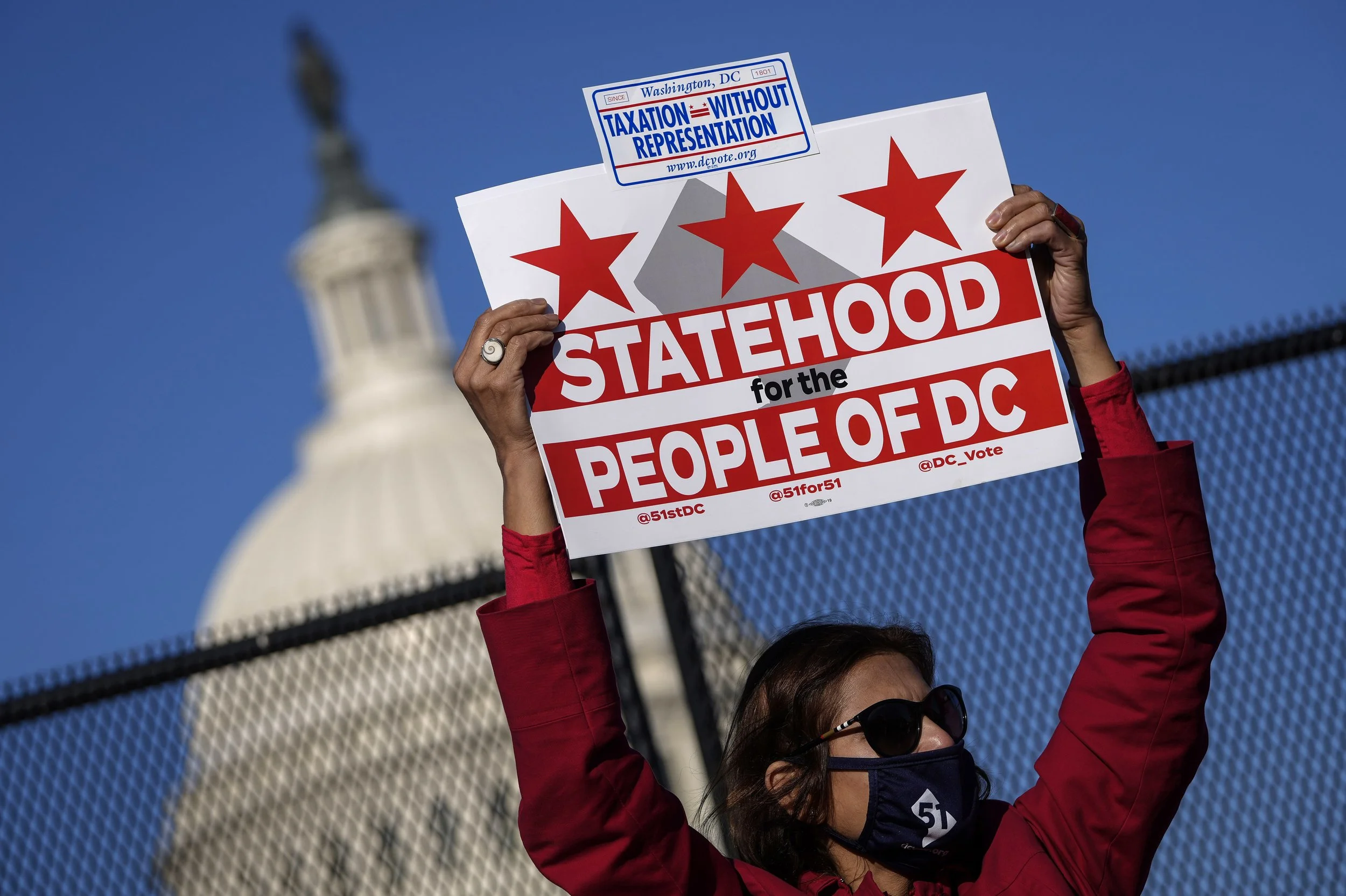
The rallying cry “No Taxation Without Representation” resoundingly marked the inception of the United States, encapsulating the core principle that ignited the drive for independence. It now, quite literally, roams the streets of the nation’s capital, Washington D.C. Since November of 2000, the D.C. license plate has projected this same phrase coined during the nation’s strive for independence. [1] For over two centuries, the United States has grappled with a stark contradiction to this foundational belief. Despite living in the heart of the nation and paying more federal taxes than individuals from many other states, Washington, D.C. residents lack full representation in Congress. Throughout the past few decades, there have been evolving movements advocating for statehood for the United States’ capital. Amid ongoing efforts for reform, the lingering question remains: will tangible change ever materialize?
Clause 17 of Article 1 Section 8 of the Constitution, also known as the “Enclave Clause” or “District Clause,” established the nation’s capital as a district “not exceeding ten miles square” independent of state control and completely under congressional jurisdiction. [2] The framers sought to ensure that state jurisdiction could not interfere with the security and functioning of the national government. The concern arose mainly from a 1783 incident under the Articles of Confederation when the Continental Congress in Philadelphia was threatened by a group of soldiers demanding monetary compensation for service. The state government refused to provide protection to Congress. [3] As a result, in July of 1790, Congress passed the Residence Act, which established Philadelphia as the temporary capital for a period of ten years. It also authorized the later creation of a new federal district along the Potomac River, which would be independent of any state and serve as the permanent location of the U.S. government. [4] This district later became known as Washington, D.C. However, the Residence Act failed to account for the representation of individuals residing in the district. Under the provisions of the United States Constitution, Congressional representation and Electoral College votes are apportioned “among the several States according to their respective numbers.” [5] This allocation does not extend to the District of Columbia, which is not recognized as a state. Residents of the District of Columbia, formerly constituents of Maryland and Virginia, were deprived of the voting and representation rights they had previously possessed.
Residents of Washington, D.C. have long sought the same voting rights as state citizens. The movement for equal representation began alongside the civil rights movement. [6] In 1961, Congress ratified the 23rd Amendment, granting “the citizens of the District of Columbia with appropriate rights of voting in national elections for President and Vice President of the United States.” [7] Regarding congressional representation, the 1970 District of Columbia Delegate Act enabled the election of a non-voting “shadow” House representative, and, starting in 1990, D.C. began electing two shadow senators. [8] The 1973 Home Rule Act allowed a locally elected mayor and city council. [9] However, Congress must still approve all D.C. legislation, including budgets, within a specified review period. In 1979, a pivotal moment in American political history unfolded with the passage of the D.C. Voting Rights Amendment in both the House and Senate. The ambitious amendment, aimed at granting statehood to the District of Columbia, achieved a remarkable feat by securing a two-thirds majority in both chambers of Congress. Despite this significant congressional support, the amendment encountered a major hurdle: ratification by at least 38 states. It fell considerably short, with only 16 states voting in favor. [10] In 2020 and again in 2021, the House passed H.R. 51, the Washington, D.C. Admission Act, similarly aimed at granting statehood to the district, but this time via legislative change rather than a constitutional amendment. The bill, however, died in the Senate both times.
In 1790, when the District was first established, only an estimated 3,000 citizens lived in the area. [11] As of July 1, 2022, the U.S. Census Bureau estimated the Washington D.C. population to be 671,803. [12] Washington, D.C., now has a larger population than it did in 1790, one significantly higher than the states of Vermont and Wyoming. Nonetheless, it is still denied representation in Congress. Moreover, this lack of political representation for the District of Columbia is argued to be one of the ways our political system underrepresents voters of color. While most states have a majority white population, Washington D.C. has a majority African American population. In 1970, 71.1% of the D.C. population was Black. [13] Most recently, according to the 2022 Census, the District of Columbia is still about 45% African-American, meaning Black Americans still comprise a considerably higher proportion of its population than other states. [14] Thus, proponents of D.C. statehood argue that the lack of representation not only perpetuates a significant issue of disenfranchisement and civil rights but also one that holds the nation back from moving forward in racial equality.
D.C. statehood proponents firmly argue that Article IV, Section 3 of the Constitution provides that Congress may admit new states to the Union. [15] However, the question in this context is not whether Congress can admit a new state but whether they can admit the nation’s capital as a new state. Therefore, while incorporating a new state into the Union is not inherently unconstitutional, transforming the District into a full state represents a significant shift of power, a move that directly challenges the explicit constitutional authority vested solely in Congress. In response to this constitutional concern, advocates for D.C. statehood often cite a certain historical precedent to support their case: the retrocession in 1846 when Congress returned the portion of the District originally ceded by Virginia back to the state. Statehood proponents see this act as an instance when Congress demonstrated flexibility in altering the composition of the District. However, there is a critical distinction to be made between partial retrocession and full statehood. The retrocession of land to Virginia in the 19th century did not encompass granting the remaining area of the District the full rights and responsibilities of statehood. Instead, it targeted the adjustment of boundaries, a move that does not directly contradict any constitutional provision. Statehood’s second potential constitutional problem is Article IV, Section 3, which provides that no new state may be created out of the territory of an existing state without that state’s permission. [16] Under this clause, it is thought by some that Maryland must consent before the District could be granted statehood. While it ceded its territory to the federal government for use of the new district, it never explicitly consented to its territory being used for a new state. However, this constitutional provision is less likely to cause issues to the push for statehood since Maryland has, in recent years, shown a more favorable stance towards the idea of D.C. becoming a state. [17] Moreover, one could argue that the territory was originally ceded for creating a federal district, not necessarily with the condition of permanence as a non-state entity, nullifying these concerns. Pursuing this line of reasoning, Maryland’s approval for statehood might not be a strict constitutional necessity. The 23rd Amendment also raises a conflict in the case that the District was to become a state via congressional legislation. [18] According to Article II, Section I of the Constitution, electors are given in proportion to their congressional representation. [19] Yet according to the 23rd Amendment, D.C.’s electoral votes should equal “in no event more than the least populous State.” [20] Addressing these complex issues that arise from statehood requires a constitutional amendment, as legislation alone would not suffice.
The question, therefore, stands: Is there a way to salvage the need for effective and efficient federalism without infringing on the representation rights of U.S. citizens? The concept of federalism, ingrained in the United State’s founding, aims to ensure that neither the federal government nor the state governments hold complete power, maintaining a check-and-balance system. The challenge with D.C. statehood lies in balancing the unique status of the nation’s capital and its contribution to federalism with the constitutional and democratic principles that guide the country. Statehood would inherently retract a significant player in the model of federalism, allowing for state laws to influence federal processes. Politically, achieving statehood is similarly complex. While Democrats are generally supportive of D.C. statehood as is, many Republicans who have voiced their support for fair representation propose full retrocession of the District to Maryland, rejecting statehood since it is seen as a threat to their hope for control over the Senate. However, this solution is far from ideal since it fails to solve the issue of federalism, which established the District in the first place. Other potential solutions could involve a constitutional amendment that provides a creative reconfiguration of the District’s boundaries or governance. A partial retrocession of this kind could reduce the impact of lack of representation by adjusting D.C.'s boundaries, leaving a smaller federal district. Alternatively, a model of cooperative federalism could offer a blend of state and federal governance. This approach would involve shared responsibilities and cooperation between the federal government and the District or new state, maintaining federal jurisdiction on protective principles surrounding federal government procedures and protections. But is this form of compromise even possible? It would necessitate innovative legislative design and a willingness to redefine long-standing governance traditions.
Notes:
David Montgomery, “Mayor Signs Order for DC Democracy Plates,” The Washington Post, August 17, 2000. https://www.washingtonpost.com/archive/local/2000/08/17/mayor-signs-order-for-dc-democracy-plates/33865026-42dd-4756-8076-f5b1d2280a9f/.
U.S. Constitution, Art. I, § 8, Cl. 17.
William Tindall, Origin and Government of the District of Columbia. Washington Government Printing Office, 1908, 6, https://www.loc.gov/item/08035146/.
“An Act for Establishing the Temporary and Permanent Seat of the Government of the United States”, Ch. 28, 1 Stat. 130, 1790.
U.S. Const. amend. XIV, § 2, cl. 1.
Maya Efrati, “DC Statehood Explained,” Brennan Center for Justice, 18 Mar. 2022, www.brennancenter.org/our-work/research-reports/dc-statehood-explained.
U.S. Const. Amend. XXIII.
“District of Columbia Delegate Act”, Pub. L. No. 91-405, Vol. 84 Stat. 845, 1970.
“District of Columbia Self-Government and Governmental Reorganization Act”, Pub. L. No. 93-198, 87 Stat. 774, 1973.
“Washington DC Voting Rights Amendment,” Legal Information Institute, Accessed 4 Dec. 2023, www.law.cornell.edu/wex/washington_dc_voting_rights_amendment.
“Overview of the State - District of Columbia - 2020,” Health Resources & Services Administration, U.S. Department of Health and Human Services, https://mchb.tvisdata.hrsa.gov/Narratives/Overview/258318d0-8dbe-46fd-9a77-385b6753e1c7.
“U.S. Census Bureau QuickFacts: District of Columbia,” United States Census Bureau, U.S. Department of Commerce, https://www.census.gov/quickfacts/fact/table/DC/PST045223.
Joy Phillips, “District of Columbia Black Population Demographic Characteristics,” Government of the District of Columbia, D.C. Office of Planning State Data Center, February 2012, https://planning.dc.gov/sites/default/files/dc/sites/op/publication/attachments/District%2520of%2520Columbia%2520Black%2520Population%2520Demographic%2520Characteristics.pdf.
“U.S. Census Bureau QuickFacts: District of Columbia,” United States Census Bureau, U.S. Department of Commerce, https://www.census.gov/quickfacts/fact/table/DC/PST045223.
U.S. Const. Art. IV, § 3.
U.S. Const. Art. IV, § 3.
Josh Kurtz, “Marylanders in Congress Aiding D.C. Statehood Effort,” Maryland Matters, 31 May 2019, www.marylandmatters.org/2019/05/31/marylanders-in-congress-aiding-dc-statehood-effort/.
U.S. Const. Amend. XXIII.
U.S. Const. Art. II, § 1.
U.S. Const. Amend. XXIII.
Bibliography:
“An Act for Establishing the Temporary and Permanent Seat of the Government of the United States.” Ch. 28, 1 Stat. 130 (1790).
“District of Columbia Delegate Act.” Pub. L. No. 91-405, Vol. 84 Stat. 845 (1970).
“District of Columbia Self-Government and Governmental Reorganization Act.” Pub. L. No. 93- 198, 87 Stat. 774 (1973).
Efrati, Maya. “DC Statehood Explained.” Brennan Center for Justice, (March 2022), www.brennancenter.org/our-work/research-reports/dc-statehood-explained.
Kurtz, Josh. “Marylanders in Congress Aiding D.C. Statehood Effort.” Maryland Matters, (May 2019), www.marylandmatters.org/2019/05/31/marylanders-in-congress-aiding-d-cstatehood-effort/.
Montgomery, David. “Mayor Signs Order for DC Democracy Plates.” The Washington Post, (August 2000), https://www.washingtonpost.com/archive/local/2000/08/17/mayor-signs-order-for-dc-democracy-plates/33865026-42dd-4756-8076-f5b1d2280a9f/.
“Overview of the State - District of Columbia - 2020.” Health Resources & Services Administration, U.S. Department of Health and Human Services, https://mchb.tvisdata.hrsa.gov/Narratives/Overview/258318d0-8dbe-46fd-9a77-385b6753e1c7.
Tindall, William. The Origin and Government of the District of Columbia. Washington Government Printing Office, (1908), https://www.loc.gov/item/08035146/.
“U.S. Census Bureau QuickFacts: District of Columbia.” United States Census Bureau, U.S. Department of Commerce. https://www.census.gov/quickfacts/fact/table/DC/PST045223.
U.S. Constitution, Art. I, § 8, Cl. 17.
U.S. Const. Art. II, § 1.
U.S. Const. Art. IV, § 3.
U.S. Const. Amend. XIV, § 2, cl. 1.
U.S. Const. Amend. XXIII.
Phillips, Joy. “District of Columbia Black Population Demographic Characteristics,” Government of the District of Columbia, D.C. Office of Planning State Data Center, (February 2012), https://planning.dc.gov/sites/default/files/dc/sites/op/publication/attachments/District%2520of%2520Columbia%2520Black%2520Population%2520Demographic%2520Characteristics.pdf.
“Washington DC Voting Rights Amendment.” Legal Information Institute, www.law.cornell.edu/wex/washington_dc_voting_rights_amendment.