

THE FORUM: NORTHWESTERN’S PREMIER LEGAL BLOG

Lindke v. Freed and O’Connor-Ratcliff v. Garnier: An Uncertain Future for Public Official-Constituent Engagement via Social Media
By: Pavan Acharya
Edited by: Jonathan Perkins and Grace Wu
In recent years, the Supreme Court has heard a variety of cases related to social media, particularly those involving potential violations of First Amendment free speech protections.
This term alone, the High Court has already heard at least three cases involving social media, including two related to state regulation of various platforms. [1] However, depending on the justices’ rulings, two other cases could have much different effects on the way public officials communicate with their constituents. In Lindke v. Freed and O’Connor-Ratcliff v. Garnier, both of which the Supreme Court heard in late October, the Supreme Court will decide whether a public official’s social media activity is an example of state action subject to the First Amendment. [2]
The subject of Lindke is the social media account of John Freed, the city manager of Port Huron, Michigan — a small city with a population of around 29,000. [3] Freed has operated a private Facebook account since he was in college. However, after the account grew too popular, he turned it into a “page” so anyone could follow him there. When he was appointed city manager in 2014, Freed updated his page to reflect the new title. [4] In 2020, a resident named Kevin Lindke commented on one of Freed’s posts, expressing discontent with the city manager’s handling of the COVID-19 pandemic. Freed proceeded to delete the comment and block Lindke, who then sued Freed on the grounds that Freed had violated his First Amendment rights. Similarly, in O’Connor-Ratcliff, two pairs of parents were blocked from their District Board of Trustees Facebook page as a result of comments they left on the page. [5]
Both Lindke and O’Connor-Ratcliff, however, are not novel cases but rather follow in the footsteps of a similar — but now moot — litigation. A former case, commonly referred to as Trump v. Knight Institute, would have resolved the question of whether former President Donald Trump’s decision to block certain individuals from his personal Twitter account constituted a violation of their First Amendment rights. [6] In Trump, the government — who was the defendant — conceded that Trump blocked people from his Twitter account after they criticized either him or his administration’s policies. [7] As a result, the Second Circuit U.S. Court of Appeals ruled that Trump had engaged in “unconstitutional viewpoint discrimination” by blocking the users since his Twitter account constituted a “public forum.” Due to President Joe Biden’s election victory in 2020 and former President Trump’s ban from Twitter in early 2021, the Supreme Court ended the lawsuit in April 2021. Though the court did not hear the case or address its merits, Justice Clarence Thomas did provide his thoughts in a concurring opinion. [8] While Thomas wrote that digital platforms like Twitter provide “historically unprecedented amounts of speech, including by government actors,” he also warned that much of this speech could be regulated by private actors. [9]
While Lindke and O’Connor-Ratcliff involve a different social media platform than the Trump case, similar questions of private versus public control over speech may prevail. Additionally, regardless of the outcome, the justices’ ruling could have a significant impact on how public officials communicate with their constituents via social media moving forward. [10] Should the Court rule in favor of the private citizen in both cases, then public officials moving forward may feel more obligated to share information related to their official duties on public social media accounts. If the Court rules the opposite, then public officials may feel more encouraged to share important information related to their duties through unofficial channels, such as personal social media accounts. Based on the hearings for both cases held in October, it is unclear how the justices will rule, or what legal tests they may employ. [11] As these cases are some of the first of their kind to reach the nation’s highest court, it is still to be determined whether the final ruling will provide a set of specific ground rules for how public officials can interact with their constituents through private social media accounts. If the final rulings are open-ended and non-specific, the way public officials interact with everyday citizens via social media may change drastically in the near future.
Notes:
1. Brian Fung. “US Supreme Court Prepares to Hear Landmark Social Media Cases.” CNN, 25 Feb. 2024, www.cnn.com/2024/02/25/tech/us-supreme-court-landmark-social-media-cases/index.html.
2. Lindke v. Freed. https://www.scotusblog.com/case-files/cases/lindke-v-freed/. Accessed 29 Feb. 2024.
3. Jeff Neal. “The Supreme Court Takes on (Anti)Social Media.” Harvard Law Today, 27 Oct. 2024, https://hls.harvard.edu/today/supreme-court-takes-on-social-media-in-lindke-v-freed-and-oconnor-ratcliff-v-garnier/.
4. “---.” Oyez, https://www.oyez.org/cases/2023/22-611. Accessed 29 Feb. 2024.
5. O’Connor-Ratcliff v. Garnier. Cornell Law School, https://www.law.cornell.edu/supct/cert/22-324. Accessed 29 Feb. 2024.
6. “Knight Institute v. Trump.” Knight First Amendment Institute at Columbia University, https://knightcolumbia.org/cases/knight-institute-v-trump. Accessed 29 Feb. 2024.
7. Naomi R. Buchwald. Knight First Amendment Institute at Columbia University v. Trump, No. 18-1691 (2d Cir. 2019). 9 July 2019, https://law.justia.com/cases/federal/appellate-courts/ca2/18-1691/18-1691-2019-07-09.html.
8. “Supreme Court Ends Long-Running Lawsuit Over Trump’s Now-Defunct Twitter Account.” Knight First Amendment Institute at Columbia University, 5 Apr. 2021, https://knightcolumbia.org/content/supreme-court-ends-long-running-lawsuit-over-trumps-now-defunct-twitter-account.
9. Clarence Thomas. Biden v. Knight First Amendment Institute at Columbia University. 5 Apr. 2021, https://www.supremecourt.gov/opinions/20pdf/20-197_5ie6.pdf.
10. Olivia B. Hoff, et al. “Supreme Court Grants Cert in Lindke and O’Connor-Ratcliff.” Lawfare, 24 May 2023, https://www.lawfaremedia.org/article/supreme-court-grants-cert-in-lindke-and-o-connor-ratcliff.
11. Ian Millhiser. “The Supreme Court Seems Stumped by Two Cases about Free Speech Online.” Vox, 31 Oct. 2023, https://www.vox.com/scotus/2023/10/31/23940738/supreme-court-twitter-facebook-oconnor-ratcliff-garnier-lindke-freed-first-amendment.
Bibliography:
Buchwald, Naomi R. Knight First Amendment Institute at Columbia University v. Trump, No. 18-1691 (2d Cir. 2019). 9 July 2019, https://law.justia.com/cases/federal/appellate-courts/ca2/18-1691/18-1691-2019-07-09.html.
Fung, Brian. “US Supreme Court Prepares to Hear Landmark Social Media Cases.” CNN, 25 Feb. 2024, www.cnn.com/2024/02/25/tech/us-supreme-court-landmark-social-media-cases/index.html.
Hoff, Olivia B., et al. “Supreme Court Grants Cert in Lindke and O’Connor-Ratcliff.” Lawfare, 24 May 2023, https://www.lawfaremedia.org/article/supreme-court-grants-cert-in-lindke-and-o-connor-ratcliff.
“Knight Institute v. Trump.” Knight First Amendment Institute at Columbia University, https://knightcolumbia.org/cases/knight-institute-v-trump. Accessed 29 Feb. 2024.
Lindke v. Freed. https://www.scotusblog.com/case-files/cases/lindke-v-freed/. Accessed 29 Feb. 2024.
“---.” Oyez, https://www.oyez.org/cases/2023/22-611. Accessed 29 Feb. 2024.
Millhiser, Ian. “The Supreme Court Seems Stumped by Two Cases about Free Speech Online.” Vox, 31 Oct. 2023, https://www.vox.com/scotus/2023/10/31/23940738/supreme-court-twitter-facebook-oconnor-ratcliff-garnier-lindke-freed-first-amendment.
Neal, Jeff. “The Supreme Court Takes on (Anti)Social Media.” Harvard Law Today, 27 Oct. 2024, https://hls.harvard.edu/today/supreme-court-takes-on-social-media-in-lindke-v-freed-and-oconnor-ratcliff-v-garnier/.
O’Connor-Ratcliff v. Garnier. Cornell Law School, https://www.law.cornell.edu/supct/cert/22-324. Accessed 29 Feb. 2024.
“Supreme Court Ends Long-Running Lawsuit Over Trump’s Now-Defunct Twitter Account.” Knight First Amendment Institute at Columbia University, 5 Apr. 2021, https://knightcolumbia.org/content/supreme-court-ends-long-running-lawsuit-over-trumps-now-defunct-twitter-account.
Thomas, Clarence. Biden v. Knight First Amendment Institute at Columbia University. 5 Apr. 2021, https://www.supremecourt.gov/opinions/20pdf/20-197_5ie6.pdf.
Florida’s Proposed Ban on Social Media for Minors and Its Controversy over Individual Rights
By: Sarah Wejman
Edited by: Clark mahoney and Connor Tooman
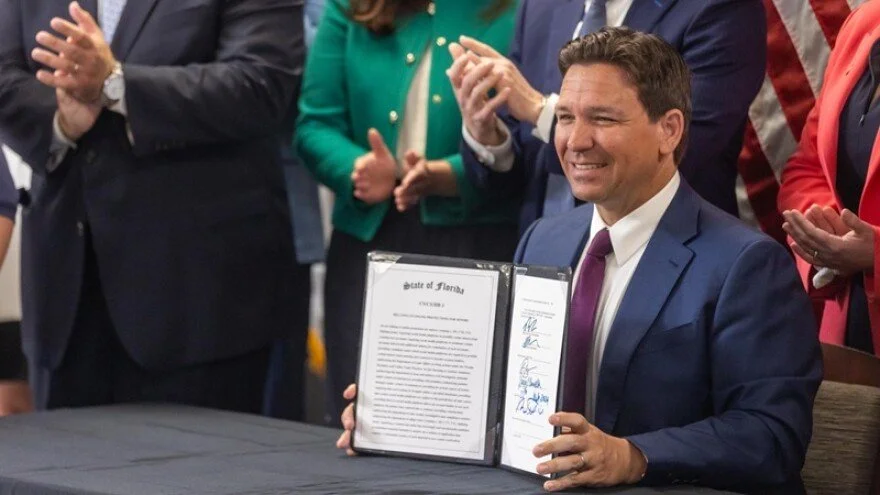
The pervasive rise of social media over the past couple decades has created a new generation of youth that is attached to their phones and instant communication. 95% of teens between the ages of 13 and 17 use social media, and over a third use it “almost constantly.” [1] Very recently on February 22, Florida’s legislature passed the HB 1 Bill that bans minors under the age of 16 from social media platforms in order to protect them from online risks to mental health, with goals to reduce cyberbullying and youth suicide rates. [2] With a vote count of 108-7 in the Florida House of Representatives and 23-14 in the Senate, it was a generally welcomed and fought for bill by the legislators. However, a number of constitutional concerns have arisen and might very well change the outcome of this rather aggressive bill.
Specifically, the law targets any social media platform that, “tracks user activity, allows children to upload material and interact with others, and uses addictive features designed to cause excessive or compulsive use.” [3] This would likely include platforms like TikTok, Instagram, Snapchat, Facebook, and YouTube. The bill would require these companies to delete existing accounts of minors and also develop measures that would prevent future accounts from being made for those under the age threshold. [4]
Florida governor Ron Desantis was a proponent for the overall aims of the bill, but ended up vetoing it. Prior to his veto, he expressed that it is critical to, “strike that proper balance when you’re looking at these things between policy that is helping parents get to where they want versus policy that may be outright overruling parents.” [5] Similar bills were proposed in other states like Arkansas and Ohio, but federal courts blocked their less restrictive laws over issues involving the free speech rights of social media companies and the right of minors to have access to social media. [6] Last year, Utah became the first state to pass a law requiring parental consent for social media use for those under 18, and also prohibited minors from using social media from 10:30pm to 6:30am. [7] This law is less objectionable to many than an outright ban, although the state is currently facing lawsuits over it.
Many parents are frustrated with the state’s decision to interfere. Angela Perry, a concerned mother from central Florida, states, “‘Whatever happened to parental rights? You are already selecting books my child can read at school. That is fine to a certain extent. But now you are also moving into their private life as well. It’s becoming intrusive.’” [8] The right for parents to control the upbringing of their children is a constitutional liberty per Washington v.
Glucksberg (1997). However, states are granted police powers, or general law making abilities to protect the health and safety of its people by the 10th Amendment of the Constitution. It will be up to the courts to continue deciding whether the state’s interests breach the parental liberties that accompany raising a child.
Desantis stated that he is already working with state officials to create a “different, superior” plan. [9] On X, he announced that “[p]rotecting children from harms associated with social media is important, as is supporting parents’ rights. I anticipate the new bill will recognize these priorities and will be signed into law soon.” [10] State decisions like this represent a larger movement that rejects the idea of unfiltered social media in order to protect vulnerable groups like children, but it must be delicately balanced against the protection of individual liberties that all Americans are guaranteed.
Notes:
Crowley, Kinsey, Dan Rorabaugh, C.A. Bridges, and Douglas Soule. “Florida Social Media Ban Passes Legislature, Headed to DeSantis’ Desk: What to Know.” USA Today, February 23, 2024. https://www.usatoday.com/story/news/politics/2024/02/23/forida-social-media-ban/72712831007/.
CS/HB1: Online Protection for Minor, Sess. of 2024
Farrington, Brendan. “Florida Lawmakers Pass Ban on Social Media for Kids under 16 despite Constitutional Concerns.” AP News, February 22, 2024. https://apnews.com/article/social-media-forida-government-2a11f9a4e9256eae 341a3d54c439c5af.
Singer, Natasha. “Florida Passes Sweeping Bill to Keep Young People of Social Media.” The New York Times, February 23, 2024. https://www.nytimes.com/2024/02/23/business/forida-social-media-youths.htm l#:~:text=The%20new%20rules%20in%20Florida,believed%20belonged%20to %20underage%20users..
Singer. “Florida Passes Sweeping Bill to Keep Young People of Social Media.”
Singer. “Florida Passes Sweeping Bill to Keep Young People of Social Media.”
Levine, Sam. “Florida Advances Law Banning Children under 16 from Using Social Media.” The Guardian, January 25, 2024, sec. US news. https://www.theguardian.com/us-news/2024/jan/25/forida-social-media-teenag er-ban-bill.
Farrington. “Florida Lawmakers Pass Ban on Social Media for Kids under 16 despite Constitutional Concerns.”
Cristiano Lima-Strong, “DeSantis Vetoes Florida Bill Banning Social Media for Most Kids,” Washington Post, March 1, 2024, https://www.washingtonpost.com/technology/2024/03/01/florida-social-media-ban-desantis-veto/.
Lima-Strong. “DeSantis Vetoes Florida Bill Banning Social Media for Most Kids.”
Bibliography:
Borter, Gabriella. “Florida Lawmakers Pass Bill to Ban Social Media for Anyone under 16.” Reuters, February 23, 2024. https://www.reuters.com/legal/florida-lawmakers-pass-bill-ban-social-media-children-under-16-2024-02-23/.
Crowley, Kinsey, Dan Rorabaugh, C.A. Bridges, and Douglas Soule. “Florida Social Media Ban Passes Legislature, Headed to DeSantis’ Desk: What to Know.” USA Today, February 23, 2024.https://www.usatoday.com/story/news/politics/2024/02/23/florida-social-media-ban/72712831007/. CS/HB1: Online Protection for Minor, Sess. of 2024
Farrington, Brendan. “Florida Lawmakers Pass Ban on Social Media for Kids under 16 despite Constitutional Concerns.” AP News, February 22, 2024. https://apnews.com/article/social-media-florida-government-2a11f9a4e9256eae341a3d54 c439c5af.
Levine, Sam. “Florida Advances Law Banning Children under 16 from Using Social Media.” The Guardian, January 25, 2024, sec. US news. https://www.theguardian.com/us-news/2024/jan/25/florida-social-media-teenager-ban-bill
Lima-Strong, Cristiano. “DeSantis Vetoes Florida Bill Banning Social Media for Most Kids.” Washington Post, March 1, 2024. https://www.washingtonpost.com/technology/2024/03/01/florida-social-media-ban-desantis-veto/.
Singer, Natasha. “Florida Passes Sweeping Bill to Keep Young People off Social Media.” The New York Times, February 23, 2024.https://www.nytimes.com/2024/02/23/business/florida-social-media-youths.html#:~:text=The%20new%20rules%20in%20Florida,believed%20belonged%20to%20underage%20users..

Can Books be Banned? The Legality of Censorship in United States Libraries
By: Faith Magiera
Edited by: Jonah Elkowitz and Isabel Gortner
When a child picks out a book in a school library, to what extent should the material they are choosing from be controlled or censored? Book bans have swept the nation as the political landscape has become more ideologically charged in recent years, with children’s education at the forefront of many debates about what materials should be present in educational landscapes. States led by conservative politicians, such as Texas, have led the nation in banning books that often pertain to LGBTQ+ or race-related topics, as Texas attempted to censor over 2,500 titles in 2022. [1] With the increase of book bans, schools have become a battleground for ideologies to rehash which reading material children have access to. With this partisan battle taking place in school districts across the country, cases addressing the legality of book bans in states such as Florida and Texas have come to the forefront of national consciousness. Grappling with the idea of book bans and their constitutionality is necessary to understanding violations of the First Amendment’s freedom of expression clause, which is something that the United States has and continues to struggle with as media coverage of this issue increases.
Book bans in states such as Texas have deemed titles such as The Bluest Eye by Toni Morison as “sexually explicit” and thus, able to be censored in children’s libraries.[2] As the American Library Association explains, the Supreme Court has historically defended the right of private individuals to consume media that could be perceived as controversial, even in the face of governmental censorship. [3] However, there are categories of speech that can and have been censored by the government, including obscenity. In Roth v. United States, the Warren Court ruled that books could be censored if they were “utterly without redeeming social importance” [4], a standard that is not only subjective but also vague. As many recent bans categorize the books in question as obscene or sexually explicit, it is important to understand the Supreme Court precedent that allows the government to infringe upon speech while still operating in the purview of the First Amendment. Board of Education, Island Trees Union Free School District No. 26 v. Pico, a similar book-banning case in the 1980s that was brought before the Supreme Court, dealt with issues that we see in today’s book bans. [5] The school board of a Massachusetts town wanted to take books out of circulation from school libraries that were deemed to be obscene and contrary to values they wanted to enforce in the educational environment. [6] Consequently, a group of students decided to sue in defense of the books with the Supreme Court eventually ruling in their favor. [7] The decision stated that “the First Amendment imposes limitations upon a local school board's exercise of its discretion to remove books from…school libraries,” which has precedent in the protection of students’ First Amendment rights by Tinker v. Des Moines School District. [8] The difference between a school library and a school classroom is something essential to consider here, as a teacher’s ability to develop a curriculum does not extend to the space of “voluntary inquiry” that a school library is supposed to be. [9] The idea of freedom of thought, something inherent to libraries, is foregrounded in the decision of Board of Education v. Pico and is something that states should keep in mind when contemplating book bans today.
In combating the increase of book bans occurring since 2020, states such as Illinois have taken an active stand in protecting the right of libraries to circulate books freely. [10] Following in the footsteps of the American Library Association’s Library Bill of Rights, the 2023 law signed into effect by Illinois Governor J.B. Pritzker prevents any book bans from occurring in the state's public schools or libraries. [11] Directly entering the partisan ideological battle, Governor Pritzker commented on other governor’s “hypocritical” censorship of books that do not fit their political ideology, potentially in reference to Florida Governor Ron DeSantis. [12] This is one way that we see book bans being confronted through the legislative system, but there are other judicial cases that are confronting the legality of book bans.
Coming back to Texas, while book bans have become more prevalent in the state within the past few years, there has also been a 2024 federal appeals court decision that blocked a law aimed at censorship of books in educational settings. [13] The decision stated that the 2023 Texas law, The Restricting Explicit and Adult-Designated Educational Resources Act, or READER Act, was unconstitutional because of its rating system that would require book vendors to rate the sexual explicitness of all books to sell them to Texas schools. [14] As the rating system requires private individuals and corporations to “either speak as the State demands or suffer the consequences,” it infringes upon the constitutional rights of those individuals not to speak or share their opinions about the books, an innately subjective task. [15] This decision in the case Book People, Incorporated v. Wong sets a precedent for other book banning systems to be unconstitutional in the future.
In an increasingly polarized political landscape, it is hard not to see the importance of these ideological battles that are occurring at the very foundation of the educational system. While book bans are no new phenomenon, as seen by Board of Education v. Pico, [16] the extent to which they have been both covered in the media and have entered the mainstream national consciousness in recent years is something to be noted and investigated, While cases and laws have recently favored the idea of freedom of expression as opposed to censorship, [17] the United States’ political landscape is tumultuous, and thus, one can never know where future Supreme Court decisions and state laws will take the legality of book bans. As book bans stand at the intersection of the question of the power of organizations such as school boards to disseminate their ideas and the freedom of speech and expression of individuals, it is an issue that cannot be neatly decided. However, for right now, it is essential to not only be informed of the ways censorship is impacting American libraries but also to understand the somewhat shaky legal grounds of the precedent decisions relating to obscenity and censorship that lie at the very root of the book bans.
Notes:
Salam, Erum. 2023. “Texas Was State with Most Book Bans in 2022, Report Shows.” The Guardian, September 14, 2023, sec. US news. https://www.theguardian.com/us-news/2023/sep/14/texas-most-book-bans-2022
Salam, “Texas Was the State with Most Book Bans.”
American Library Association. 2008. “First Amendment and Censorship.” American Library Association. June 13, 2008. https://www.ala.org/advocacy/intfreedom/censorship.
Roth v. United States, 354 U.S. 476 (1957).
Island Trees Sch. Dist. v. Pico by Pico, 457 U.S. 853 (1982).
Island Trees Sch. Dist. v. Pico by Pico, 457 U.S. 853 (1982).
Island Trees Sch. Dist. v. Pico by Pico, 457 U.S. 853 (1982).
Island Trees Sch. Dist. v. Pico by Pico, 457 U.S. 853 (1982).
Island Trees Sch. Dist. v. Pico by Pico, 457 U.S. 853 (1982).
Mayorquin, Orlando. 2023. “To Fight Book Bans, Illinois Passes a Ban on Book Bans.” The New York Times, June 13, 2023, sec. U.S. https://www.nytimes.com/2023/06/13/us/illinois-book-bans-schools-public-libraries.html.
Mayorquin, “Illinois Passes a Ban on Book Bans.”
Mayorquin, “Illinois Passes a Ban on Book Bans.”
Helsel, Phil. 2024. “U.S. Appeals Court Blocks Texas Law That Could Ban or Restrict Library Books.” NBC News. January 18, 2024. https://www.nbcnews.com/news/us-news/us-appeals-court-blocks-texas-law-ban-restrict-library-books-rcna134426.
Book People, Inc. v. Wong, No. 23-50668 (5th Cir. 2024).
Book People, Inc. v. Wong, No. 23-50668 (5th Cir. 2024), 28.
Island Trees Sch. Dist. v. Pico by Pico, 457 U.S. 853 (1982).
Helsel, “U.S. Appeals Court Blocks Texas Law.”
Bibliography:
American Library Association. 2008. “First Amendment and Censorship.” American Library Association. June 13, 2008. https://www.ala.org/advocacy/intfreedom/censorship.
Book People, Inc. v. Wong, No. 23-50668 (5th Cir. 2024), 28.
Helsel, Phil. 2024. “U.S. Appeals Court Blocks Texas Law That Could Ban or Restrict Library Books.” NBC News. January 18, 2024. https://www.nbcnews.com/news/us-news/us-appeals-court-blocks-texas-law-ban-restrict-library-books-rcna134426.
Island Trees Sch. Dist. v. Pico by Pico, 457 U.S. 853 (1982).
Mayorquin, Orlando. 2023. “To Fight Book Bans, Illinois Passes a Ban on Book Bans.” The New York Times, June 13, 2023, sec. U.S. https://www.nytimes.com/2023/06/13/us/illinois-book-bans-schools-public-libraries.html.
Roth v. United States, 354 U.S. 476 (1957).
Salam, Erum. 2023. “Texas Was State with Most Book Bans in 2022, Report Shows.” The Guardian, September 14, 2023, sec. US news. https://www.theguardian.com/us-news/2023/sep/14/texas-most-book-bans-2022.

Moody v. Net Choice and Net Choice v. Paxton: The Future of Online Content Moderation
By: Matthew Vega
Edited by: Isabel Niemer and ISabel Gortner
On February 26th, the Supreme Court heard oral arguments for Moody v. Net Choice, LLC and Net Choice, LLC v. Paxton, both of which were cases involved with content moderation laws protecting conservative speech in Florida and Texas, respectively. The Supreme Court is expected to release its decisions by the summer, which will determine whether the content moderation restrictions in Florida S.B. 7072 align with the First Amendment and whether the law's requirements for individualized explanations also adhere to First Amendment principles in the case of Moody v. Net Choice.[1] The Supreme Court will also decide whether the provisions of Texas HB 20, which prohibit social media platforms from censoring users' content and impose strict disclosure requirements, violate the First Amendment in the case of Net Choice v. Paxton.[2]
The Supreme Court did not have many cases to use as precedent for social media speech regulation, instead basing most of their arguments on cases involving other kinds of speech, such as Miami Herald v. Tornillo which held that the government cannot force newspapers to print replies from candidates they criticize, as it would infringe upon the newspaper's editorial discretion and right to control its content, giving the press the right to editorial discretion. [3] Neither of these proposed laws have been enacted yet, as the U.S. Court of Appeals for the 11th Circuit blocked Florida from enforcing most of the law and the Supreme Court barred the state from implementing its law while the case continued.
During oral arguments, the Supreme Court justices remained skeptical of the constitutionality of the new Florida and Texas laws. In the case of Moody v. Net Choice, Henry Whitaker argued on behalf of the petitioners that “the design of the First Amendment is to prevent the suppression of speech, not to enable it.” [4] Many members of the Supreme Court rejected this framework of the issue, such as Justice Kagan who called the proposed legislation “a classic First Amendment violation.” Justice Kavanaugh even rebuked this notion by Whitaker, citing Hurley v. Irish-American Gay, Lesbian and Bisexual Group of Boston, PG&E v. Public Utilities Comm'n, and Miami Herald Publishing Company v. Tornillo as cases that “emphasize editorial control as being fundamentally protected by the First Amendment.”[5] [6] This editorial control issue was shared by nearly every member of the Supreme Court. Even Justice Alito who appeared more inclined to uphold the laws, asked Whitaker if content moderation was anything more than “a euphemism for censorship”. Justice Alito additionally pointed out that because of the broad scope of the Florida Legislation, Internet mail services like Gmail also fall under the scope of controlled speech, asking if “Gmail [has] a First Amendment right to delete, let's say, Tucker Carlson's or Rachel Maddow's Gmail accounts if they don't agree with … his or her viewpoints?”
At the beginning of the Net Choice, LLC v. Paxton case, Paul Clement, who argued on behalf of Net Choice in both cases that day, began his oral argument by jokingly pointing out how similar both cases were, then stating the primary difference between the two was that the Texas legislation is much more narrowly focused on social media platforms rather than websites. [7] This means that the Gmail example in the previous case would not apply. However, the Texas legislation also excludes websites based on “news, sports, and entertainment” which he called content-based discrimination which would be “facially unconstitutional.” Justice Gorsuch expressed confusion with the application of editorial control from social media platforms and why they do not consider it speech in regards to the First Amendment and not speech in regards to the Texas law.
Though they appeared to have issues with the proposed legislation from both Florida and Texas, the Justices did appear to be in favor of some changes being made to the ability of social media platforms to restrict or promote content. Given the sweeping implications of this case on online speech, the Supreme Court is expected to deliver an incredibly narrow decision regardless of which side they rule in favor of. If the court rules in favor of Net Choice, they likely anticipate another case similar in content to be brought to them in the future.
Notes:
"Moody v. NetChoice, LLC" SCOTUSblog, October 14, 2023. https://www.scotusblog.com/2023/10/justices-question-finding-that-s-c-district-was-unconstitutional-racial-gerrymander/
"NetChoice, LLC v. Paxton” SCOTUSblog, October 14, 2023. https://www.scotusblog.com/2023/10/justices-question-finding-that-s-c-district-was-unconstitutional-racial-gerrymander/
"Miami Herald Publishing Company v. Tornillo." Justia US Supreme Court, https://supreme.justia.com/cases/federal/us/475/1/.
"Oral Argument Transcript: Moody v. Net Choice, LLC." Supreme Court of the United States, 2023, https://www.supremecourt.gov/oral_arguments/argument_transcripts/2023/22-277_5536.pdf.
"Hurley v. Irish-American Gay, Lesbian and Bisexual Group of Boston." Justia US Supreme Court, https://supreme.justia.com/cases/federal/us/515/557/.
"PG&E v. Public Utilities Comm'n." Justia US Supreme Court, https://supreme.justia.com/cases/federal/us/418/241/.
"Oral Argument Transcript: Net Choice, LLC. v. Paxton " Supreme Court of the United States, 2023, https://www.supremecourt.gov/oral_arguments/argument_transcripts/2023/22-555_omq2.pdf
Bibliography:
"Hurley v. Irish-American Gay, Lesbian and Bisexual Group of Boston." Justia US Supreme Court, https://supreme.justia.com/cases/federal/us/515/557/.
"Miami Herald Publishing Company v. Tornillo." Justia US Supreme Court, https://supreme.justia.com/cases/federal/us/475/1/.
https://www.supremecourt.gov/oral_arguments/argument_transcripts/2023/22-555_omq2.pdf
"Moody v. NetChoice, LLC" SCOTUSblog, October 14, 2023. https://www.scotusblog.com/2023/10/justices-question-finding-that-s-c-district-was-unconstitutional-racial-gerrymander/
"NetChoice, LLC v. Paxton” SCOTUSblog, October 14, 2023. https://www.scotusblog.com/2023/10/justices-question-finding-that-s-c-district-was-unconstitutional-racial-gerrymander.
"Oral Argument Transcript: Moody v. Net Choice, LLC." Supreme Court of the United States, 2023, https://www.supremecourt.gov/oral_arguments/argument_transcripts/2023/22-277_5536.pdf.
"Oral Argument Transcript: Net Choice, LLC. v. Paxton " Supreme Court of the United States, 2023,
"PG&E v. Public Utilities Comm'n." Justia US Supreme Court, https://supreme.justia.com/cases/federal/us/418/241/.